Author Archives for twistedbasics

Unknown's avatar

About twistedbasics

Welcome! Food is my focus, livelihood, art form and my passion. My wife and I run a 5.5 acre organic vegetable farm. Join me fellow foodie as we explore the changing seasons and the food it brings.

Shelter From The Storm

As we wind up week six of social distancing, I am recognizing my emotions looming large.  One minute grief, then anger, jumping to anxiety, then surprising me completely by hope. I can be washing the dishes or folding clothes and I find tears running down my face.  I listen to the news and feel angry at people who aren’t taking this virus seriously.  I’m furious at the misinformation and lies.  I wake up during the night and process thoughts for 2-4 hours.  There are times I think, “What’s wrong with me? Am I losing my mind?” The truth is, I am completely normal. There is absolutely nothing wrong with me. I am simply leaning fearlessly into my emotions. I want to know what is below the surface of my packaging. The average person didn’t see the corona-virus coming; and then the world came to a collective pause. Everything changed. Nothing is as is was.

We are in shock. I keep hearing people wanting to get back to normal. Yet what does that look like? Why long to return to an existence that was not working for most of us? I for one, have no desire to return to the times of collective exhaustion, greed and disconnection.  In this collective pause why not dream of a better way? Why not take these precious  moments and rein-vision something that sustains and nourishes us? We already know how to distance. We’ve been running away from healthy solutions for humans and the planet for generations, chasing our desire for bigger and better until the world couldn’t take it anymore.

For now, cooking and my kitchen help to steady my emotional tides. Preparing food for me is like meditation or prayer for some. One thing I do know: we need to practice a lot more kindness and compassion for each other. Our world is not a virtual reality; it is the reality. Right here, right now. We all yearn for shelter from the storm.


Spring Green

During these times of perceived scarcity, it’s always good to recognize that nature offers up gifts to those who’s eyes are willing to see them.  Our land during Civil War times was a brickyard.  The clay was ideal for profits from this product and bricks were shipped by rail between Detroit and Chicago.  In World War II, the land was turned into an onion farm to help feed the troops.  This is where our story begins today, as the land is covered with wild chives by the thousands waiting for someone to notice them.  I dry them in our food dehydrator to use in the winter, but the real treat is when they are turned into pesto.  Now there are as many pesto recipes as there are cooks, but isn’t it wonderful when you have something randomly growing that can be used?  I think so.

This morning I put a teaspoon in my scrambled eggs; whipped it into the eggs with a little half and half and it was delicious.  The options for using wild chive pesto are only as limited as our imaginations.  Try using it as a base for a vinaigrette, or thinning it with additional olive oil, vinegar and mustard then tossing it with hot red-skinned potatoes for a French take on warm potato salad.  Don’t be afraid to add other herbs to it like dill or parsley; it makes a good dip when mixed with sour cream or Greek yogurt.  Swirl it into a brothy soup for a touch of spring.  I think you’re getting the idea.

WILD CHIVE PESTO

img_6275

INGREDIENTS:

  • 4 cups cleaned, lightly packed wild chives, cut into manageable lengths with scissors
  • 3 garlic cloves
  • 1/2 cup toasted pine nuts (or walnuts or pistachios)
  • 1 teaspoon sea salt
  • 1/2 – 3/4 cup olive oil


img_6276

img_6279

INSTRUCTIONS:

  1. You will need 3-4 4 ounce canning jars ready, as these are perfect size for freezing this pesto.  Then with your food processor running, drop your garlic cloves in one at a time until they are minced and clinging to the sides of the bowl.
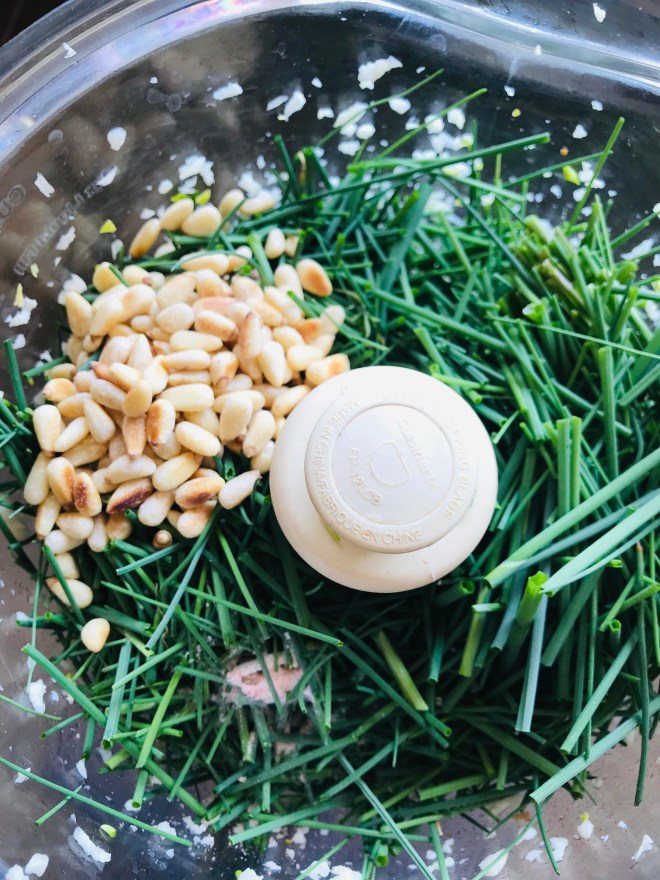
  2. Open up your food processor and place your 4 cups of lightly packed wild chives in the bowl.  Add to this your pine nuts, and salt.
  3. Pulse your ingredients for about 5 times, so they are blended together; then with you processor running, slowly pour in a 1/4 cup of your olive oil.  Stop your processor and scrape down the sides of the bowl with a spatula.
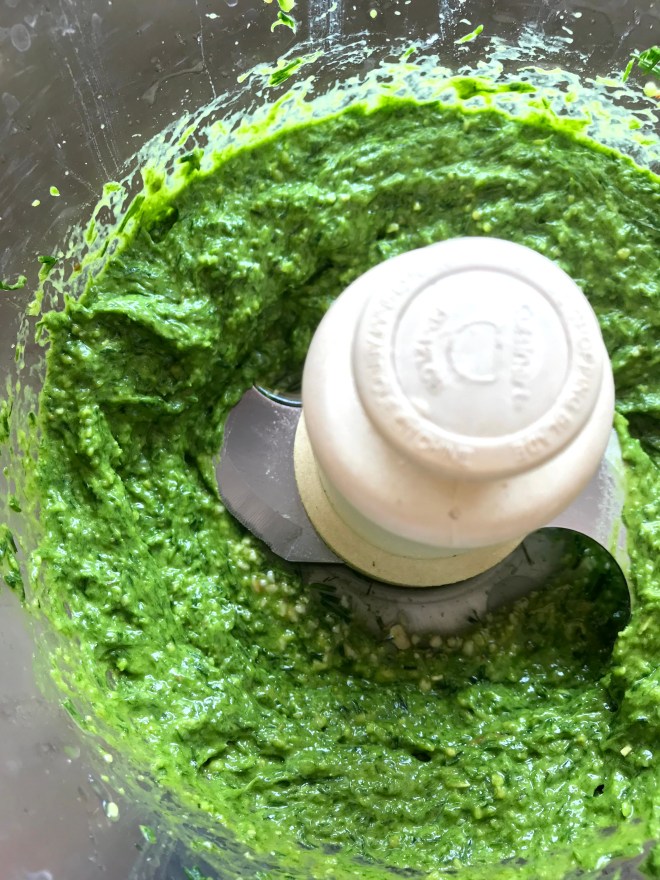
  4. Turn your processor back on and pour an additional 1/4 cup of olive oil.  Open your processor and check to see if it’s at the consistency you want (I usually look for a loose paste).  Taste to see if the salt component is to your liking.
  5. Spoon into 4 ounce canning jars and top with additional olive oil.  This will easily keep in the freezer for up to a year.

Yield: 3-4 4 ounces jars

“The real voyage of discovery is not seeking new landscapes, but seeing with new eyes.”

—Marcel Proust


Grandma Knew Best

Entering week five of sheltering in place, during the novel corona-virus pandemic; and  I’m discovering skills I didn’t know I had.  I’ve never been much of a baker.  Not because I don’t like wonderful baked goods, but because I have an aversion to measuring.  Writing cookbooks was challenging when trying to deliver a consistent product.  I basically wing it, taste, adjust, taste again as I go along.  Being at home consistently for this length of time has taught me several things.  One, why should I be talking myself out of something, when I really should be talking myself into something new?  I’ve always played with food, why not play with baking?  So I’ve been starting with savory quick breads and muffins with great results.  If there’s a down side to this exploration, it’s that  I’m now slightly obsessed, and one thing is leading to another.

This week it’s soda bread.  My wife Val inherited a 100 year old cast iron skillet from her Grandmother years ago (along with a classic potato masher), so I wanted to try out a soda bread using a skillet, rather than a free-form shape.  I’m coming around to the beauty of these old skillets for many uses, and I enjoy the historical continuity of using something that was handed down from a previous generation.  I mixed the bread in my Grandmother’s pottery mixing bowl, so I was channeling traditions from both families.  It felt wholesome somehow, and a basic quick bread like this could have been made by either of our Grandmother’s.  Val makes a delicious golden raisin and candied ginger scone that I love, and this reminded me of that texture with a savory profile.

I’m afraid that I will run out of flour, before I run out of ideas; but the experimentation was certainly worth it.  Next challenge, homemade pasta.

SKILLET SODA BREAD WITH ROASTED RED PEPPERS & FETA

img_6256

INGREDIENTS:

  • 4 cups all-purpose flour
  • 1 tablespoon baking powder
  • 1 1/2 teaspoons sea salt
  • 1 teaspoon baking soda
  • 1 stick (1/2 cup) unsalted butter, cold and cut into 1 inch cubes
  • 2 eggs
  • 1 1/2 cups buttermilk
  • 1 whole roasted red pepper, (I used jarred), drained and chopped
  • 1/2 cup feta cheese, crumbled
  • 1/4 teaspoon dried oregano
  • 1/4 teaspoon freshly ground black pepper

img_6255

img_6257

img_6259

INSTRUCTIONS:

  1. Preheat your oven to 400 degrees F.  In a large bowl, combine the flour, baking powder, salt, baking soda, oregano, black pepper and cubed butter, using a pastry cutter or fork to incorporate the butter.  The mixture should resemble course crumbs.
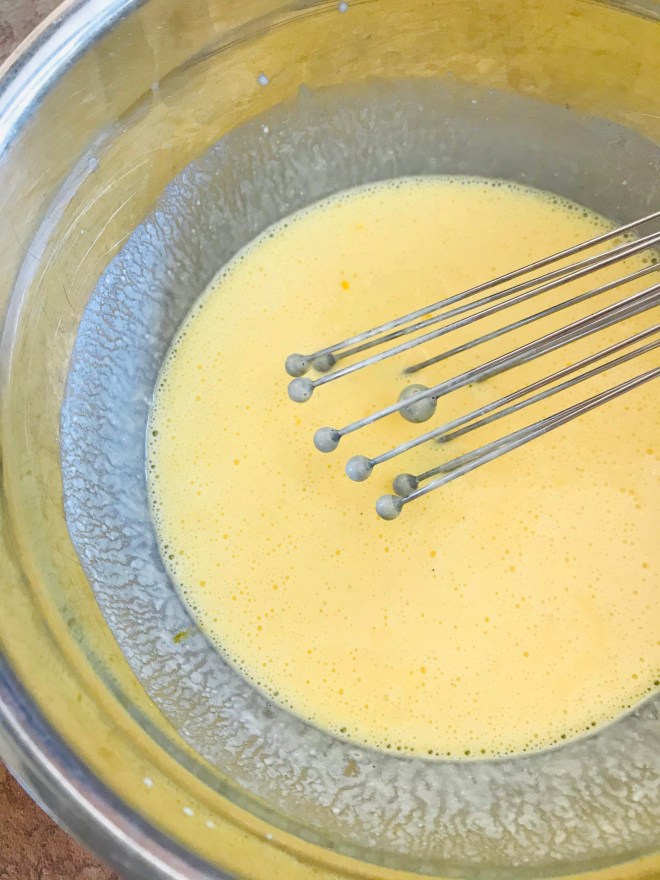
  2. In a separate bowl, whisk together the eggs and buttermilk and add it to the flour mixture.  Combine the dough using a large wooden spoon or spatula until it’s almost incorporated.
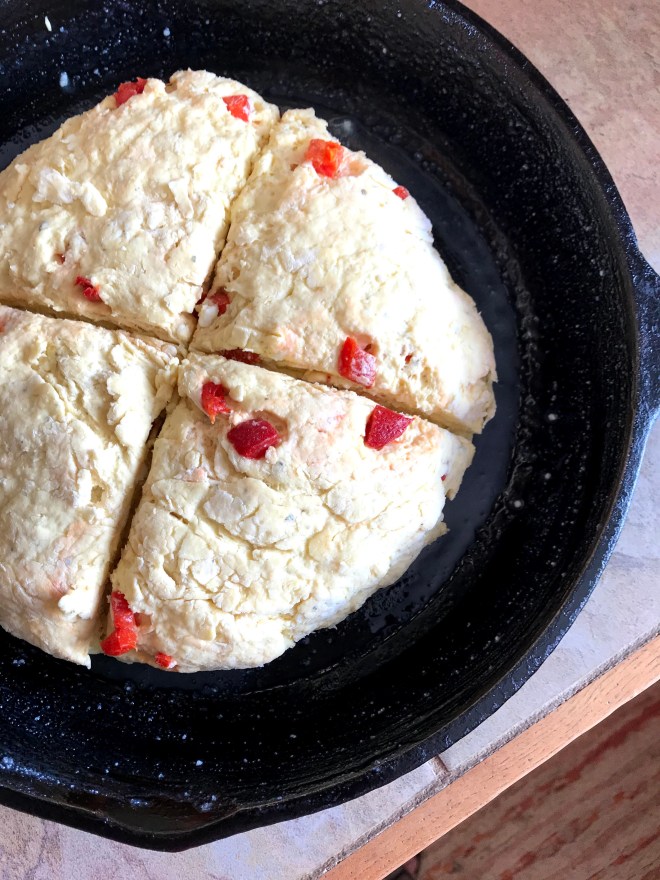
  3. Add the roasted peppers and feta and finish mixing.  Kneed the dough with your hands for a few minutes until comes together and transfer it to a greased cast iron pan (I use ghee).  Using a serrated knife, score the bread into four sections to help prevent it from bubbling up in the center.
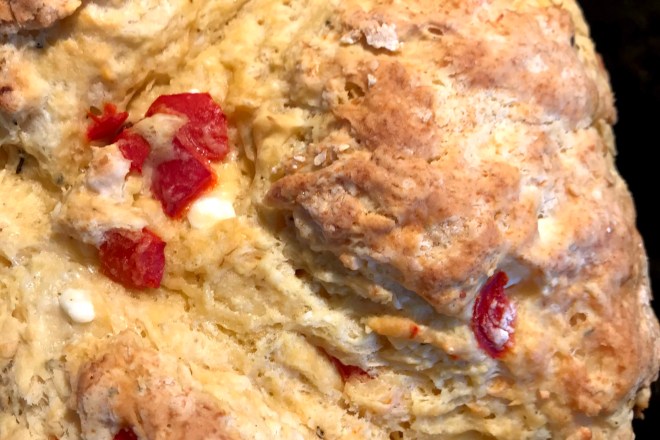
  4. Bake for 30-35 minutes, or until the top is golden brown.  Serve warm with butter.

Serves: 8

img_6260

img_6261

“People who give you their food, give your their heart.”  –Cesar Chavez


Made To Order

Well, we’ve been self-sheltering for a month now and we are entering that phase of searching through the freezer, pantry and reduced items in the refrigerator.  As vegetable farmers we are fortunate that we do a lot of canning and freezing during the optimal summer months; and for that we are grateful.  With a little thought and creativity, it’s amazing just what you can come up with that is not only inventive, but delicious!

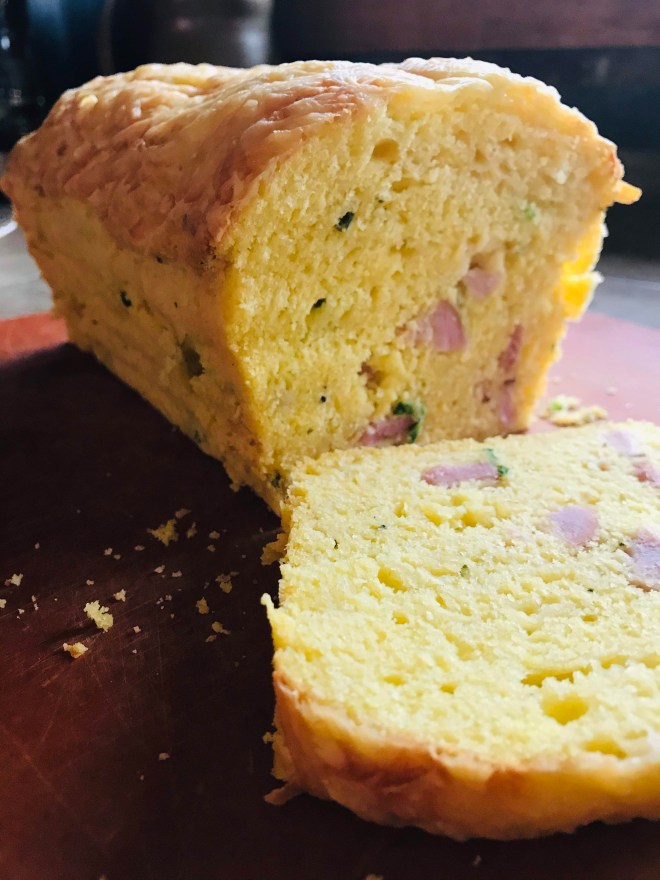
We don’t eat many sweet things in our household.  We lean more to the savory spectrum.  I can enjoy a quick bread like zucchini or pumpkin as well as the next person; but this….this savory quick bread has multiple options galore.  Remember that piece of ham you froze during the holiday’s?  Perfect.  That hunk on cheese in your refrigerator?  Yes!  Don’t like Gruyere ?  Ok…use cheddar.  Those herbs in your crisper that need to be used or composted soon? Yup.  Vegetarian?  Leave out the ham and toss in some olives, or sun-dried tomatoes.  You can make two loaves and freeze one.  I love it toasted the next day with butter and a fresh slice of tomato and sprouts.  You are only limited by your imagination.  Enjoy.

img_6228

SAVORY QUICK BREAD

INGREDIENTS:

  • 1/2 stick unsalted butter (4 tablespoons), melted and cooled
  • 2 1/2 cups all-purpose flour
  • 1 1/2 teaspoons baking powder
  • 1 teaspoon sea salt
  • 1/2 teaspoon baking soda
  • 1 cup ham, chopped in small cubes
  • 1/4 cup scallions, using both green and white parts, sliced thinly
  • 1 tablespoon fresh thyme leaves, chopped (or dill, chives or tarragon)
  • 2 cups (8 ounces) Gruyere, Swiss or cheddar cheese, shredded
  • 2 large eggs
  • 1 cup buttermilk *

Note:  If you find yourself without buttermilk on hand, use 1 cup whole milk and add 1 tablespoon lemon juice or white vinegar.

img_6231

INSTRUCTIONS:

  1. Heat oven to 350 degrees F.  Butter and flour a metal 9 x 5 inch loaf pan and set it aside.
  2. In a large bowl, whisk together the flour, baking power, salt and baking soda.  Stir in chopped ham (or olives and sun-dried tomatoes), scallions, herb of choice, and all but 1/4 cup of your selected cheese (you will use the rest for topping).
  3. In a separate bowl, whisk together the melted butter, eggs and buttermilk.  Add the wet mixture to the flour mixture and stir to combine.  The batter will be thick.
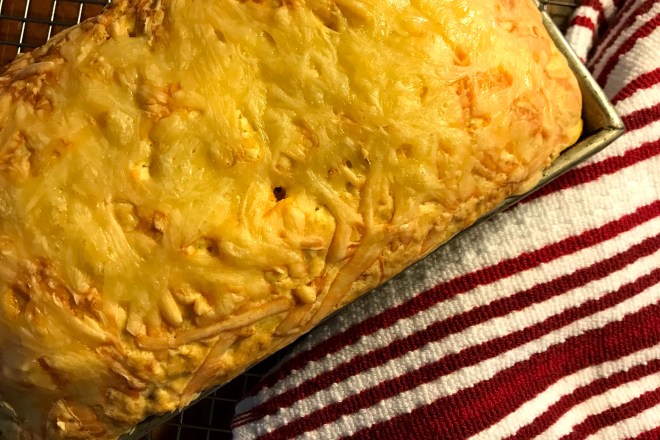
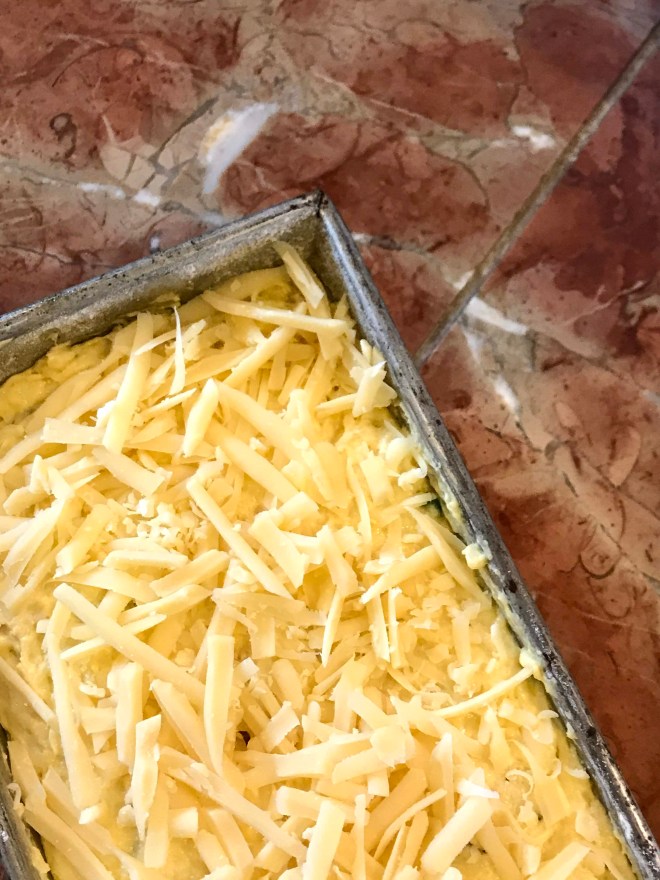
  4. Transfer the batter to your prepared loaf pan.  Spread batter out evenly with a spatula.  Top with remaining 1/4 cup cheese.  Bake until the top springs back when lightly pressed, about 45-55 minutes.
  5. Cool on a wire rack for 10 minutes, then remove from loaf pan and let completely cool on wire rack.

img_6233

Yield: 1 loaf

“Give us this day our daily bread.”

Give Me Shelter

As I sit at my desk right now, my home is silent and I recognize the daily importance of silence in my life.  Silence is a dear friend, the kind of friend that can sit with you and not feel uncomfortable when listening to the sound of the heart.  We are so bombarded with noise; we are plugged in and turned on.  Unabated noise can be an onslaught of constant stimulation in a way that confuses, rather than comforts.

During this period of sheltering in place or social distancing,  we are offered an opportunity to listen to our own thoughts. Living a rural life offers periods of time when you don’t see many people, yet I am never lonely.  Our social time largely centers around our weekly appearance at our farmers market to sell our wares.  I can be quite a talker and this is a great time for discussion and sharing.  Now that this is not an option, I do miss the absence of that scheduled human contact; the hugs, the warm conversations with customers, friends and vendors.  However this extended time away from our social connections, allows us to pare down even further in the discovery of what we really value in our life.

Adversity has the power to change us if we are open to that change.  It is my sincere hope that people pause and reevaluate what is most important to them and then act on that knowledge.  May this challenging time provide the reset needed, and the catalyst for manifesting better lives for ourselves and each other.

SALMON WITH ARTICHOKES, CAPERS AND SPINACH

Make sure you have all you ingredients measured and prepped, as this comes together rather quickly.  You don’t want to overcook your salmon!

INGREDIENTS:

  • 2-4 wild caught salmon fillets, weighing approximately 6 ounces each
  • 1 tablespoon extra-virgin olive oil
  • Salt and freshly ground black pepper to taste
  • 3 large garlic cloves, grated
  • 1/2 cup sun-dried tomatoes, chopped
  • 1 can 15 oz. artichoke hearts, drained and chopped
  • 3 tablespoons capers, drained
  • 6 ounces fresh baby spinach
  • 1 cup heavy cream
  • 1/2 teaspoon sweet paprika

img_6190img_6191

INSTRUCTIONS:

  1.  You will want to sear your salmon in a 12 inch non-stick skillet over medium-high heat.  Heat 1 tablespoon olive oil in skillet.  Generously salt and pepper your fillets.
  2. When your oil is hot, add salmon fillets flesh side down (skin side up).  Sear for about 4 minutes.  Reduce heat to medium and turn each fillet over (skin side down).  Sear for another 4-5 minutes until salmon is almost flaky.
  3. Remove salmon from skillet.  In the same skillet, add chopped sun-dried tomatoes, grated garlic, chopped artichokes and capers. Cook, stirring for about 2 minutes.
  4. Add fresh spinach, and continue cooking, stirring occasionally until spinach wilts, 1-2 more minutes.
  5. Add heavy cream and paprika.  Bring to a simmer.  Simmer for 1-2 minutes more.  Taste and adjust for seasoning.
  6. Add fillets back to pan with vegetable and cream.  Heat gently for about 2 minutes.
  7. Serve with sauce spooned over fish.

img_6196

“It is in the shelter of each other that people live.  –Proverb

Opportunity Knocks

As we all creep forward during this time of uncertainty; nature, reading, planting our vegetable farm and cooking are keeping me grounded and hopeful.  Rural living is a calming lifestyle that continues to nourish us.  Even with the farm year slowly ramping up, we have an established rhythm for daily life, that is forward thinking and hopeful.  Regardless of how this crisis plays out, if we can’t get to the farmers market to sell our food, it will certainly not be wasted.  We will be canning, along with making sure that our neighbors have access to fresh food. I respect that our farmers market is staying open, with a plan of action and necessary precautions.  Young farmers and businesses need to serve their communities and stay open as long as possible.  As elders, with my wife having a compromised immune system, we have been self-sheltering with the understanding that growing food is the very best use of our time.

It is often said that the character of a individual is how they respond to adversity.  After all happiness is an inside job; but I admit to having several sleepless nights. I am keenly aware of my privilege in feeling relatively safe during this time.  My heart hurts for people who have lost their jobs, businesses that have had to close, people without a sufficient safety net to get them through this time of uncertainty.  I trust the creativity and innovation of people, much more than the total lack of leadership at the federal level.  I know we will collectively get through this stressful time.  It is my hope that lessons will be learned that can lift all of us up, in the face of future challenges.

Actually, self-sheltering has been our rural life style.  When people come to the farm to laugh, cook and eat with us, they often say how they need to be a part of something with purpose.  Urban living has its own forms of signature stress.  They see a well lived in home, with a rich history, surrounded by land and vegetables, as something distant from their own reality.  We look forward to being able to welcome our friends back into our home and break bread together.  In the meantime, reading, writing, planting and preparing food is our devotion.

I usually make the following recipe during the summer months, but I have found that the use of frozen corn and the frozen cherry tomatoes that I put up during the last farm season create a beautiful and delicious alternative.  Depending on your circumstances and location, most grocery stores have cherry tomatoes even this time of year.

FRESH CORN POLENTA WITH ROASTED CHERRY TOMATOES

INGREDIENTS:

  • 6 ears of fresh corn (or 6 cups frozen)
  • 2 1/4 cups water
  • 3 tablespoons unsalted butter, cut into small cubes
  • 7 ounces feta, crumbled
  • 1 teaspoon salt, divided
  • Freshly ground black pepper to taste
  • 6 cups fresh or frozen cherry tomatoes
  • 4 large garlic cloves, peeled
  • 4 tablespoons extra-virgin olive oil
  • Chopped fresh basil or parsley for garnish
img_4999

img_5001

img_3130

INSTRUCTIONS:

FOR THE TOMATOES:

  1. Preheat your oven to 350 degrees F.  Pour cherry tomatoes and garlic onto sheet pan and drizzle 4 tablespoon extra-virgin olive oil.  Roll the tomatoes around with the palms of your hands to evenly coat.
  2. Sprinkle the tomatoes and garlic with 1/2 teaspoon kosher salt and freshly ground black pepper to taste.  Roast for 30 minutes.
  3. Remove from oven and toss the tomatoes.  Return to oven for 20-30 minutes more or until the tomatoes have slit and are slightly brown in some places.

FOR POLENTA:

  1. If using fresh corn, peel the leaves and silk from each ear, then chop off the pointed top and stalk.  Use a sharp knife to shave off the kernels, taking care to remove as much of the ‘milk’ below the kernels as possible, while stabilizing the cob on a cutting board.  You will need 6 cups of kernels.
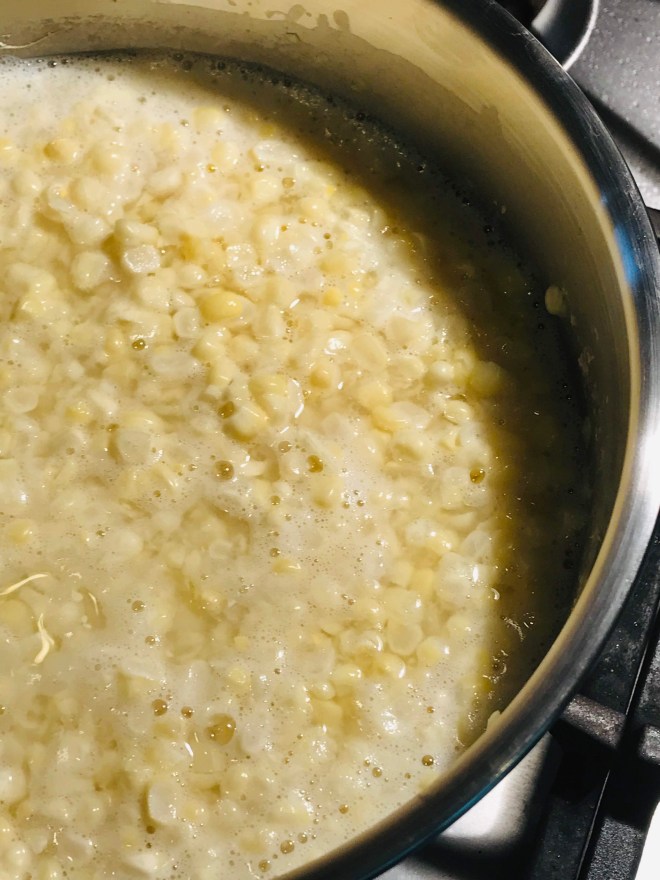
  2. Place the fresh or frozen kernels in a medium saucepan and barely cover them with water.  Cook for 12 minutes on a low simmer.  Use a slotted spoon to lift the kernels from the water and into a food processor; reserve the cooking liquid in a Pyrex measuring cup.
  3. Process for several minutes; you want to break as much of the kernel case as possible.  Add some of the cooking liquid if the mixture becomes too dry to process.
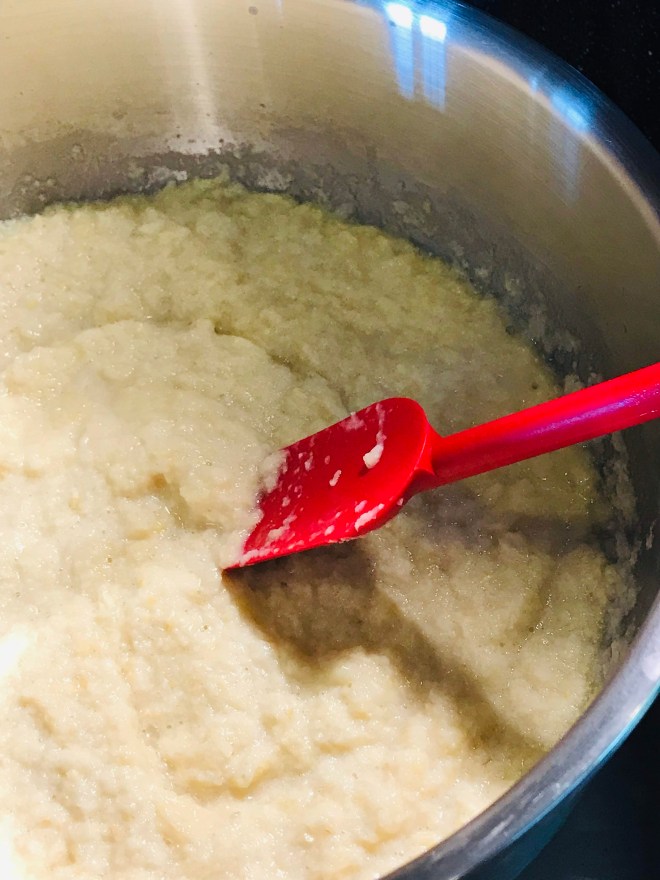
  4. Return the corn paste to the pan with some of the cooking liquid and cook, while stirring, on low heat for 10-15 minutes; or until the corn mixture thickens to a mashed potato consistency. (the more liquid you use, the longer this process will take; watch carefully in case it sputters)
  5. Fold in the butter, the feta, salt and pepper.  Taste and adjust seasonings.

TO ASSEMBLE:

Spoon some of the polenta into individual shallow bowls,.  Spoon roasted cherry tomatoes and garlic on top.  Garnish with fresh basil or parsley.

Serves: 4

img_5003

“When we are generous in welcoming people and sharing something with them— some food, a place in our homes, our time— not only do we no longer remain poor: we are enriched.”  —Pope Francis


Twisted Basics: Laugh, Cook Eat!

img_5909

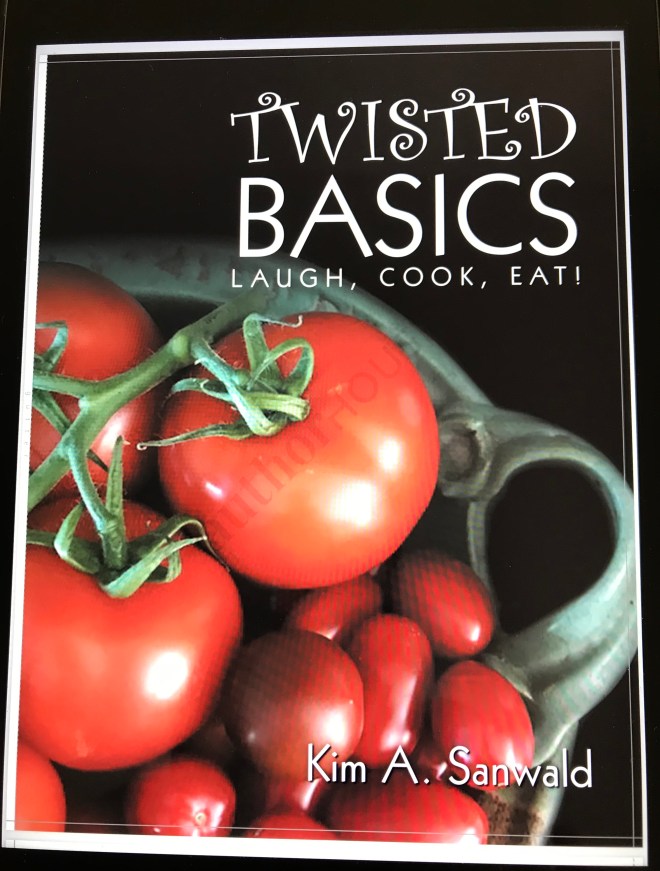
I am pleased to announce my second cookbook, Twisted Basics: Laugh, Cook, Eat!  will be available for purchase in late April.  I’m so proud to advocate for local farmers markets and entrepreneurs.  This is my love letter to our local Fulton Street Farmers Market in Grand Rapids, MI; where we have been vending for 20 years.

The focus of this particular cookbook is about creating intimacy through cooking.  After all, humans have been obsessed with food since the beginning of time.  It defines us geographically, ethnically, culturally and economically.  It has been a focus of my life since childhood.  It is my vocation, entertainment, art form and passion.  I hope it will become your passion too.

Recent studies have shown that the average American eats out 4-6 times a week.  The fast pace of contemporary living sells the idea that there is no time to cook.  Cooking seems old-fashioned; but what has really happened is that the public has collectively been sold a bill of goods.  Premade entries, extensive deli’s and takeout lure you away from something that feeds you not only physically but emotionally.  Cooking done with care is an act of love.  Julia Child has said, “You don’t have to cook fancy or complicated masterpieces, just good food from fresh ingredients.”

The emphasis of Twisted Basics: Laugh, Cook, Eat! is veggies.  There are guides for a well-stocked pantry along with assorted tips and variations for many recipes to personalize ingredients for individual tastes.  The chapters are organized by type of vegetable such as greens, alliums, tomatoes, root vegetables, etc.  Most are easy to prepare.  All of them are nutritious and satisfying.  You do have time to cook!  Get your spouse or family involved.  Make cooking a bonding and conversational time.  Sharing a simple meal together will increase the intimacy between you and your loved ones.  Get off your phones and into your food.  What have you got to lose?

May there be joy at your table.

“There is something profoundly satisfying about sharing a meal.  Eating together, breaking bread together, is one of the oldest and most fundamentally unifying of human experiences.”    —Barbara Colorso

Oowie, Goowie

Cooking is my passion.  If you enjoy eating you’re my kind of person.  We have just returned from a two week vacation in California, visit family.  My brother-in-law, my two sisters-in-law live in southern California; in La Quinta and Palm Springs respectively.  Southern California is a different universe.  Wealth is on display everywhere, along with manicured lawns, gated communities, golf courses, cars we’ve never seen before, Latino labor, and a incredible wealth discrepancy.

Josheusimg_5983

The weather was beautiful.  Most days were in the 80’s; and dry heat is a thing.  We went up the tram in Palm Springs; although Val was terrified.  We ate sushi, gourmet Mexican, Italian sandwiches, gourmet pizza and burgers.  We went to cocktail bars, and Joshua Tree National Park.  It was a lesson in contrasts.  In spite of the culture shock, the farmers markets and Mexican grocery stores were inspiring and abundant.

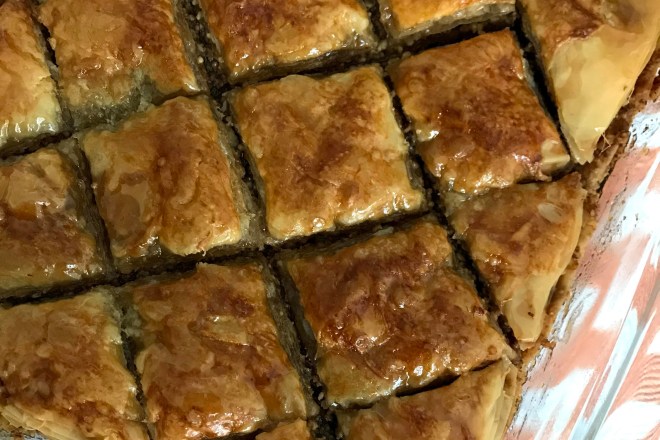
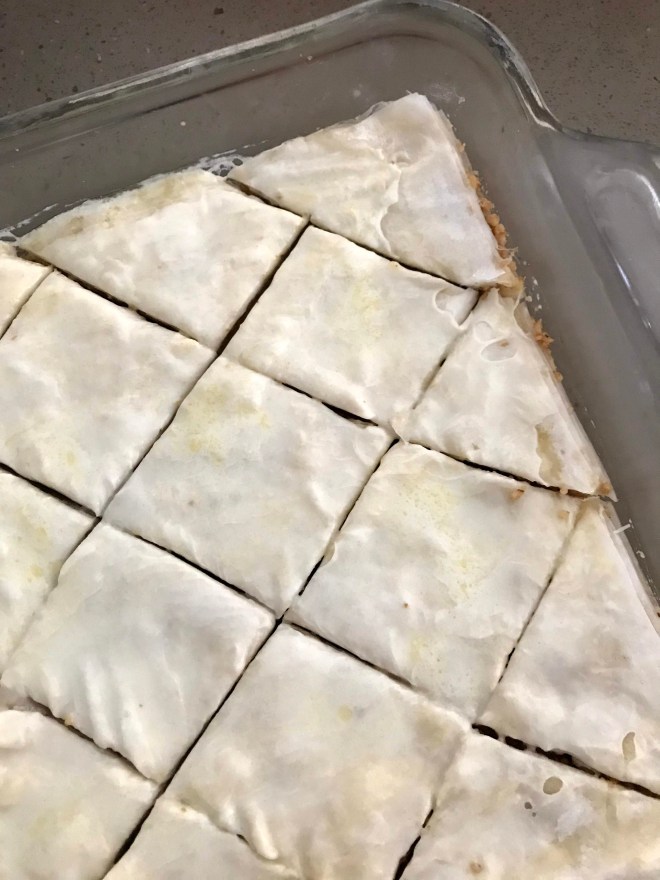
Even though it was a much needed vacation for us, my joy was cooking for family and new acquaintances with some of the best produce I’ve ever encountered.  I’ve never taken so many photographs.  We were surrounded by mountains, and there wasn’t a bad view to be had.  One of the things I enjoyed making was my first Baklava.  I have gotten used to working with phyllo dough and it was rich an satisfying.  My family loved it, and it was a special time together.

INGREDIENTS:

FOR THE BAKLAVA:

  • 16 ounces walnuts
  • 1.5 teaspoons ground cinnamon
  • 1/4 teaspoons ground cardamom
  • 16 ounces phyllo dough, thawed
  • 1 cup unsweetened butter melted

FOR SYRUP:

  • 1 cup water
  • 1 cup cane sugar
  • 1 cup good quality honey
  • 1 cinnamon stick
  • 1 strip orange peel
  • 1 strip lemon peel

img_6073-1

img_6075-1

img_6071-1

INSTRUCTIONS:

  1. Preheat the oven to 350 degrees F.
  2. Pulse the walnuts in a food processor with the cinnamon, cardamom, and salt until finely chopped.
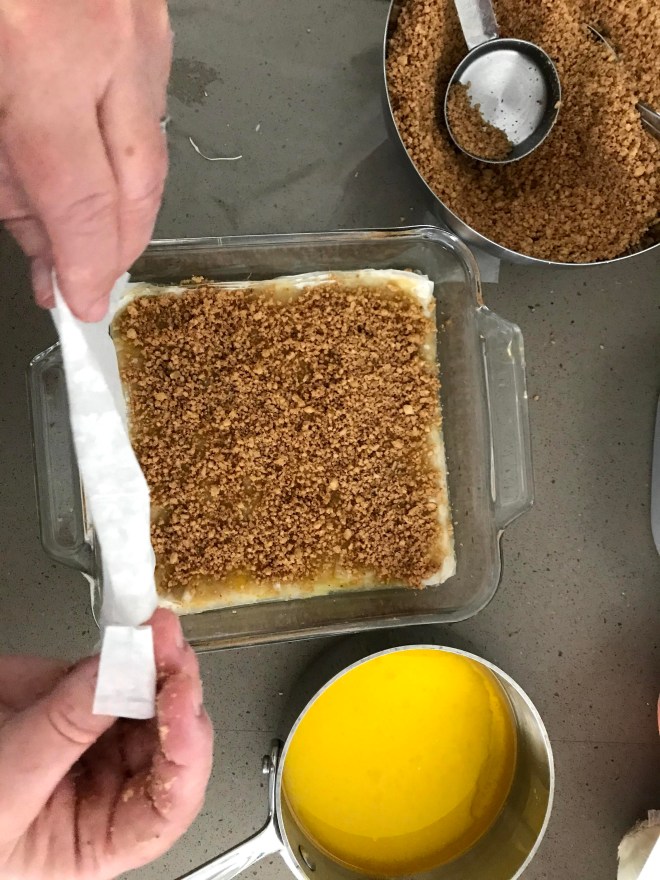
  3. To assemble the baklava, place 8 layers of phyllo dough on-by-one on the bottom of a 9 x 13 baking pan, brushing each lightly with butter.
  4. Spread 2/3 cup of walnuts mixture evenly on top.
  5. Add another 5 layers of phyllo one-by-one, brushing each one with butter, then add another layer of walnuts.  The total sequence should be phyllo layers of 8,5,5,5,5,8, with nuts in between each layer.
  6. Using a sharp knife, cut teh baklava into whatever shape you desire (diamonds, square, triangles).
  7. Bake the baklava for 50 minutes, until golden on the edges and tops.  Then let cool for at least 15 minutes.
  8. In the meantime, bring all the syrup ingredients to a boil in a saucepan, then reduce to a simmer for 5 minutes.
  9. Remove the cinnamon stick, and citrus peels, and pour the hot syrup evenly over the baklava.  Let the baklava cool completely at room temperature for 8 hours (uncovered to prevent sogginess).  Then it’s ready to enjoy.

img_6080

img_6081

“A good cook works by the fire of the imagination not merely by the fire in the stove.”

Robert Tristram Coffin


Occasional Decadence

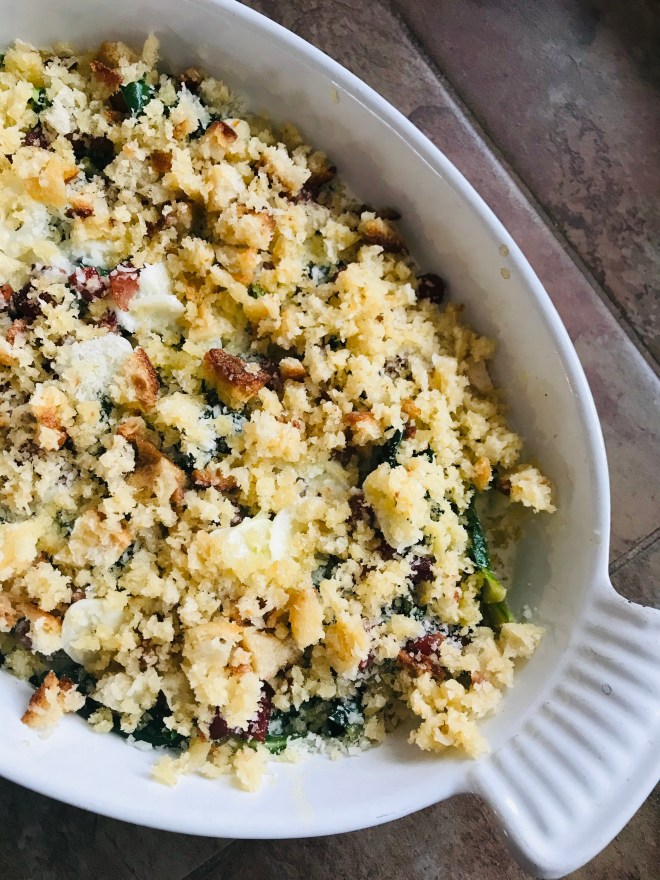
My father had many sayings that he would repeat when the mood suited him; but my favorite was, “All things in moderation, including moderation.”  I pretty much live by this code.  I don’t apologize for the occasional desert or rich dish; their just soooo yummy!  This one is no exception.  Cream, pancetta, and garlic take Swiss chard to another level entirely.  You could make it with bacon, but why not hit a home run rather than a base hit?  The first time I made this for my green’s hating brother-in-law, he took seconds (twice).  Another time my nephew pulled the casserole to his place setting and wondered what everyone else was going to eat.  It’s tradition at Thanksgiving, but I can’t help making it at least once a month during the winter season.

SWISS CHARD CASSEROLE

INGREDIENTS:

  • 2 tablespoons unsalted butter
  • 1 cup fresh breadcrumbs (I use ciabatta)
  • 6 cloves garlic, thinly sliced
  • 1/2 teaspoon Kosher salt, and freshly ground black pepper to taste
  • 2 cups heavy cream
  • 3 slices pancetta, diced
  • 2-3 bunches Swiss chard, wash and spun, stems removed and chopped into 1/4 inch slices (approximately 2 1/2 cups); leaves cut into ribbons (approximately 8-12 cups
  • 2/3 cup freshly grated pecorino cheese

img_5582

img_5583

INSTRUCTIONS:

  1. Preheat oven to 400 degrees F.  Melt 1 tablespoon of the butter and toss it with the breadcrumbs; set aside.
  2. In a medium saucepan, bring the cream and garlic to a boil.  Lower heat and simmer for 8 minutes, reducing the volume slightly.  Season with salt and pepper.
  3. Meanwhile, in a 12 inch non-stick skillet, cook the pancetta over medium heat until crisp and browned.  Drain on paper towels, reserving 1 tablespoon of the fat in skillet.  Add remaining 1 tablespoon of butter to skillet and melt.  Add the chard stems and saute over medium-high heat until they are soft and slightly browned, about 8-10 minutes.  Reduce heat to medium and add chard leaves.  Saute chard for about 3-5 minutes or until wilted.
  4. With tongs, transfer the chard to a gratin or ceramic dish, leaving any excess liquid in skillet.  Spread evenly.
  5. Sprinkle pancetta over chard.  Pour the seasoned cream over chard.  Sprinkle pancetta over cream and chard; top with buttered bread crumbs.  Bake until golden and bubbly, about 25-35 minutes.  Let rest for 10 minutes before serving.

Serves 4-6

img_5585

”Comfort food—food that reassures—is different things to different people.”  –David Tanis

Anyway You Slice It

I eat a lot of salads.  I never tire of the crunch factor.  The winter is a great time to step outside the box and look for salads that don’t rely on lettuce as the main ingredient.  I usually look for seasonal, stable vegetables; and brassicas are an easy solution.  Every thing from cauliflower, to broccoli, to cabbage offer creative and healthy options for salads with a seasonal flare.

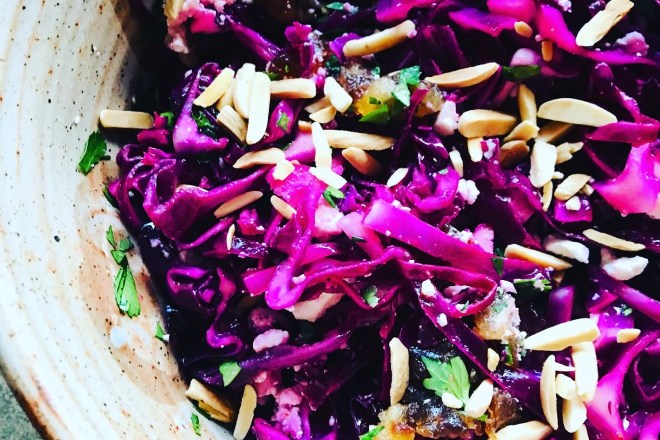
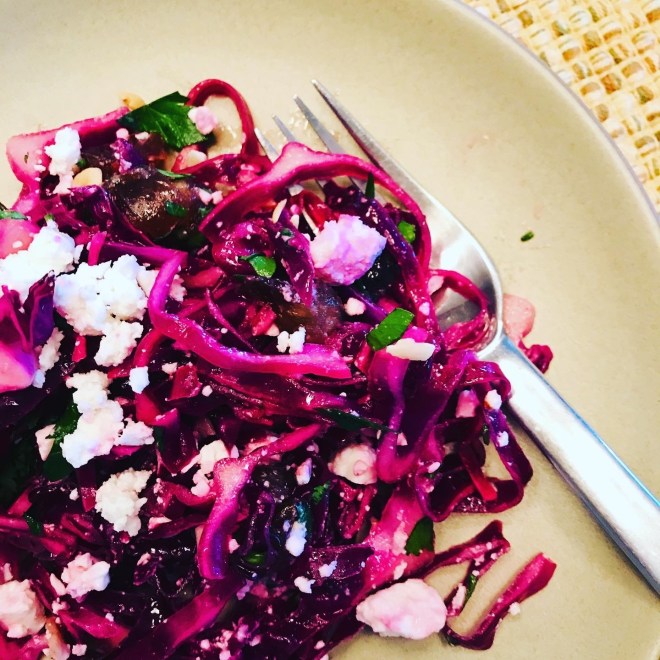
Another thing to keep in mind is to include a variety of textures, color and flavor profiles.  Sweet against salty, is one I often use to help keep it interesting.  This salad has all the elements that I enjoy.  It’s colorful, crunchy, sweet and salty all at the same time.  It has great staying power and lasts for several days in the refrigerator.

Red Cabbage Salad with Dates and Feta

INGREDIENTS:

  • 1 small red cabbage (or half of a large one), halved, cored, then quartered and sliced very thin
  • 3 tablespoons extra-virgin olive oil
  • 2 tablespoons fresh lime juice
  • Sea salt and freshly ground black pepper to taste
  • 1/4 teaspoon Aleppo pepper flakes
  • 1/2 cup pitted Medjool dates, coarsely chopped
  • 4 ounces feta, crumbled
  • 2 tablespoons flat-leaf parley, chopped
  • 1/4 cup slivered almonds, toasted

img_5547

INSTRUCTIONS:

  1.  In a large bowl, toss the cabbage with olive oil, lime juice, salt and pepper to taste.  Taste and adjust with more lime juice and salt.  It should taste well seasoned.  Let macerate on counter for 30-45 minutes, to slightly soften cabbage.
  2. Toss dressed cabbage with half of the dates. and feta.  Arrange in a bowl or on a platter, and sprinkle the rest of the dates and feta on top.  Garnish with parsley and toasted almonds.

Serves 4-6

ceb4919b-5d37-46a7-ace4-da56b4472502

 “Winter is the time for comfort, for good food and warmth, for the touch of a friendly hand and for a talk beside the fire: it is the time for home.””


1 9 10 11 18