Salads

Anyway You Slice It

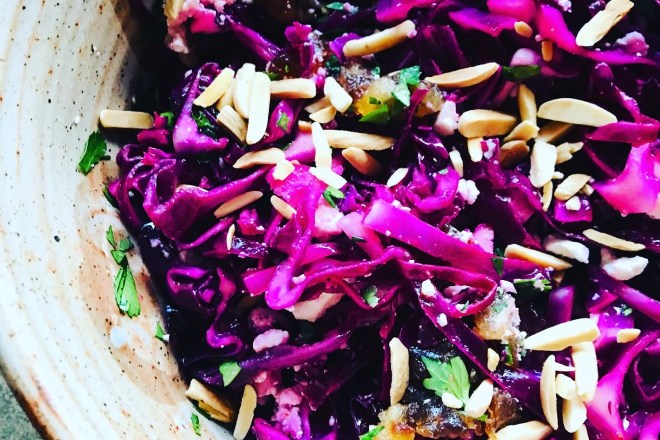
I eat a lot of salads.  I never tire of the crunch factor.  The winter is a great time to step outside the box and look for salads that don’t rely on lettuce as the main ingredient.  I usually look for seasonal, stable vegetables; and brassicas are an easy solution.  Every thing from cauliflower, to broccoli, to cabbage offer creative and healthy options for salads with a seasonal flare.

Another thing to keep in mind is to include a variety of textures, color and flavor profiles.  Sweet against salty, is one I often use to help keep it interesting.  This salad has all the elements that I enjoy.  It’s colorful, crunchy, sweet and salty all at the same time.  It has great staying power and lasts for several days in the refrigerator.

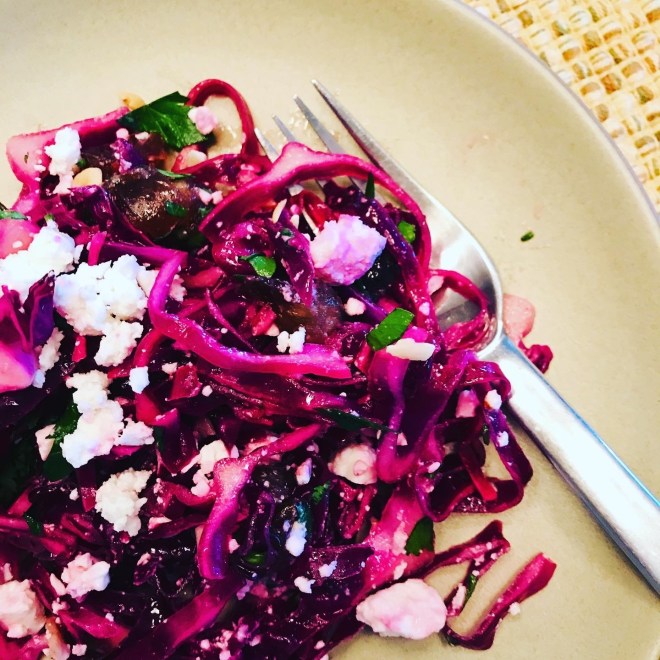
Red Cabbage Salad with Dates and Feta

INGREDIENTS:

  • 1 small red cabbage (or half of a large one), halved, cored, then quartered and sliced very thin
  • 3 tablespoons extra-virgin olive oil
  • 2 tablespoons fresh lime juice
  • Sea salt and freshly ground black pepper to taste
  • 1/4 teaspoon Aleppo pepper flakes
  • 1/2 cup pitted Medjool dates, coarsely chopped
  • 4 ounces feta, crumbled
  • 2 tablespoons flat-leaf parley, chopped
  • 1/4 cup slivered almonds, toasted

img_5547

INSTRUCTIONS:

  1.  In a large bowl, toss the cabbage with olive oil, lime juice, salt and pepper to taste.  Taste and adjust with more lime juice and salt.  It should taste well seasoned.  Let macerate on counter for 30-45 minutes, to slightly soften cabbage.
  2. Toss dressed cabbage with half of the dates. and feta.  Arrange in a bowl or on a platter, and sprinkle the rest of the dates and feta on top.  Garnish with parsley and toasted almonds.

Serves 4-6

ceb4919b-5d37-46a7-ace4-da56b4472502

 “Winter is the time for comfort, for good food and warmth, for the touch of a friendly hand and for a talk beside the fire: it is the time for home.””


Wild Thing

Boy, are we ever having a heat wave!  Just in time for harvesting our 5500 heads of garlic.  The good news is it’s great for garlic; not so much for us garlic diggers and cleaners.  We get up early while the heat is bearable, then stop by midday to avoid becoming ill.  This is definitely the time of year for simplicity in the kitchen.  You can always throw something on the grill, but I really go for meal salads.  They don’t heat up the kitchen, and you can munch on them for a few days.  Virtually any grain or bean will work well, combined with vegetables of your choice.  I go for texture differences whenever possible; which usually means crunch and savory elements.  I’ve been making this salad for decades.  It’s great for a picnic (no mayo) and can be doubled or tripled to serve a crowd.

WILD RICE SALAD

INGREDIENTS:

  • 1 cup long grain wild rice, cooked, drained and cooled
  • 8 pieces of bacon, chopped, fried and drained
  • 2 cups celery, diced
  • 2 cups white onion, diced
  • 4 ounces white or brown mushrooms, stems removed, caps sliced
  • 2 cups curly parsley, chopped
  • 1 cup pecans or almonds, toasted

DRESSING:

  • 1/2 cup sunflower oil
  • 1/2 cup fresh lemon juice
  • Kosher salt and freshly ground black pepper to taste

img_4821

DIRECTIONS:

  1. Measure 3 cups water into a medium saucepan and add 1 teaspoon salt.  Bring to a boil and stir in wild rice.  Turn down to low, partially cover and cook for 40 minutes.  Drain in a wire colander and set aside to cool.
  2. Chop bacon, fry until crisp and drain on paper towels.  Set aside.
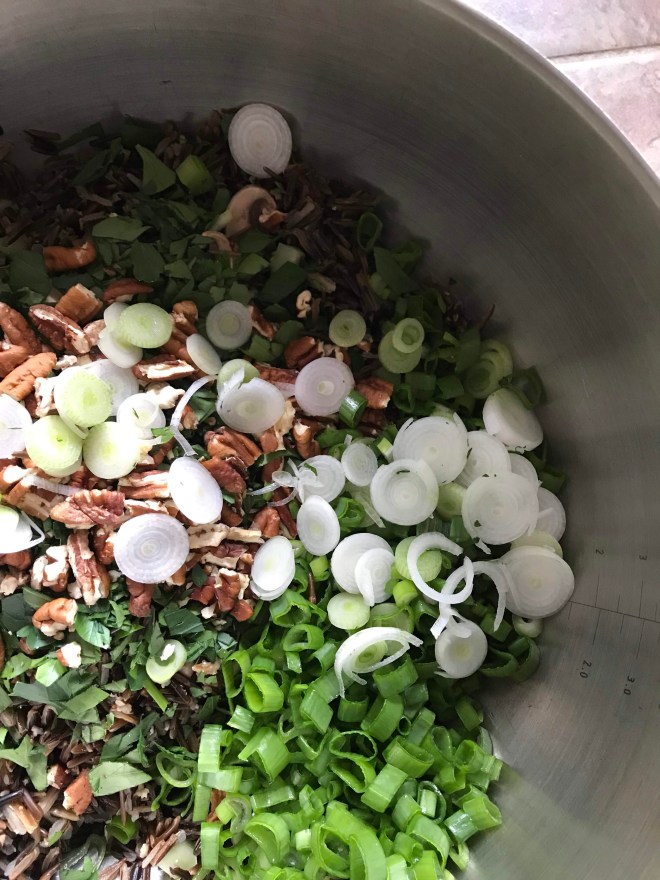
  3. In a large bowl, place cooled wild rice, with celery, onions, mushrooms, pecans and parsley.
  4. Place ingredients for dressing in a pint mason jar.  Seal with lid and shake vigorously.  Pour over salad and mix thoroughly but gently.
  5. Serve on a platter and top with crumbled bacon.

Serves 4-6

img_4822-1

“I love how summer just wraps its warm arms around you like a blanket.”  —Kelle Elmore

It’s Bean A Long Time Coming

This has not been a typical farm year for us.  Challenges with weather, deer, woodchucks and bunnies have made it difficult to grow our delicious haricot verts called Maxibels or as we call them at market, ‘skinny French girls’.  Finally after 3 tries we have succeeded in harvesting our first beans.  I wait all summer for certain vegetables.  Garlic, tomatoes and Maxibels.  I couldn’t wait to make this protein filled, colorful, crowd pleasing salad.  I did a Mediterranean spread today with our dear friends George and Karen.  Lamb meatballs in tomato sauce and feta, roasted beets with preserved lemon and dill, hummus salad, raw zucchini thyme and walnut salad, and this was a wonderful addition.

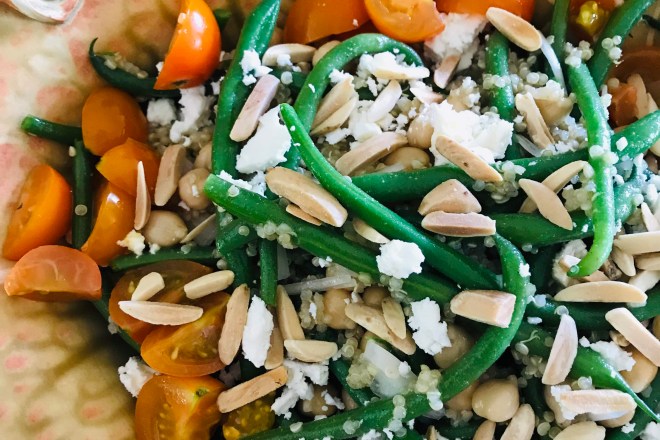
This salad has an assortment of textures; al dente green beans, toasted almonds, sweet cherry tomatoes, quinoa, chickpeas, onion and feta.  Although it originally calls for red onion, we had my favorite sweet onion Bianca and I substituted that variety (poetic license)  During the summer, after working all day on the farm, it’s nice to have meal salads that are simple to make and refreshing to eat.  Leftovers can be refrigerated for up to 3 days.  This salad can be doubled to serve a crowd.


img_4802

img_4804

HARICOT VERTS, QUINOA AND CHICKPEA SALAD

INGREDIENTS:

  • 1 cup quinoa (any color)
  • 1 3/4 cups water
  • 1 pound green beans (I like haricot verts) or a combination of yellow and green
  • 1 cup almond slivers, toasted
  • 1 can canned chickpeas, drained and rinsed
  • 1/2 small red onion  (or onion of your choice), thinly sliced vertically
  • 1/4 cup extra-virgin olive oil
  • 1/4 cup white wine vinegar (I used my homemade tarragon vinegar)
  • 1/2 teaspoon Dijon mustard
  • 1 tablespoon pure maple syrup
  • Kosher salt and freshly ground black pepper to taste
  • 3 ounces feta, crumbled (optional)
  • 1 cup cherry tomatoes, halved (any color)

DIRECTIONS:

  1. In a medium saucepan combine quinoa and cold water; bring to a boil over high heat.  Once boiling, cover and turn heat to low.  Cook for 20-25 minutes.  When finished pour onto sheet pan and let cool completely.
  2. Toast the almonds on a sheet pan in a 350 degree F oven for 5 minutes.  Remove from sheet pan and let cool.
  3. Wash and trim the beans.  In a large pot bring salted water to a boil and blanch beans for 3-6 minutes depending on the variety that you use.  Maxibels 3 minutes, traditional green beans 6 minutes.  Drain and place in ice bath to cool completely.
  4. To make vinaigrette, place olive oil, vinegar, mustard, maple syrup, and salt and pepper to taste in a pint mason jar.  Place lid on snugly and shake vigorously.
  5. To assemble, place cooled quinoa, drained green beans, onions and chickpeas in a large salad bowl.  Mix gently with your hands;  add 1/2 of the dressing and mix again with your hands.  Add almonds and additional dressing if needed.  Place salad on serving platter and top with crumbled feta and cherry tomatoes if using.  Serve immediately.

Serves 4 as a entree, 6-8 as a side

“Nothing is more memorable than a smell.  One scent can be unexpected, momentary and fleeting, yet conjure up a childhood summer beside a lake in the woods.  –Diane Ackerman

The Hummus Among Us

There is family that you are born into, and there is your tribe that you adopt.  Your tribe may be a collection of people that enjoy some of the same things you do, or perhaps are like minded in their approach to living.  Frequently, conversations and laughter take place over food.  There is something special about gathering around a table that can evoke extraordinary sharing.  This is much more than the sum of its parts.  Breaking bread with people you love and respect can teach you unexpected lessons in life; particularly when there are multiple generations present.

Part of our tribe is a mother and daughter that started out as customers at our farmers market where we have a seasonal stall.  Over time, our conversations became lengthier and more personal.  We invited them out to our farm.  We met their spouses, and then their daughters/granddaughters.  Sometimes we would meet at a local restaurant to enjoy each other.  We all loved food and drink.  Our relationship was cemented when my wife Val had her brain surgery last year, and they were here to help in anyway they could.  They planted garlic, tomatoes, weeded and gave emotional support.  With the help from our extended tribe we managed to get through an extremely difficult time.  It was a real honor to be present to openhearted, loving and freethinking people.  Not only were they generous with their time, but with their hearts.  In a world filled with too much animosity, this is a real gift.

One of things that I love to both eat and serve during gatherings is some kind of hummus.  The possibilities are endless for incorporating it into a meal.  Folks it is not just something to scoop up with a pita chip.  Mediterranean and Middle Eastern food is endlessly creative.  You can serve it on a platter with braised meat or like this recipe does with assorted colorful vegetables on top.  It packs in lots of protein and deliciousness, not to mention how it can easily feed a crowd.  If you want a textured hummus, keep out half the chick-peas and mash them in a bowl with a potato masher.  This recipe is a lighter version, using less olive oil and replacing it with yogurt.  The topping of tomato, cucumber, onion and parsley makes use of all things fresh and flavorful during summer.

img_4746


LAYERED HUMMUS SALAD

INGREDIENTS

FOR HUMMUS:

  • 2 (15-ounce) can chick-peas, drained, reserving 1 cup of their liquid
  • 3 large garlic cloves
  • 3 tablespoons lemon juice
  • 2 tablespoons extra-virgin olive oil
  • 3 tablespoons sesame tahini (well mixed)
  • 1/4 whole fat plain yogurt (or more as needed)
  • 1 teaspoon ground cumin
  • Kosher salt to taste

FOR MIDDLE LAYER:

  • 2 cups whole milk Greek yogurt
  • 2 tablespoons sesame tahini
  • 1/2 teaspoon kosher salt
  • 1 cup (from a 15-ounce can) chick-peas, drained

FOR SALAD:

  • 1 cucumber, diced
  • 1 pint cherry tomatoes or 8 Campari salad tomatoes, cut into 6th sixths
  • 3 green onions, or 1/2 red onion, minced
  • 1 cup lightly packed fresh curly parsley, coarsely chopped
  • 2 tablespoons extra-virgin olive oil
  • 1 tablespoon red wine vinegar
  • Kosher salt to taste

DIRECTIONS:

  1. Turn  on a food processor fitted with a steel blade and drop in the garlic.  When the garlic is finely chopped, turn off the machine and add the chick-peas.  Process for about 30 seconds, or until the chick-peas are chopped and mealy; then add the lemon juice, olive oil, tahini, yogurt, cumin, and salt.  Process until the mixture in smooth.  Thin out as desired with additional liquid from chick-peas, adding 2 tablespoons at a time.  The hummus should be smooth but not runny.  From time to time, scrape the sides of the processor bowl.  If the puree seems dry, add a bit more yogurt or olive oil.
  2. Remove the mixture from the food processor and combine with the mashed chick-peas if using.  Taste and adjust salt.
  3. Next prepare you middle layer.  Mix Greek yogurt with tahini and salt.  Set aside.
  4. Lastly, prepare your salad.  Mix parsley, tomatoes, cucumbers and onion; dress with extra-virgin olive oil and red wine vinegar.
  5. To serve spread hummus on platter, top with yogurt leaving 2 inches of hummus exposed.  Sprinkle 1 cup reserved chick-peas around border.  Top with reserved salad.  Use vegetables such as red bell pepper, cucumbers or pita bread to scoop up salad.

Serves 8-10

img_4749

What’s for dinner doesn’t matter–it’s the communal environment that you create that makes all the difference.”  –Ronnie Koenig

Stand By Me

“Have a little kindness for your fellow man.”  I learned this directly from my father.  Yesterday was Father’s Day and my father William Howard Sanwald has been on my mind.  He died of early-onset Alzheimer’s in September of 1980 long before much was known about the disease or the treatment to keep it at bay.  He was only 53 years old.

When I was a small child, it was my father who bathed me.  I still remember how he went in between each toe to make sure it was dry.  It was a tenderness I will never forget.

I am grateful for the many mental pictures of our time together. As a child I remember  my parents had an evening cocktail hour.  I carry this tradition forward to this day.  My parents didn’t go out much, but when they did, I remember that it was a big deal.  My mother would get dressed up and my father always the gentleman’s gentleman, would light my mother’s cigarette, cupping his hand around the flame, my mother’s lipstick surrounding the filter of her cigarette as she exhaled.

When I turned sixteen, my parents took me to Chicago to celebrate my birthday.  My June celebration was delayed until it worked in my parents schedule, so it actually happened in January.  My mother didn’t like being outside, but my father and I walked several miles down Michigan Ave. in brutal winds, taking refuge in a small cafe to warm up before we headed back to the hotel.  In companionable silence, we sipped our coffee and hot chocolate.  It did not matter that I was frozen to the core.  What mattered was that I was doing this with my father beside me.

When I remember my father, I remember a man who was generous and kind.  My friends loved him.  He was quiet yet interested.  Serious, yet playful.  He had many sayings that he would share on a regular basis.  Such as, “Kindness is free.  And “Do not judge someone’s history that you have not lived.”  Or “Do not make a federal case out of a county courthouse issue.”

He was a man with depth and compassion.  He felt that education taught people to open their heart and minds to a deeper reality.  He loved classical music and was a grill master.  I begged to go with him on any errand.  He had a FM unit in his Volkswagen beetle and he was surprised that I enjoyed his FM stations.  He called the car wash the ‘the sea monster’ and we loved going through the tunnel together.

My most vivid memory was our last walk together.  Walking was soothing while my father was losing is cognitive abilities.  While we were walking we came across a field of cows.  They were close to the fence.  We stood there for several minutes, when he said, “I can see my soul in the eyes of this cow.”  This was a reflection of how my father saw life.  It was real, spontaneous and true.  He lives in my heart and I hope to honor his memory.  The men in my life that are dear friends, have personality traits similar to my father; somewhat reserved, the ability to laugh easily and are loving and kind to others.

img_4678

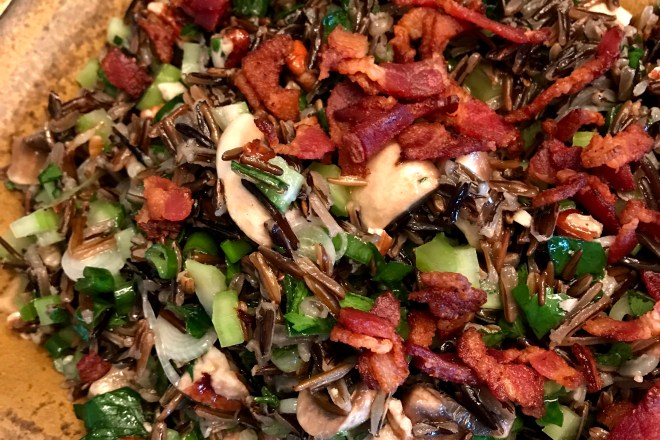
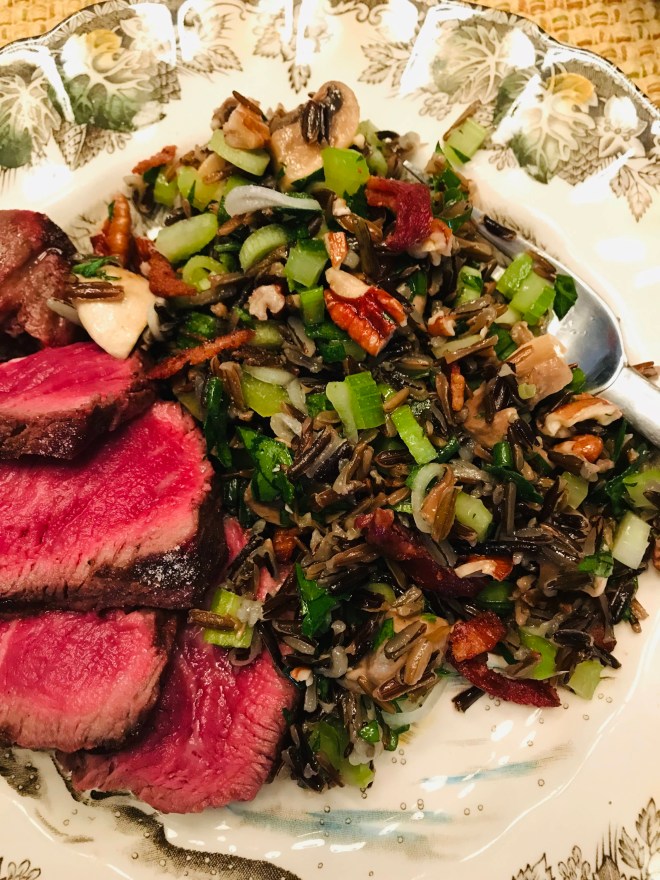
My father loved all the things that fed him.  Nature, people, food and drink.  This salad satisfies on many levels.  Wild rice, harvested in long-boats by hand, mushrooms growing from the spores of things ended, interesting textures and a vinaigrette that elevates the salad to perfection.

WILD RICE SALAD WITH LEMON VINAIGRETTE

INGREDIENTS:

  • 1 cup wild rice
  • 10 slices bacon, chopped, fried and drained on paper towels.
  • 1 cup celery, sliced thinly
  • 1 cup green onions, sliced thinly
  • 1 cup pecans, toasted and coarsely chopped
  • 2 cups white button mushrooms, sliced
  • 3/4 cup Italian parsley, chopped
  • 1/3 cup avocado oil
  • 1/3 cup lemon juice
  • Kosher salt and freshly ground black pepper to taste

img_4672

DIRECTIONS:

  1. In a heavy medium size pot, combine 1 cup wild rice with 4 cups salted water.  Bring to a boil and simmer for 40 minutes, or until soft and chewy.  Drain in colander and let cool.
  2. Meanwhile, fry up bacon until crisp and drain on paper towels.  Set aside.
  3. In a large bowl combine celery, green onions, pecans, mushrooms and parsley.  Add cooled rice.  Mix gently but thoroughly.
  4. In a pint Mason jar, combine avocado oil and lemon juice.  Add salt and pepper to taste.  Shake thoroughly.  Pour over salad, combining dressing with other ingredients.
  5. Arrange salad on a platter or bowl.  Sprinkle with fried bacon.  Serve.  (salad will keep in the refrigerator for up to 3 days)

Serves 4-6

img_4676

“When my father didn’t have my hand, he had my back.”   —Linda Pointdexter


Getting a Little Nutty

So let me ask…..how many of you have vegetable gardens?  How many of you frequent farmer’s markets?  Until I lived and worked on a farm, I was pretty clueless about growing food.  So why should we be concerned?

Food gardens and orchards were once common in the western world, but have been replaced by manicured lawns and a few ornamentals.  How is this possible when surveys show gardening as our favorite pastime?  Yet when it comes to whole food, the closest most of us get is the local produce section of our grocery stores.  The enlightened might venture out to the farmer’s market and hopefully spend their food dollars with a genuine farmer.

Not long ago we were an agricultural rather than industrial society.  Most farms were family farms until the 1940’s.  These farms were not mono-cultures, but grew and raised a variety of vegetables, fruits and livestock.  These were largely self-sustaining farms that grew their own feed grains to feed their livestock, using field rotation and organic methods.  They would compost and return their manure to their fields to fertilize the soil.  Pests were controlled by having multiple crops in smaller fields.  Although it was labor intensive, the hoe and the plow were the weed control methods of the day.

Enter WWII.  Many left family farms to serve, creating an exodus to the cities by many who no longer valued agrarian life.  There was opportunity in the city.  With this change came the battle cry of bigger is better; mono-crops replaced the thoughtful and common sense approach to farming.  Cheap petroleum, along with new science, created the world of pesticides, to address the new push of agribusiness for mono-crops.  Commodities replaced food.  Herbicides were the preferred weed control method.  Free range animals were sequestered into feed lots, resulting in the need for preemptive antibiotics.  Chemicals were more cost-effective than manual labor.  The family farm was lost.

Rachel Carlson was before her time when she wisely commented: “Future historians may well be amazed at our distorted sense of proportion.  How could intelligent human beings  seeking to control a few unwanted species by a method that contaminated the entire environment and brought the threat of disease and death even to their own kind?”

Our food system is more fragile than we realize.  Dr. Vandana Shiva stated, “Seeds controlled by Monsanto, agribusiness trade controlled by Cargill, processing controlled by Pepsi and Phillip Morris, retail controlled by Wal-Mart–is a recipe for food dictatorship.  We must occupy the food system to create food democracy.”

As these concerns play out, organic farming and the local food movement has tried to respond by educating the consumer about how to change our food system to become more sustainable.  Concerns about quantity over quality, profit over sustainability and the environment, will need to be seriously addressed in our lifetime.  Our current industrial practices are not sustainable.

I had never put up food before I came to the farm over 12 years ago.  I would simply purchase whatever I needed whenever I needed it.  I was not conscious of the connection between food and health.  When fresh became my motto, I learned that if I planted it, raised it and harvested it, it’s going to taste better than if I bought it.  Fresh herbs and whole foods became my passion.

These days I am driven to put up the food we grow.  You might ask, “How in the world do you find the time?”  My response to that is twofold; one, we are NOT television watchers, and two, it’s a labor of love.  The flavor of home-grown vegetables is so superior, I literally find the time.  Since doing this we have cut our grocery food budget by more than half, saving thousands of dollars annually.  But the monetary savings is only one form of wealth.  We are so much richer for the life on our farm.  The sound of birdsong, the physical labor, the smell of fresh earth, the excitement of watching seeds grow into mature plants, which produce vegetables so good that you close your eyes when you eat.  This is not a need for nostalgia, but a prayer of gratitude for seeing with new sight.  Knowing what is possible when food is home-grown or grown locally, makes me want to sing its praises and encourage others to dynamite their lawn and put in a food garden.

Family relationships become deeper when you work together and a family food garden is a great place to start.  When seeds are planted, there is a sense of purpose; a stewardship of your plot of land.  With attention to what’s needed your efforts will be rewarded with food grown with your own hands for your own table.  I know each spring when row after row of seeds are sown, there is nothing quite like the thrill of seeing rows of tiny green seedlings breaking ground and reaching for the sun.  It’s a birth and there you stand like a proud parent.

Then it starts.  You read, you experiment, and you want the best for those seedlings.  How much water is too much; how much too little?  Those little seedlings will inform you whether or not you are on the right track.  You will weed and weed again.  Each day you will observe.  Didn’t it grow twice as big after the last rain?  You will curse the cut-worm or slug that caused it to fail.  You will take it personally.  You will uncover your creativity and discover solutions for problems and challenges.  All the while, each of you will be invested in the outcome.  With shovel and hoes in hand, your investment will bare fruit as you slowly become closer to the earth and each other.  You will find that you do indeed reap what you sow.  If your space is limited, you might consider incorporating vegetables in your perennial garden as borders or backdrop.  Many vegetables offer both color and texture to the aesthetic eye.

So start now.  Whether it’s a few pots on your balcony or deck, or planning a small 10 x 10 plot; learn what it takes to grow food.  The learning curve is immense, but the reward will more than match your efforts.  What I have learned about farming and growing food is not planted in the soil, but in the heart.  In these fields of plenty, we are all asked to the table.

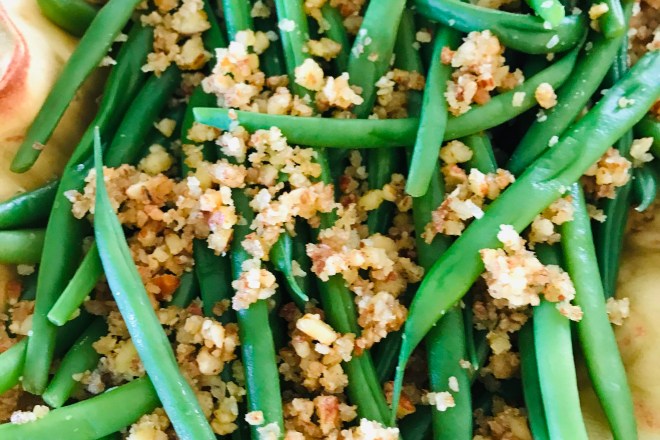
I’m sure there are as many pesto recipes as there are cooks; in this recipe almonds are front and center rather than herbs.  I love the texture difference, and this works great on any fresh bean.  This recipe makes enough for a crowd, but you can adjust the amount of beans for your family.  The pesto will easily keep in the refrigerator for a week or more to use as needed.

HARICOT VERTS WITH ALMOND PESTO

INGREDIENTS:

  • 2 pounds haricot verts (or as we call them: Skinny French Girls)
  • 1 cup (5 ounces) whole almonds, toasted and cooled
  • 1 1/4 ounces Parmesan or pecorino cheese, grated
  • 1 garlic clove, peeled and crushed
  • 1 teaspoon fresh thyme leaves
  • 1/2 teaspoon Kosher salt
  • 3 teaspoons white wine vinegar
  • 1/3 cup extra-virgin olive oil + extra for drizzling

img_4280

DIRECTIONS:

  1. Bring a large pot of salted water to a boil.  Trim green beans and blanch in boiling water for 3 minutes.  Remove beans with tongs and plunge them into an ice water bath to stop the cooking process.  Allow to fully cool.  Drain and pat dry with a clean kitchen towel.
  2. In a food processor, place almonds, cheese, garlic, thyme, and and pepper in bowl and pulse 6-8 times or until they are a coarse paste.  Add vinegar, and pulse again.  Place contents in small mixing bowl and stir in olive oil.
  3. Toss cooled haricot verts with some of the pesto.  Place beans on a platter, and drizzle with a little extra-virgin olive oil.

Serves 6-8

img_4281

img_4283

img_4301-1

“Everything that slows us down and forces patience, everything that sets us back into the slow circles of nature, is a help. Gardening is an instrument of grace.”  –May Sarton
Beeting the System

While doing some research I came across a staggering statistic: 70% of Americans don’t cook.  That’s right.  Most Americans eat out at least 4 times a week.  We heat up, microwave or assemble food; but cooking from scratch is becoming something of a novelty.  I asked myself, “Are we really that busy?”  I can’t imagine myself not cooking regularly.  For me, it’s my most sincere expression of love.  I wonder if people understand what they are missing?  The kitchen has always been the heart of the home; a place where intimacy takes place, both in the preparation of food and the sharing of it around our tables.  As I contemplate this, I feel as though we’ve been sold a collective bill of goods.  As we scramble to meet our financial needs, we are forgetting some of the fundamental, simple pleasures of life; cooking fresh food with love, for our friends and family.  Isn’t it time we break bread together?

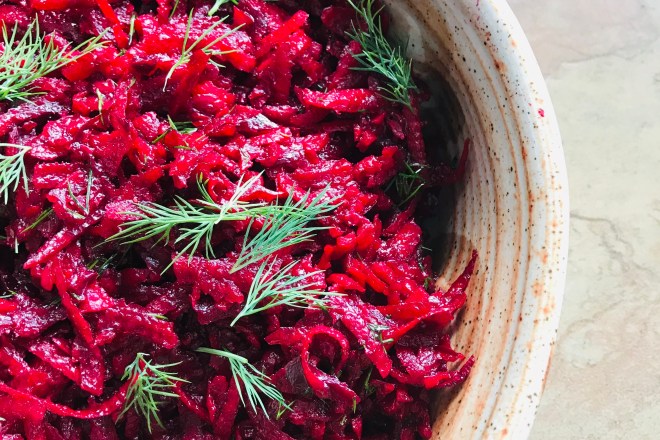
Those of you who have followed this blog or my previous one Basics with a Twist, know I have not been a beet lover until recently.  Alas I have come to my senses.  The first time I  had this salad was as a guest in the home of Kat and Tom Vanhammen.  When she told me what we were having for dinner I remember thinking, “Oh-oh, I’ve never had raw beets and can’t say I was excited about the prospect.  But as a child I was instructed to be a gracious guest and took a serving.  Wow.  Now I can’t leave this salad alone.  I could eat it for breakfast, lunch and dinner.  I make it several times a month.  It’s as though my body literally craves it..

And no wonder!  You simply can’t beat beets!  Your body does love them.  They are chock-full of nutrients like B vitamins, iron, manganese, copper, magnesium, and potassium.  They can lower your blood pressure, lower your risk of heart disease, improve your stamina, help you brain work better, and detox your liver.  Whew.  Now that’s real nutrition!

img_4115

Raw Beet Salad

INGREDIENTS:

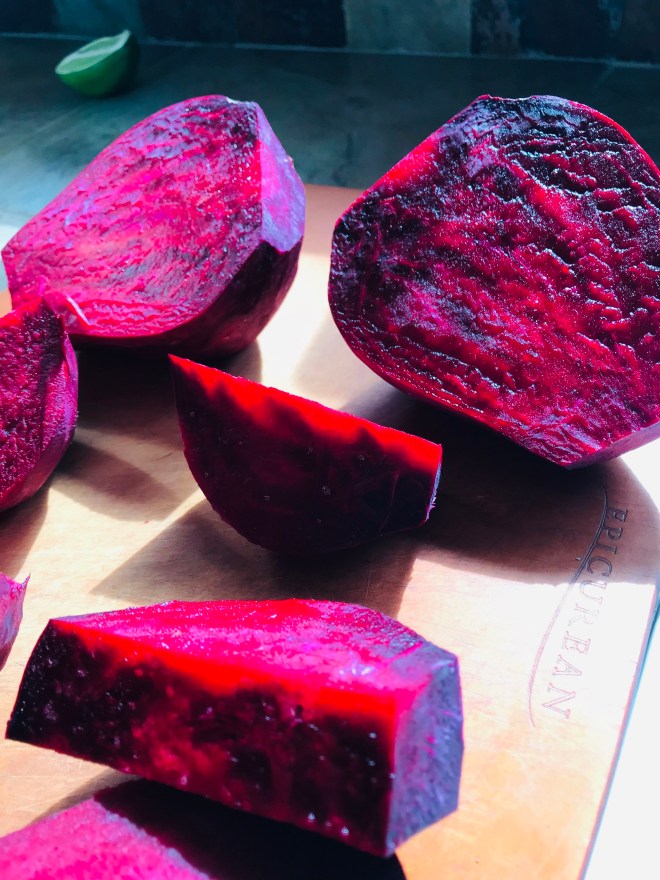
  • 2 pounds of beets, scrubbed and peeled
  • Kosher salt and freshly ground black pepper to taste (don’t be shy)
  • 1/4 cup extra-virgin olive oil
  • 1/3 cup apple cider vinegar (I use Braggs; this might seem like a lot of vinegar, but look at it as a raw pickled beet)
  • 1/4 cup fresh dill, chopped

img_4116

DIRECTIONS:

  1. Grate the beets by hand on a box-grater, or food processor fitted with a metal blade or a Kitchen Aid fitted with a shredder cone.  Place in a large bowl.
  2. Toss beets with the salt, pepper, oil and vinegar.  Add chopped dill.  Let the salad macerate on your kitchen counter for about 1 hour.  Taste and adjust with more vinegar, salt or both.  I like mine with a little zing.

Serves 4

img_3992

“The food you eat can either be the safest & most powerful form of medicine or the slowest form of poison.”   —unknown

Smoking Kale Salad

Kale is often considered a bitter green, appropriate for soups, stews, even smoothies that allow you to break down the leaves in some way.  Being vegetable farmers, we sell a lot of kale at market in late summer and early fall. The most familiar variety is Tuscan or lacinato.  But why limit yourself to this one variety?  There is also curly, redbor, red Russian or Siberian, scarlet and winterbor to mention a few.  There are times I have to really pitch these additional varieties to our customers, but they are every bit as delicious.

Kale was once something most people used as a garnish around other foods, but now it’s the darling of health conscious consumers.  And why not?  It has so many good things going for it.  It’s low in calories, high in fiber, iron, Vitamin K, C and A not to mention loaded with calcium and powerful antioxidants.  Personally, I’m all over kale salads, particularly during the fall and winter months when quality lettuce is sometimes challenging to find.  I am crazy about kale Caesar salad and prepare this as much as I do  the more traditional one made with romaine lettuce.  It’s simply nice to have some flexibility.

When using raw kale in a salad it’s important to macerate the leaves so that they are supple, tender and easy to chew.  There are a couple ways of approaching this objective. One way is to rub olive oil into the leaves with your hands then let it sit for 20-30 minutes.  Another way is to use ground nuts  to break down the cell walls by massaging those into the leaves.  Both techniques work well depending on the additional ingredients you are using.

Other things to consider when working with raw kale is contrasting textures.  In this salad you not only the the crunch of the nuts, but also their smokiness.  Putting shallots or red onions into the dressing allows them them to soften and pickle slightly.  Pan toasting flavor packed fresh breadcrumbs with garlic, thyme, paprika and cumin adds interest along with a slight crisp crunch.  I had one friend ask if there was bacon in the salad.  Amazingly enough it’s vegan!

IMG_2469

KALE SALAD WITH SMOKED ALMONDS AND TOASTED BREADCRUMBS

  • 1/2 cup shallots or red onion, thinly sliced
  • 5 tablespoons of sherry vinegar
  • Kosher salt and freshly ground black pepper
  • 2 tablespoons local honey
  • 1 cup smoked almonds
  • 8 tablespoons extra-virgin olive oil, divided
  • 3-4 slices crusty white bread, cut into 1″ cubes (I use sourdough)
  • 1 garlic clove, grated with a micro-plane
  • 2 teaspoons fresh thyme leaves,  chopped
  • 1 teaspoon sweet paprika
  • 1 teaspoon ground cumin
  • 2 bunches kale of your choice, stemmed, washed, spun dry and thinly sliced (about 10 cups)
  • 1 cup lightly packed mint leaves, chopped


  1. In a small bowl or measuring cup, whisk together the shallots or red onions with the sherry vinegar and 1/2 teaspoon of salt.  Let sit for 15 minutes.  Whisk in the honey, 5 tablespoons of the olive oil and a few grinds of pepper; set aside.
  2. In a food processor, pulse the almonds until coarsely chopped, about 8-10 pulses; transfer them to a large bowl.  Add the kale to the bowl with the almonds and massage the kale until it softens and darkens.  About 30-40 seconds.  Set aside.
  3.  Add the bread to the processor and process to rough crumbs, about 30 seconds.  Add the garlic, thyme, paprika, cumin and additional salt and pepper.  Process until incorporated, about 15 seconds.  Add the additional 3 tablespoons olive oil.  Process 10 seconds more.
  4. Transfer the crumb mixture to a large skillet over medium heat and cook, stirring frequently, until crisp and browned, about 10 minutes.  Transfer to a plate to cool.
  5. Add half of the dressing and onions to the kale.  Toss to combine.  Add 1/2 of the breadcrumbs and chopped mint.  Toss again, adding additional dressing and/or breadcrumbs if needed.  (Kale will have reduced in volume after macerating leaves).  Taste and season with additional salt and pepper.


Smokey, healthy and delicious!


“Salad can get a bad rap. People think of bland and watery iceberg lettuce, but in fact, salads are an art form, from the simplest rendition to a colorful kitchen-sink approach.”

–Marcus Samuelsson


Beyond Lettuce

I’m a huge fan of salads.  I could eat one everyday, particularly since we grow so many ingredients for them during the farm season.  When I was on a restricted diet following my recent surgery (the first 10 days were liquids) what I missed the most was a variety of texture.  God, just give me some crunch, something to chew!

Often times, when purchases from the farmer’s market are limited and the choice of lettuces from the grocery store are packed in plastic containers, picked over a week ago, you simply have to get out of the box.  If you want texture you have to get beyond the Honeymoon Salad (lettuce a lone!) and look for more seasonal fare.

There are many veggies that work beautifully in the winter for salads.  Try combining both fruit and vegetables like pear and butternut squash or kale, chickpeas and pomegranate seeds.  Nuts such as almonds, pine nuts or pepitas, hard-boiled eggs and hard or soft cheeses also work.  Try all kinds of cabbage, broccoli, cauliflower or one of my favorites: Brussels sprouts.

Any type of cabbage pairs well with the smokey taste of bacon or pancetta. This gives you the option of making a warm dressing with some of the fat by adding something acidic like lemon juice or vinegar.  Get creative! Seasonal winter salads can be warm or cold.  They can be the center or side of a meal. You are only limited by your own imagination!

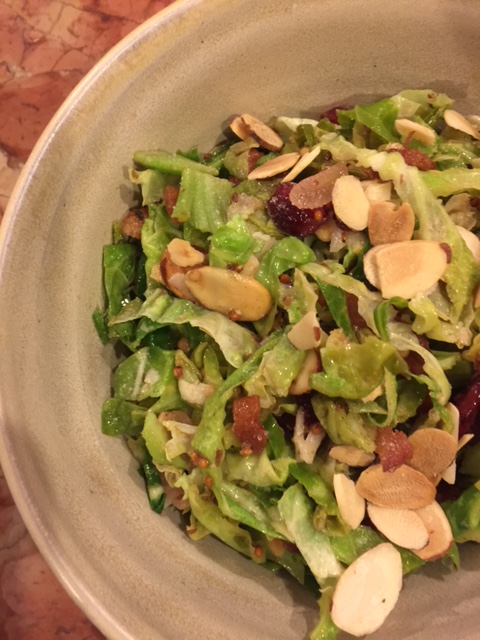
Brussels Sprout Salad With Warm Bacon Vinaigrette:

IMG_1744

  • 1/4 cup red wine vinegar
  • 1 generous tablespoon whole-grain mustard
  • 1 teaspoon sugar
  • Kosher salt and freshly ground black pepper to taste
  • 2 shallots, thinly sliced
  • 6 slices bacon, chopped into 1/2 inch pieces
  • 2 lbs. Brussels sprouts, trimmed, halved and sliced thin using a mandolin or knife
  • 3 ounces shredded Pecorino cheese
  • 1/3 cup dried cranberries, chopped
  • 1/2 cup sliced almonds, toasted
  1. Whisk together vinegar, mustard, sugar and 1/2 teaspoon salt in small Pyrex measuring cup.  Add shallot, cover and heat in microwave for 30-60 seconds or until steaming.  Stir, then cover and let come to room temperature, about 15 minutes.
  2. Cook bacon in deep 12-inch skillet over medium-heat until crisp, stirring frequently.  Drain bacon on paper towels.  Add shallot mixture off-heat, stir until combined.  Add shredded Brussels sprouts and toss with tongs until dressing is evenly distributed and sprouts are slightly wilted, about 3 minutes.
  3. Transfer to serving bowl.  Add Pecorino, dried cranberries and almonds and toss to combine.  Season with salt and pepper to taste. Serve immediately.

IMG_1745

Serves 4-6

IMG_1746

“What a wild winter sound,— wild and weird, up among the ghostly hills…. I get up in the middle of the night to hear it. It is refreshing to the ear, and one delights to know that such wild creatures are among us. At this season Nature makes the most of every throb of life that can withstand her severity. ”  –John Burroughs, “The Snow-Walkers,” 1866

Crazy Love

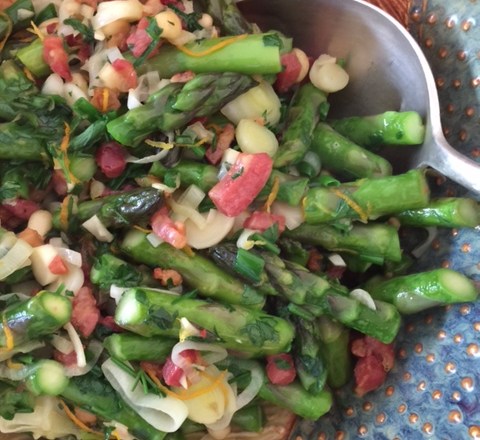
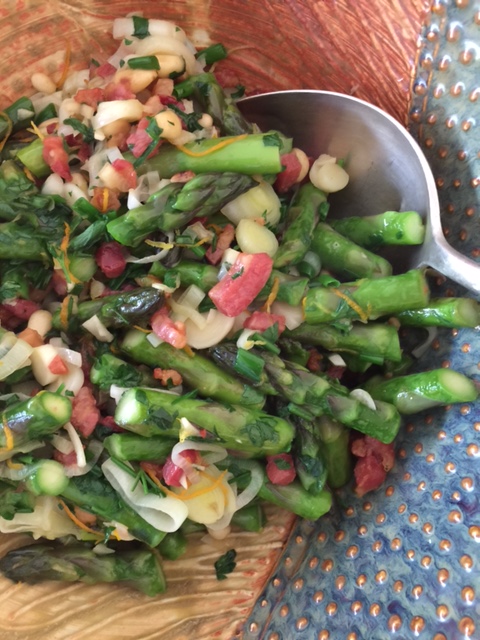
Certain foods simply go together; peas and mint, tomatoes and basil, apples and pork, mac and cheese, fries and ketchup.  Ooops, I digress.  For me the first spring asparagus inspire endless combinations for salads, soups, omelettes and tarts.  Asparagus have always been my favorite veggie; one of the few that I will only use fresh.  In asparagus, texture is everything!  I have found the combination of asparagus, leeks and pancetta to be down right decadent; I mean who needs chocolate?  Ok…maybe for dessert!

I was taught at a young age, that you “eat with your eyes”, meaning all the visual elements in a recipe matter.  The tender-crisp asparagus, smokey pancetta, the buttery leeks;  the dish is greater than the sum of its parts.  The citrus adds a counter-balance to the richness.  Bingo…seasonal, local and delicious.

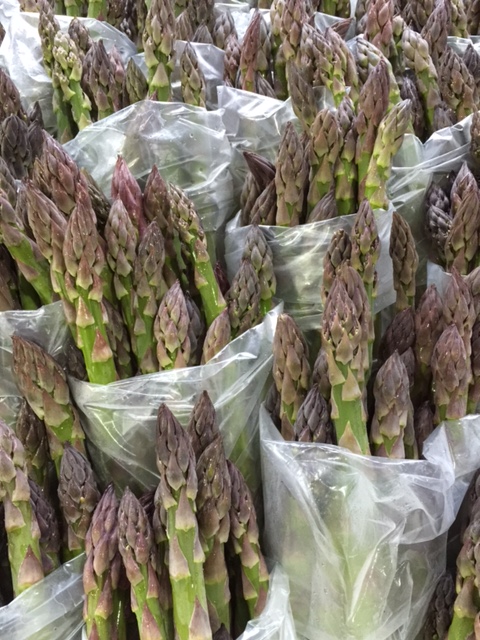
Perfect asparagus from our neighbors at Fulton Street Farmer's Market

Perfect asparagus from our neighbors at Fulton Street Farmer’s Market

Crazy Love Asparagus:

  • 4 oz pancetta, cut in 1/4 inch dice
  • 1 Tablespoon unsalted butter
  • 1 pound asparagus, woody ends trimmed and sliced into 2 inch pieces on the bias
  • 1 1/4 cup leeks, thinly sliced crosswise (white and pale green parts only)
  • 4 cloves garlic, minced
  • Zest of one lemon
  • 2 teaspoons orange zest
  • 3 Tablespoons toasted pine nuts
  • 2 Tablespoons fresh Italian parsley, chopped
  • Salt and freshly ground black pepper to taste
  1. In a large non-stick skillet, saute pancetta, stirring frequently, over medium heat, until crisp and lightly golden.  Drain on paper towels.
  2. Add 1 tablespoon of butter to pan.  Add asparagus and leeks to pan and saute until asparagus is crisp tender, about 4 minutes.
  3. Add in the drained pancetta, garlic, lemon and orange zest, toasted pine nuts and parsley and saute for about 1 minute, until fragrant.  Season to taste with freshly ground black pepper and salt.  Serve immediately.  Swoon.
I just can't stop making this!

I just can’t stop making this!

“It is spring again.  The earth is like a child that knows poems by heart.”

—-Rainer Maria Rilke