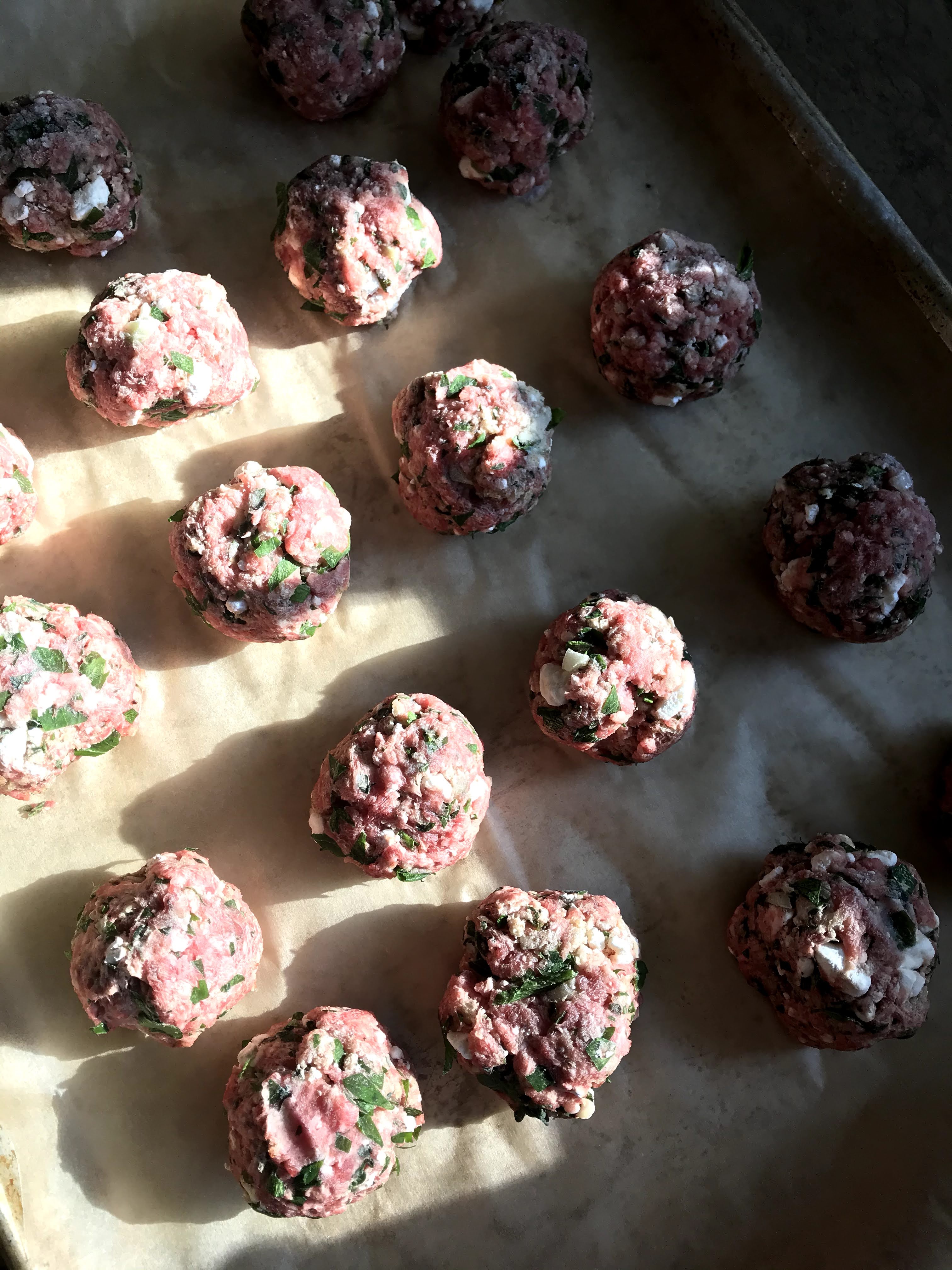
I often find that if I’m making something that freezes well, why not double or triple the recipe? I often do this with sauces, condiments, caramelized onions and especially this recipe , Lamb & Feta Meatballs. If I make a single recipe I get approximately 16-18 meatballs. Two weeks ago I quadrupled the recipe using 4 pounds of ground lamb and made 60 (enough for 5-6 meals)!!
These little orbs are versatile and full of flavor. Plate them with last weeks recipe for Roasted Sweet Pepper and Tomato Sauce, place them in a pita with tomato and tahini sauce, use them in spaghetti and meatballs, serve them with tzatziki sauce. You can serve them as an appetizer by stabbing them with bamboo skewers with a sauce on the side. You get the idea. They freeze beautifully, so with a little effort, you are ready for a quick delicious option at a moments notice. If you have a food saver you are golden, if not, place frozen meatballs in a quart freezer bag and remove as much air as possible.
LAMB AND FETA MEATBALLS
INGREDIENTS:
1 pound grass-fed ground lamb
4 ounces feta, crumbled
2 tablespoons fresh thyme leaves
3 garlic cloves, grated on micro-planer
1/2 cup fresh parsley, chopped
1 cup fresh breadcrumbs, without crusts, pulsed in a food processor
1/2 teaspoon ground cinnamon
Kosher salt and fresh ground black pepper to taste
1 tablespoon extra-virgin olive oil
Lamb meatballs ready to freezeFrozen meatballs vacuumed sealed
INSTRUCTIONS:
If making a single batch, preheat oven to 425 degrees F. Line a large baking sheet with parchment paper (you will use two of these to freeze the meatballs prior to vacuum sealing them if doubling or tripling your recipe).
In a large mixing bowl, place the ground lamb, feta, thyme leaves, garlic, breadcrumbs, ground cinnamon, olive oil, along with salt and pepper and mix thoroughly with your hands. Using a meatball scoop or your hands, shape into golf ball size balls. You should end up with about 18 meatballs, placing them uniformly on baking sheet about 1 1/2 inches apart.
If freezing extra, place sheet in freezer overnight. Once frozen place 10-12 meatballs in a vacuum seal bag or freezer bag and seal. To defrost place bag in sink of cool water for about an hour. If making a single batch place in oven for 15-20 minutes, or until browned. Serve hot.
There’s a reason fall is called a transitional season. The wind is howling here today with 50 mph gusts, sending our bird feeders crashing against our deck. It’s in the 30’s with periods of snow, mixing in with the falling leaves, sending everything on a Twister ride. No worries, the forecast for next Sunday is 70 degrees!
We are fortunate that our larder is full. Comfort food means different things to each of us. I love it when we turn the corner from summer vegetables to fall. I enjoy pairing vegetables with whole roasted chickens or roasting them for sheet-pan dinners. I’m a visual person, after all, we eat with our eyes, and I love to have bright colors and contrasts in food. This dish is perfect when red cabbage and apples are at Market. It combines the best of color and contrast; as it’s both sweet and sour. It comes together in under an hour and pairs well with chicken, pork or duck.
Sautéing the onions and cabbage
SWEET AND SOUR RED CABBAGE
INGREDIENTS:
2 tablespoons unsalted butter
1 medium yellow onion, chopped
1 medium red cabbage, cored and thinly sliced (about 6-8 cups)
3/4 cups apple cider or fresh apple juice
1 teaspoon salt
3 tablespoons fresh dill, chopped, plus more to garnish
2 teaspoons fennel seed
1/2 cup golden raisins
3-4 tablespoons apple cider vinegar
1 tablespoon local honey
INSTRUCTIONS:
In a large pot sauté the onions in butter until lightly browned. Add the cabbage and sauté for an additional 10 minutes, stirring occasionally. The cabbage will reduce in volume quite a bit.
Add the remaining ingredients except the honey. Cover, cook on low heat for about 25-30 minutes.
Add honey and adjust with more vinegar or honey if needed.
Serves 4
Colorful and delicious!
“Vegetables to me are….I don’t want to say the most exciting part of cooking, but certainly a very exciting part of cooking, because they continue to change. They come into season and they go through different phases.”
As we move closer to the presidential election, I find myself feeling overwhelmed by both the pandemic and our turbulent political discourse. I traverse between a feeling of calm to a nameless agitation that grabs me the moment I leave the safety of our home. It seems that the world is becoming more and more dangerous. My heart grieves for the victims of Covid, the poisoning of our planet for profit, the inequality and injustice displayed by people in power. Our problems seem overwhelming. I often wonder what impact one person could possibly have to change the tone of the conversation, much less the world? As an individual how do I live a life that nurture others, the planet and myself? How do I stay authentic to my beliefs in a world that wants to label me?
In the small microcosm of my life, I look for signs of hope. How have I made a difference? Since I moved to the country, my greatest teachers have been nature, the seasons, and the land. If we care for the land, the land offers up the food that both feeds us and provides our livelihood. That clean, wholesome food is taken to the farmers market and sold to people that care about what they feed themselves and their families. It’s a life that is simple, focused and real. We place a seed in the ground and have faith that it will grow. I believe that we often receive what we put into the world; a sort of what goes around, comes around. When I am kind to people, it follows that people are generally kind to me. But what happens when people are unkind, disrespectful, and angry? What happens when there is drought or deluge or crop failure? When a pandemic strikes or unemployment, or changes we didn’t expect or ask for? I believe this is when our faith is really tested, when our priorities and attitudes matter.
It seems to me that faith, the belief in things unseen, is about the things in life that cause us to question, to change, to grow. I don’t believe that the challenges in life are judgements, but opportunities to understand the world and ourselves more fully. How do we cultivate our better selves when we are up against our fears and the rapid pace of change? We are all flawed human beings; there are no saints among us. How do we nurture our inter-connectedness? How do we come to realize what happens to one of us, happens to us all? My greatest challenge is to keep my heart open, to feel pain when someone is hurting, to look at the glass as half full.
As the fall prepares us for winter, may we take the time to reflect and adopt a slower pace. The land rests, and in the same sense so do I. Dormancy is a gift. I can’t assimilate life without periods of quiet. There is time for long morning coffee and deep listening. Clocks tick, fires burn and hearts beat. It is a season where less is more. This resting period is a time to replenish both our physical and emotional beings. In this quiet stillness I hear a small voice say, “Your faith is measured by the wideness of your heart.” One of my favorite poets, Stanley Kunitz said it in a different way: “Live in the layers, not on the litter.” In these layers of life, the peace I sought is found.
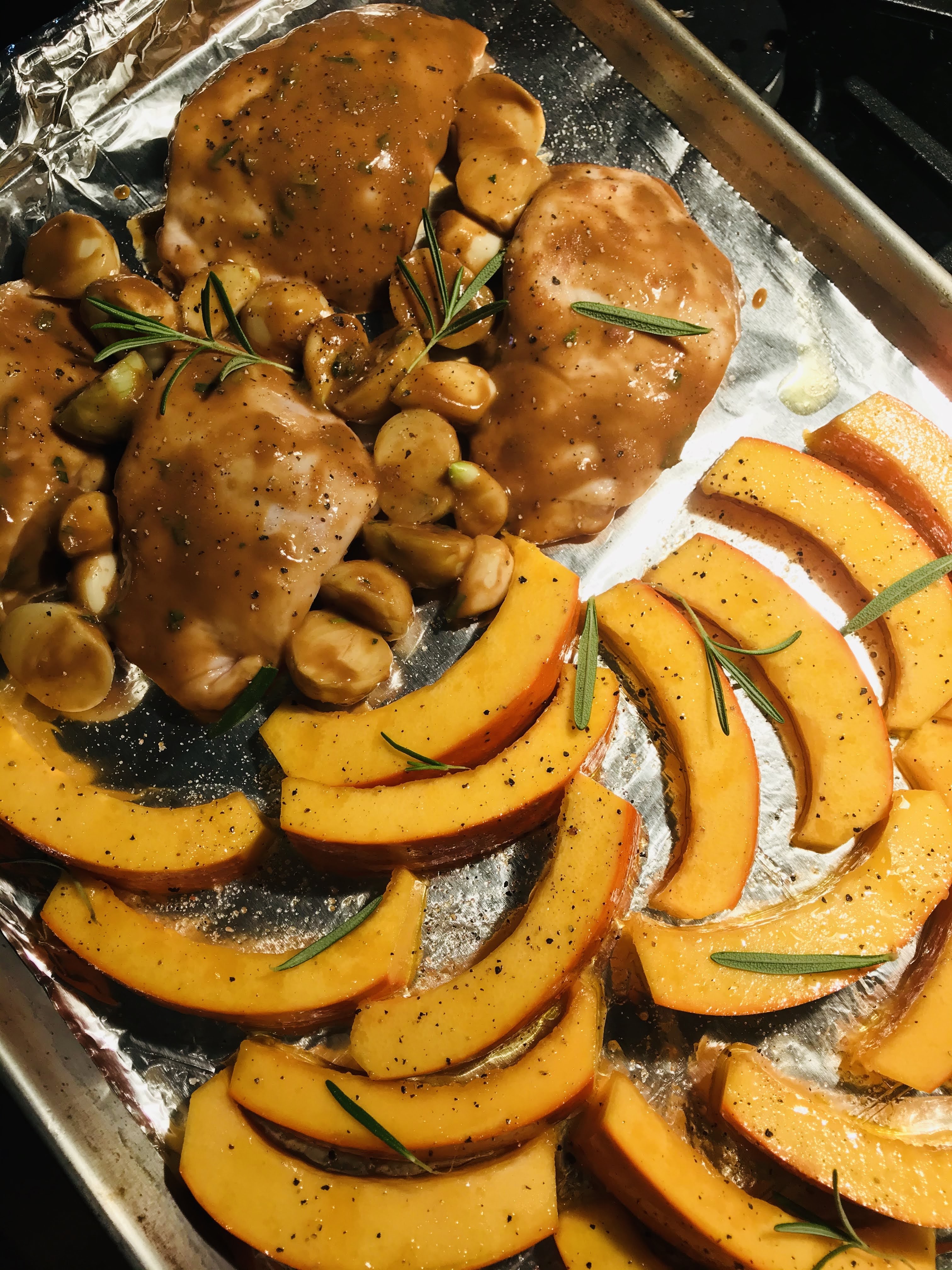
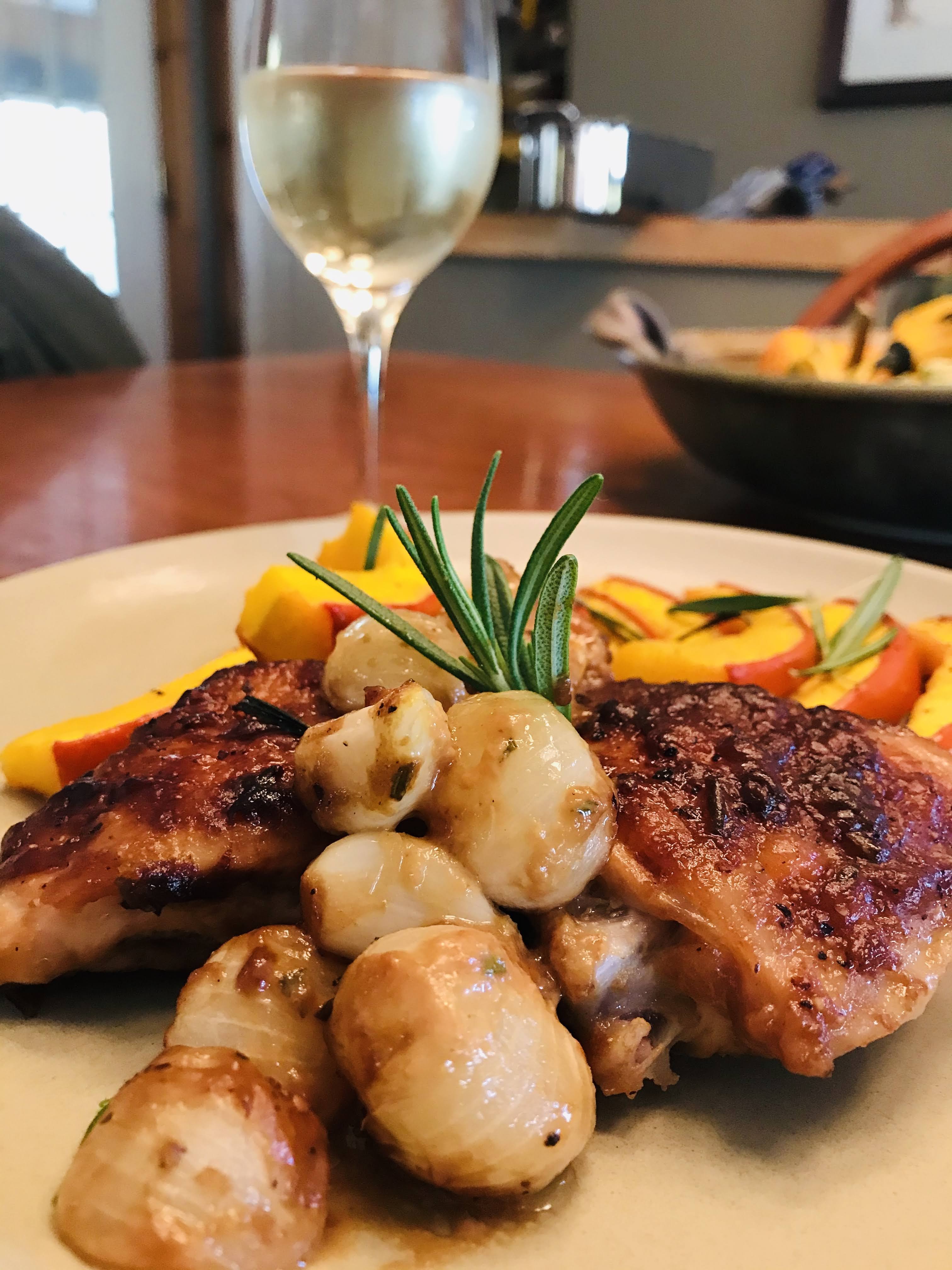
Although food is my passion, there are days when I’m involved in other interests or projects. This is when the simplicity of a sheet pan dinner is exactly what I turn to for a meal that is virtually hands off, yet delicious. They are basically designed around a protein and a vegetable. This one uses everything that I have either in freezer or pantry. Although I have used pumpkin as the vegetable, you could just as easily use sweet potatoes or butternut squash. Don’t forget to save your pumpkin seeds to roast, for an added treat.
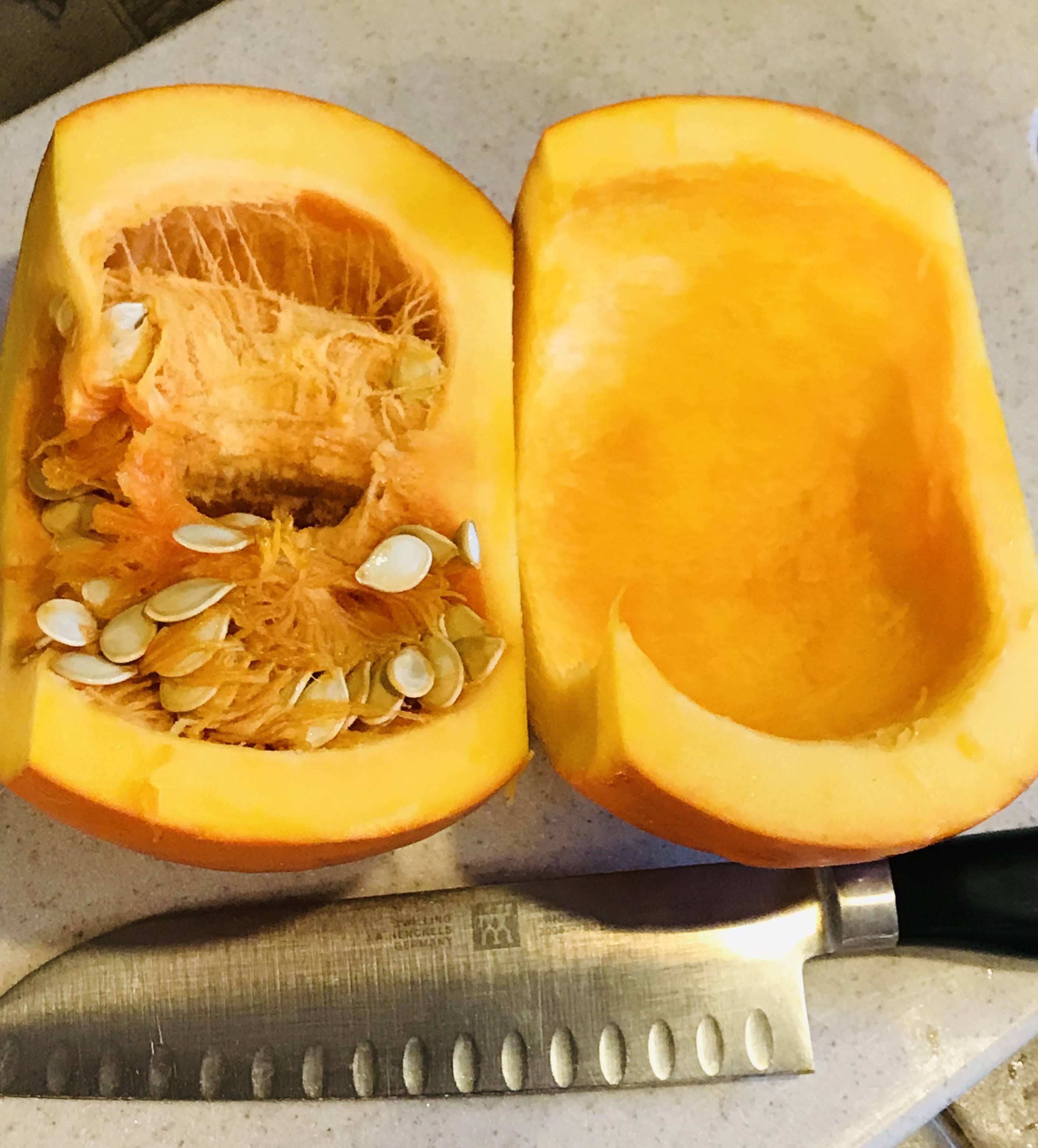
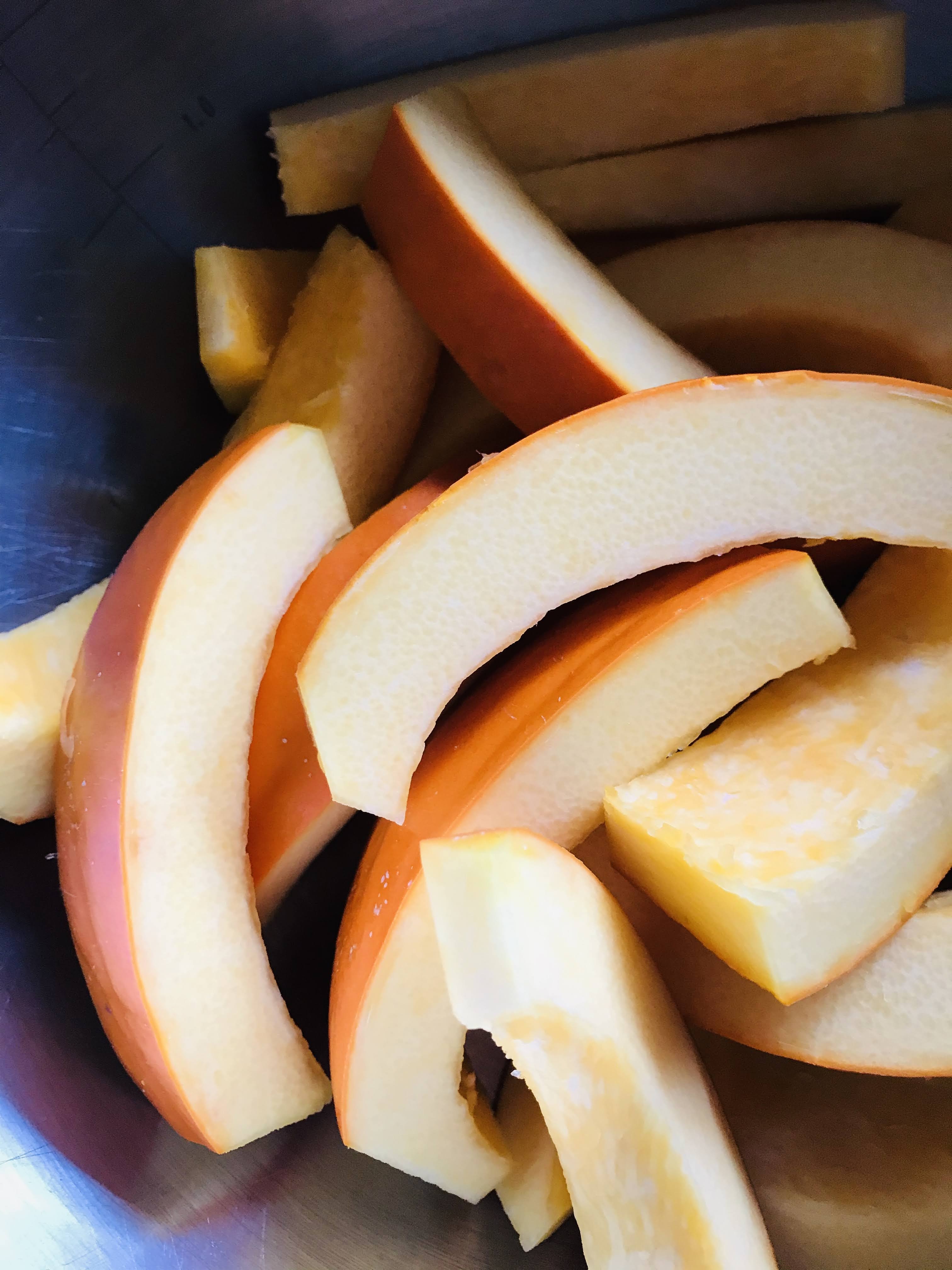
A delicious sugar pumpkin, loaded with seeds.Pumpkin wedges, ready to be tossed with olive oil and maple syrup.
DIJON-ROSEMARY CHICKEN THIGHS WITH MAPLE GLAZED PUMPKIN
INGREDIENTS:
3 tablespoons Dijon mustard
5 tablespoons extra-virgin olive oil
1 1/2 tablespoons balsamic vinegar
5 large garlic cloves, peeled and left whole
6 skin-on, bone-in chicken thighs
5 shallots, halved lengthwise
1 small sugar pie pumpkin (about 2 lbs.)
2 tablespoon pure maple syrup
Kosher salt and freshly ground black pepper to taste
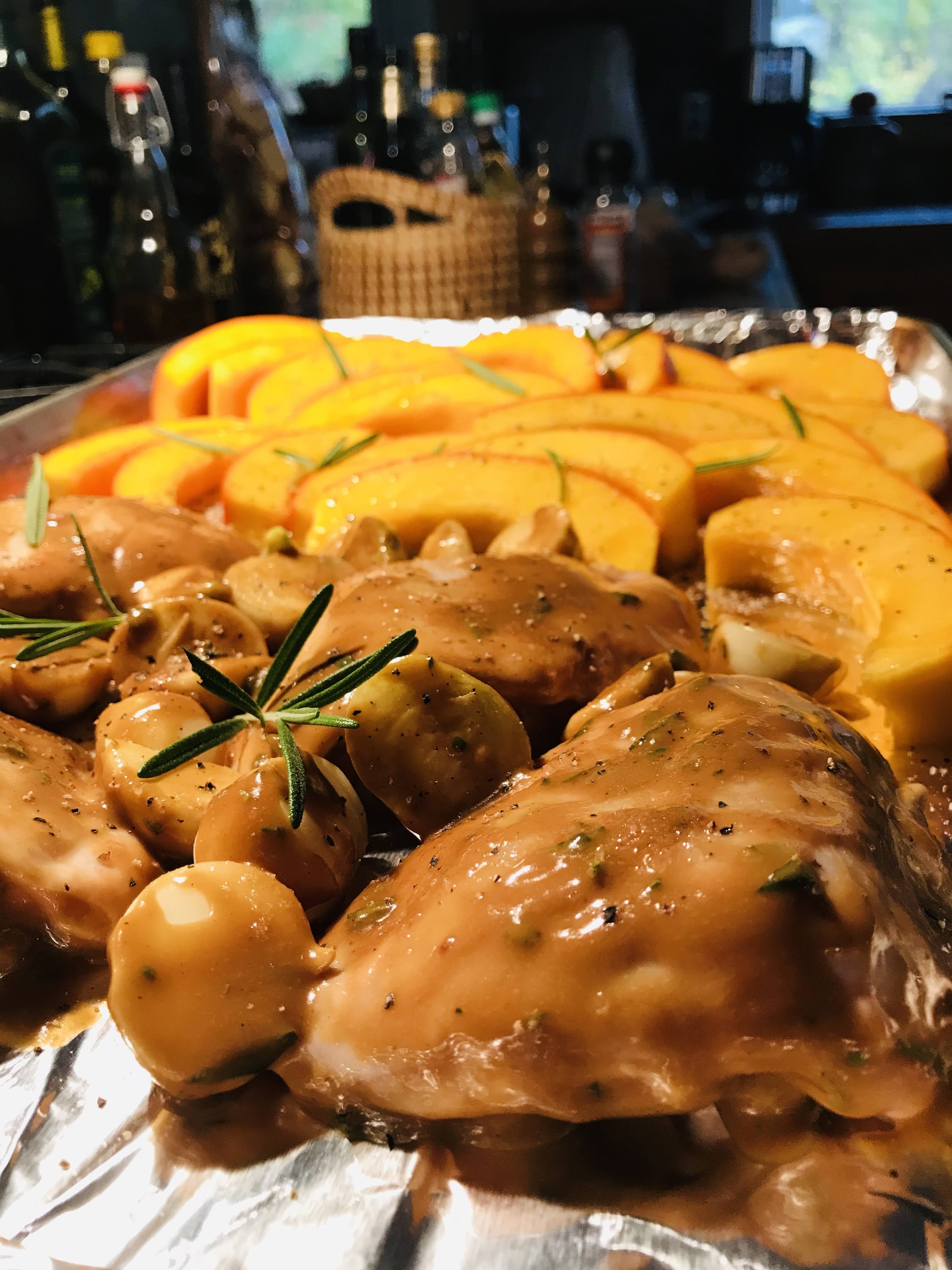
Ready for the ovenSeasoned perfectly
INSTRUCTIONS:
Preheat the oven to 400 degrees F. Line a large sheet pan with aluminum foil.
In a large bowl, whisk together the mustard, 3 tablespoons of the oil, the vinegar, garlic, and rosemary. Add the chicken, garlic and shallots and toss to coat. Let stand at room temperature while you prepare the pumpkin.
Cut off the top and bottom of the pumpkin, then cut it in half lengthwise and remove the seeds. Cut each half into 1-inch wedges. In another large bowl, stir together the maple syrup and the remaining 2 tablespoons olive oil. Add the pumpkin and toss to combine. Place the pumpkin wedges in a single layer on one end of the prepared pan. Remove the chicken, garlic and shallots from the marinade and place on the other side of the pan. Season generously with salt and pepper.
Roast until the chicken is opaque (160 degrees F) throughout and the pumpkin is golden brown and soft, about 45-50 minutes. Serve right away. Sprinkle fresh rosemary leaves as a garnish.
It’s the little things. Small gestures given freely. Each evening my wife Val makes sure that my coffee is programed for the next morning (she drinks tea). She understands the daily ritual that our coffee hour is our bonding time. She understands how much cream I like in that coffee, and that I only drink two cups. I know how she likes her Manhattan’s, how much vermouth to rye whiskey, with two drops of bitters.
These small things nurture our marriage. I bring this attentiveness into the world when I leave the farm. If farming is the what, then the farmers market is the why. Our relationships there add to the richness in our life. The Covid pandemic has completely changed our experience at the market. Val’s compromised immune system requires that she self isolate on the farm during this pandemic, to stay as safe as possible. When I go to the market on Wednesday’s I am in my own section on a slower day. Customers are not allowed to touch the produce or soap products that we sell. Everyone is required to wear masks. There is hand-sanitizer in multiple locations at our stall. You learn to read the eyes above the masks for clues about each other. Are those eyes playful, warm or anxious? There is an overall feeling of being AWOL from the usual fullness of our exchange. We give virtual “hugs”, which only underscores their absence; somehow elbow bumping just doesn’t do it.
Then Shalini appears at our stall. She comes bearing gifts of garam marsala, black salt, amchoor powder (dry mango) and Tamarind-Date Chutney. She gives me tips about how to make Indian greens and Channa (chickpea salad). She also brings the warmth of her smile. I consider Shalini my spiritual mentor of sorts. She loves Jesus, I’m not religious, yet her sense of humanity, compassion and grace comes through in our conversations. She leads by example. She shares that there are times in order to find common ground with others, she must keep her heart open and simply speak human to human. “We are all human after all.We are all suffering in our own ways. I’ve made a personal decision that if someone needs a hug, they will receive one from me.regardless of the situation we find ourselves in.”
I immediately stop what I am doing and walk purposefully around the stalls to where she is standing. We embrace, and I am awash in the sweet necessity of human contact. Something intangible is exchanged; the unseen, enters and we are nourished. We simply need each other as human beings. On the other side of this pandemic, I’m looking forward to breaking bread together once again.
I first made this bread recipe over 30 years ago. It floated up in my consciousness after Val and I had harvested and dried dill seed from the farm. It is a no-knead bread with terrific flavor. I used our own dehydrated onions as well, but the real treat is when you toast it. The scent of dill and onions will fill your home. Don’t spare the butter!
NO-KNEAD DILL ONION BREAD
INGREDIENTS:
1 package active dry yeast (2 1/4 teaspoons)
1/4 cup warm water
1 cup cottage cheese, room temperature
2 tablespoons white sugar
1 tablespoon unsalted butter, room temperature, plus more as needed
1 teaspoon salt
1/4 teaspoon baking soda
1 tablespoon dill seed
1 tablespoon dried minced onion
1 farm fresh egg
2 1/4 cups all-purpose flour
Pinch of Maldon or other flake salt
Mixed dill/onion dough, ready for the ovenDill/Onion Bread straight from the oven, coated with butter and salt
INSTRUCTIONS:
Soften yeast in warm water; let stand for 10 minutes.
Mix cottage cheese, sugar, butter, salt and baking soda together in a large mixing bowl. I use my Kitchen-Aid mixer with paddle attachment. You can mix this at this stage with a wooden spoon or whisk. Add dill seed, dried onion, eggs and yeast mixture. Mix well.
Gradually add flour, about 1/2 cup at a time, on medium speed. If you are doing this manually, you can also mix this with your hands. The dough will be sticky. It dough seems too sticky, add another tablespoon or two of flour.
Cover bowl with a clean kitchen towel and place in a warm place until double in size, about 1 hour.
Preheat oven to 350 degrees F. Generously butter a 2 quart round baking dish. Gently spoon dough into prepared dish. Bake in center rack in preheated oven until golden brown, about 30-35 minutes.
Remove from oven; brush with butter and sprinkle with flake salt. Let bread cool 5 minutes before transferring from the baking dish to a cooling rack.
“True life is lived when tiny changes occur.” –Leo Tolstoy
Today I am grateful. Grateful for living in the country on our vegetable farm. It provides a much needed counterbalance to the daily stress and anxiety of watching our world unravel by the seams. So many things are out of our control; so I focus on the things I can do to live a meaningful life. These include keeping in touch with those I love, planning for an uncertain future, reading, playing games with Val, and above all cooking with as much creativity that I can muster.
If I am an obsessive cook, Val is an obsessive farmer. She loves growing vegetables that are unfamiliar to us. These include some vegetables that don’t necessarily excite me, like turnips. Turnips have never been on my radar. When there are so many vegetables that I love, why grow turnips? When I expressed this to Val she simply said, “Then learn to like them.” She was obviously not detoured. So grow them she did, while I did my part and explored recipes for ideas on how to use them.
I found myself gravitating to recipes that featured them roasted. I figured most vegetables that are roasted are usually sweeter. Really, I didn’t know what to expect, so I tried a simple side dish that roasted them, then tossed them with a vinaigrette while warm; I imagined similar to a French potato salad. It was certainly worth a try. I made a vinaigrette using scallions, tarragon vinegar, whole-grain mustard, extra-virgin olive oil and fresh parsley. I reasoned if I liked everything else in the recipe, I would have a good chance of enjoying them. I butterflied a whole chicken for the grill and we were in business.
I roasted and tossed the turnips with the vinaigrette and the sharpness of the mustard with the vinegar and olive oil smelled wonderful. I went out to finish up the chicken, when Val appeared shortly after with a piece of turnip between her fingers. “It’s time.” she said and popped it in my mouth. Frankly, I was stunned! This was a turnip? This was what I had been avoiding? It was absolutely delicious! Wow. Val stood there with a smirk on her face. “I assume we should grow these again?”
It’s safe to say, I am now a convert. I was so impressed with them I decided that I could use a similar strategy to roast them with chicken. This time I pan-seared chicken thighs, then pan-roasted turnips with fresh tarragon, course mustard, garlic, lemon zest, white wine and chicken stock. I then finished the whole thing covered in the oven for 25 minutes. I have found that turnips love roasting, tarragon and mustard for sure.
ROASTED TURNIPS IN MUSTARD-VINAIGRETTE
INGREDIENTS:
1 tablespoon tarragon or white wine vinegar
2 teaspoons whole-grain mustard
1 scallions, sliced thin
1/2 cup extra-virgin olive oil
2 tablespoons chopped flat-leaf parsley
Kosher salt and freshly ground black pepper to taste
24 small or 10 larger turnips, cut in half or wedges depending on size
INSTRUCTIONS:
In a bowl, whisk the vinegar with the mustard, scallion, parsley and 1/4 cup of the olive oil. Season with salt and pepper.
Preheat oven to 425 degrees F. Line a rimmed baking sheet with foil. Cut the turnips in half through the stems if small, quarter or cut in sixths if larger. In a large bowl toss the turnips with the remaining 1/4 cup olive oil and season with salt and pepper. Spread the turnips on the baking sheet and roast for about 18 minutes.
After 5 minutes or so, transfer to a decorative bowl and toss with vinaigrette. Serve.
Serves 4-6
ROASTED CHICKEN WITH TURNIPS, TARRAGON AND LEMON
INGREDIENTS:
3-4 pounds skin-on, bone-in chicken thighs
1 tablespoon extra-virgin olive oil
Kosher salt and freshly ground black pepper to taste
6 medium to large turnips
6-8 sprigs of fresh tarragon
1 tablespoon finely grated lemon zest
1 tablespoon whole-grain mustard
4 garlic cloves, thinly sliced
1 tablespoon tarragon or white wine vinegar
1/2 cup dry white wine
1/2 cup chicken stock
1/4 cup heavy cream
1/4 cup parsley, chopped
INSTRUCTIONS:
Preheat the oven to 350 degrees F. Heat a heavy oven-proof Dutch oven on a stove top over high heat. Pat the chicken thighs with paper towels, then rub with the olive oil. Sprinkle generously with salt and pepper. Add to pot and sear 6-8 minutes per side, or until well browned. Remove from pot and set aside.
Turn heat down to medium. Pan roast the turnips, adding a bit more olive oil if needed, until lightly golden. Add the tarragon, mustard, garlic, vinegar, wine and stock. Bring to a simmer. Return chicken thighs to pot.
Transfer to oven and roast for 20-25 minutes or until the chicken is just cooked through. Remove from oven and take out chicken thighs; cover them with tented foil.
Place pot back on stove over medium-high heat. Reduce liquid by a little less than half. Stir in heavy cream. Cook an additional 5 minutes or until sauce starts to thicken.
With a slotted spoon, remove turnips and place on each plate. Top with a chicken thigh; then spoon sauce over both. Garnish with parsley and serve.
Serves 4
“This is about trying new things, and getting out of your rut.” — Teri Gault
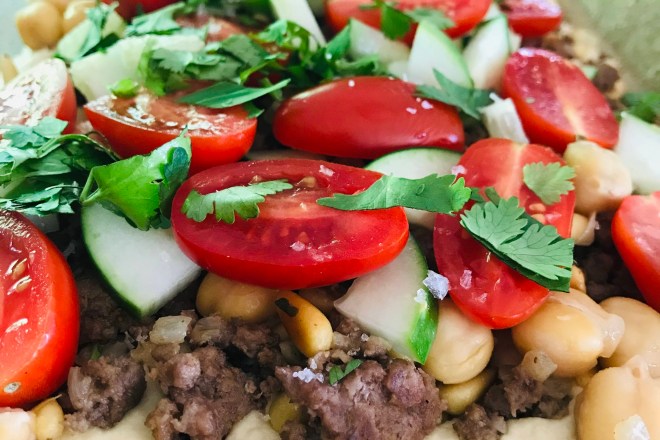
After 3 inches of rain last night, it is a steamy, warm day here in Michigan. Although the farm really needed the rain, humidity generally puts me into salad mode; and there is no better time for salads than summer. I enjoy leafy salads, I like to get outside the box and create salads that use other ingredients. Anything Mediterranean comes to mind, so a layered salad of hummus, ground lamb, and veggies hits just the right cord.
This layered salad makes a particularly nice presentation at a gathering on a large platter. You can also make individual plates if you rather. The hummus can be made a few days ahead to save time on the day of assembly. Macerating the cherry tomatoes in red wine vinegar and extra-virgin olive oil adds even more flavor. You can also top it with crumbled feta cheese. Garnish it with parsley, cilantro or mint. It makes a good appetizer for a crowd along with other Mediterranean sides or can be used as a main coarse. I find that I typically have leftovers after I construct the salad, which are just as good the following day. Serve with pita or naan.
MEDITERRANEAN LAYERED SALAD
FOR HUMMUS (from my first cookbook Basics with a Twist:In
2 15 ounce cans of chickpeas, drained but reserving their liquid; save 1/4 cup chickpeas for garnish
1 teaspoon of Kosher salt
3 large garlic cloves
3-4 tablespoons fresh lemon juice
3 tablespoons extra-virgin olive oil
3 tablespoons Greek yogurt
3 tablespoons tahini
1/2 teaspoon ground cumin
METHOD:
Place drained chickpeas in a four cup glass measuring cup and heat in your microwave for 1 1/2 minutes. Heating your chickpeas allows them to break down in the food processor much easier.
Feed your garlic through the tube of your food processor.
Add remaining ingredients except liquid from chickpeas. This liquid will be used to thin the hummus if needed.
Process for at least 3 minutes. Your hummus should be very smooth and creamy. If you feel you need to thin it slightly, add chickpea liquid 1 tablespoon at a time.
Taste for salt and/or additional lemon juice. Refrigerate until ready to assemble.
FOR LAMB:
1 pound ground lamb
1 medium yellow onion, chopped
3 cloves garlic, thinly sliced
1/3 cup toasted pine nuts
1 teaspoon Ras el Hanout
METHOD:
Brown the ground lamb in a medium sized non-stick skillet over medium-high heat.
Add garlic, onion, pine nuts and Ras el Hanout. Saute until onion is soft and translucent. Depending on the age of the lamb, you may need to take a few paper towels held with tongs and absorb any unwanted fat. This can sit until you are ready to assemble your salad.
FOR VEGETABLES AND GARNISH:
2 cups cherry tomatoes, halved
2 cups sliced cucumbers, quartered
1/4 cup red wine vinegar
3 tablespoons extra-virgin olive oil
Coarse salt, such as Maldon
1/4 cup chopped herbs, such as parsley, cilantro or mint
1/2 cup crumbled feta cheese, (optional)
METHOD:
Place cherry tomatoes in a small bowl; sprinkle with red wine vinegar, olive oil and a little coarse salt. Mix and let macerate for 30 minutes. Keep tomatoes and cucumber separate.
Chop herbs.
ASSEMBLY:
On large decorative platter, spoon hummus over bottom leaving a little space near the edges. Next top with lamb leaving an edge to show the hummus. Sprinkle reserved chickpeas around the edges.
Sprinkle cucumber over lamb. With a slotted spoon drain cherry tomatoes, then sprinkle them on top of cucumbers. Garnish with herbs. Sprinkle with crumbled feta if using.
Serves 4
“Food is symbolic of love when words are inadequate.” —Alan D. Wolfelt
Wow, it’s been quite a week. My sadness for our country is overwhelming. I bow to my black and brown brothers and sisters who in spite of the pandemic have peacefully protested for justice for George Floyd and for themselves. We have not been listening. Historically, it has always been the youth that have demanded change. Although the timing of such things is not in our hands, the call for justice is asking us to lend our voices to promote it. I am proud of our country’s youth and have confidence they will help to lead us out of this quagmire.
Here, we still farm. This week we have planted, caged and wired 400 tomato plants. When they become ripe, we will savor their sweetness, dust off our canners and prepare for cooler months. We will sell some, process for our future and take what we have remaining to local food banks. Our land is sacred to us. It has fed many families for 2 decades. As we age we are confident this land will find its future in the hands of like minded people of service.
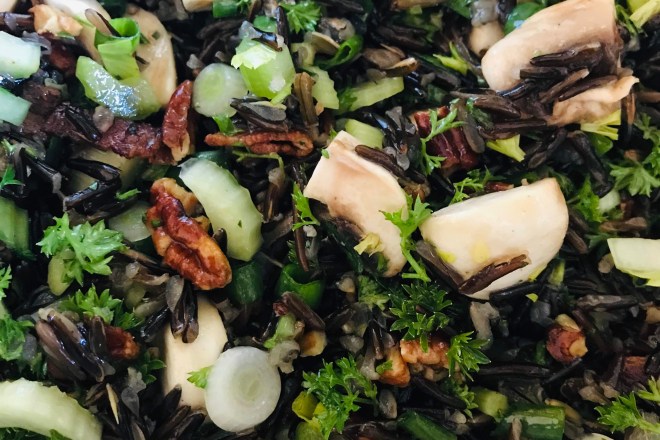
This week we needed a sturdy salad that we could enjoy when we were too tired to cook. This amazing salad will hold for 5 days in the frig and only gets better as the dressing macerates the veggies in the salad. It has crunch, texture, and an appealing nuttiness that compliments the lemony dressing. It’s great for a picnic or potluck, since it’s completely stable with no dairy. I think you will agree it’s a keeper.
WILD RICE SALAD
INGREDIENTS:
2 cups good quality long grain wild rice
6 cups filtered water
1 teaspoon Kosher salt
1 cup toasted pecans, roughly chopped
1 cup celery, chopped
1 cup green onions (white and green parts), sliced thin
Kosher salt and freshly ground black pepper to taste
INSTRUCTIONS:
In a heavy medium pot bring the rice, water and salt to a boil. Adjust heat to medium and simmer until tender, 45-55 minutes. Drain, and place in a large bowl.
To toast pecans, heat oven to 350 degrees F and place on rimmed baking sheet. Toast for 8 minutes. Remove and let cool.
Add celery, green onions. parsley, and mushrooms to bowl. Mix gently.
In a pint mason jar, measure avocado oil and fresh lemon juice, and salt and pepper. Shake vigorously.
Add pecans and dressing to bowl and mix thoroughly. Place in decorative bowl or platter. Crumble bacon on top. Serve.
Serves 6-8
“Truth never damages a cause that is just.” —Mahatma Gandhi
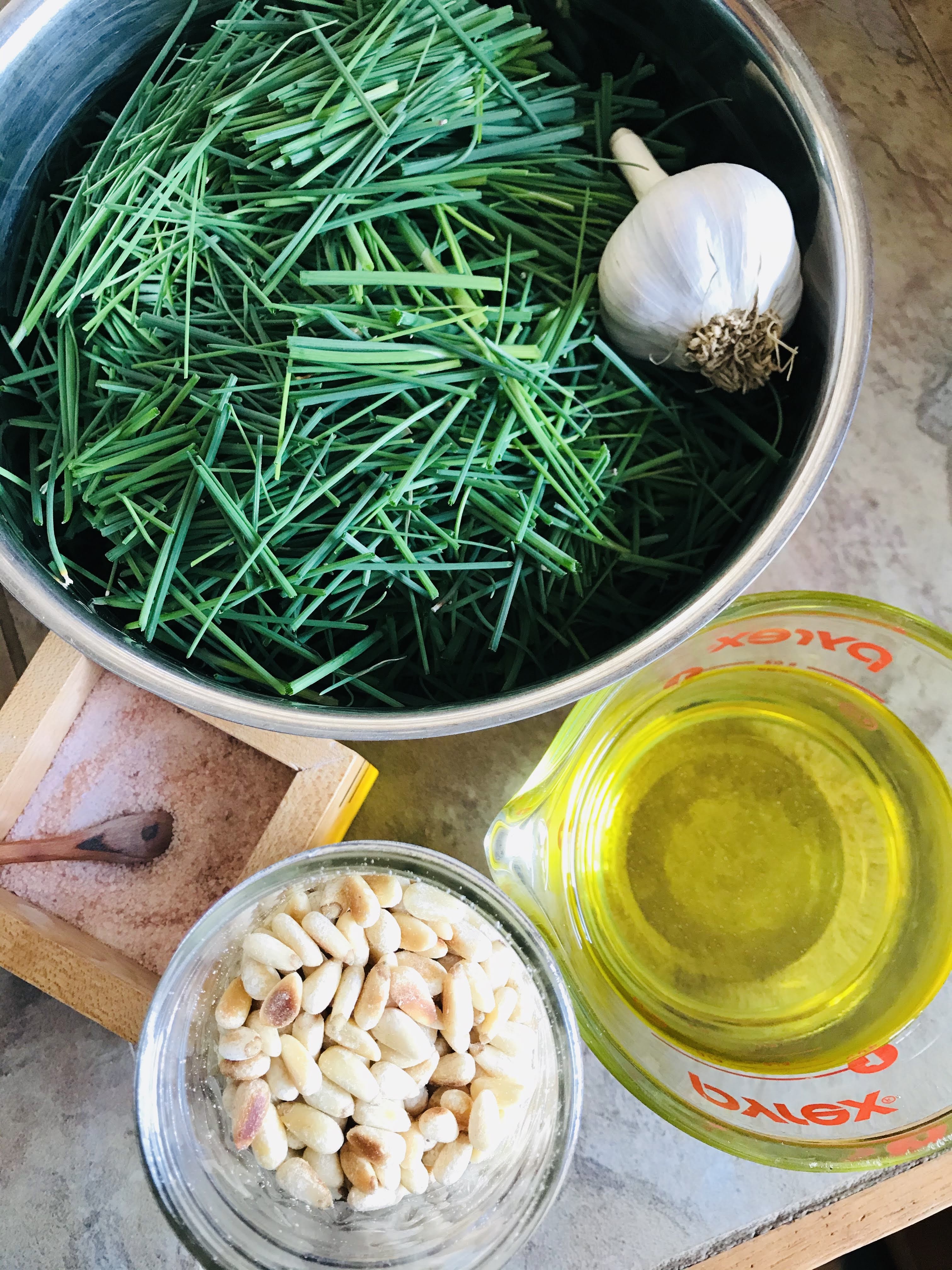
During these times of perceived scarcity, it’s always good to recognize that nature offers up gifts to those who’s eyes are willing to see them. Our land during Civil War times was a brickyard. The clay was ideal for profits from this product and bricks were shipped by rail between Detroit and Chicago. In World War II, the land was turned into an onion farm to help feed the troops. This is where our story begins today, as the land is covered with wild chives by the thousands waiting for someone to notice them. I dry them in our food dehydrator to use in the winter, but the real treat is when they are turned into pesto. Now there are as many pesto recipes as there are cooks, but isn’t it wonderful when you have something randomly growing that can be used? I think so.
This morning I put a teaspoon in my scrambled eggs; whipped it into the eggs with a little half and half and it was delicious. The options for using wild chive pesto are only as limited as our imaginations. Try using it as a base for a vinaigrette, or thinning it with additional olive oil, vinegar and mustard then tossing it with hot red-skinned potatoes for a French take on warm potato salad. Don’t be afraid to add other herbs to it like dill or parsley; it makes a good dip when mixed with sour cream or Greek yogurt. Swirl it into a brothy soup for a touch of spring. I think you’re getting the idea.
WILD CHIVE PESTO
INGREDIENTS:
4 cups cleaned, lightly packed wild chives, cut into manageable lengths with scissors
3 garlic cloves
1/2 cup toasted pine nuts (or walnuts or pistachios)
1 teaspoon sea salt
1/2 – 3/4 cup olive oil
INSTRUCTIONS:
You will need 3-4 4 ounce canning jars ready, as these are perfect size for freezing this pesto. Then with your food processor running, drop your garlic cloves in one at a time until they are minced and clinging to the sides of the bowl.
Open up your food processor and place your 4 cups of lightly packed wild chives in the bowl. Add to this your pine nuts, and salt.
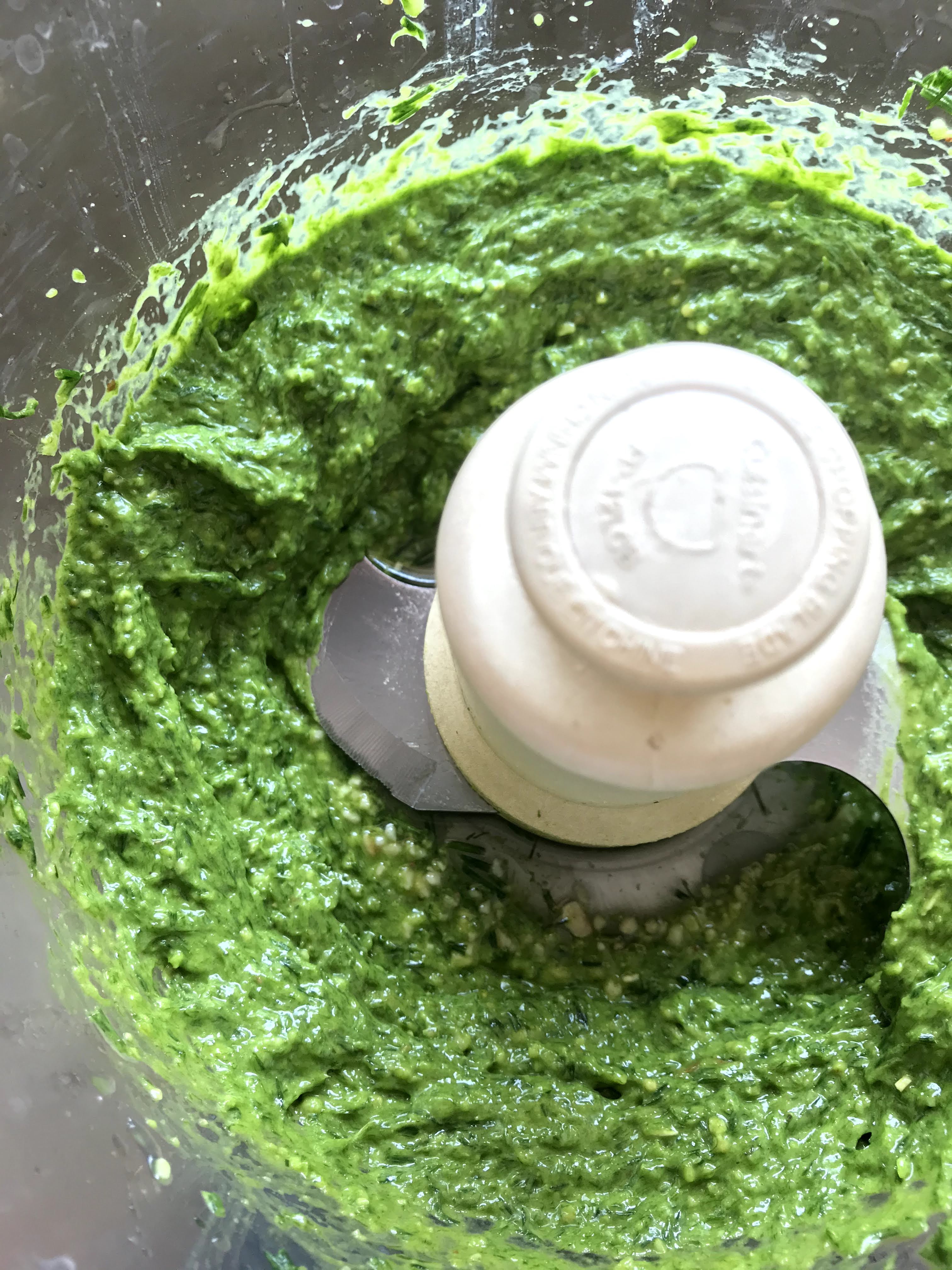
Pulse your ingredients for about 5 times, so they are blended together; then with you processor running, slowly pour in a 1/4 cup of your olive oil. Stop your processor and scrape down the sides of the bowl with a spatula.
Turn your processor back on and pour an additional 1/4 cup of olive oil. Open your processor and check to see if it’s at the consistency you want (I usually look for a loose paste). Taste to see if the salt component is to your liking.
Spoon into 4 ounce canning jars and top with additional olive oil. This will easily keep in the freezer for up to a year.
Yield: 3-4 4 ounces jars
“The real voyage of discovery is not seeking new landscapes, but seeing with new eyes.”
Well, we’ve been self-sheltering for a month now and we are entering that phase of searching through the freezer, pantry and reduced items in the refrigerator. As vegetable farmers we are fortunate that we do a lot of canning and freezing during the optimal summer months; and for that we are grateful. With a little thought and creativity, it’s amazing just what you can come up with that is not only inventive, but delicious!
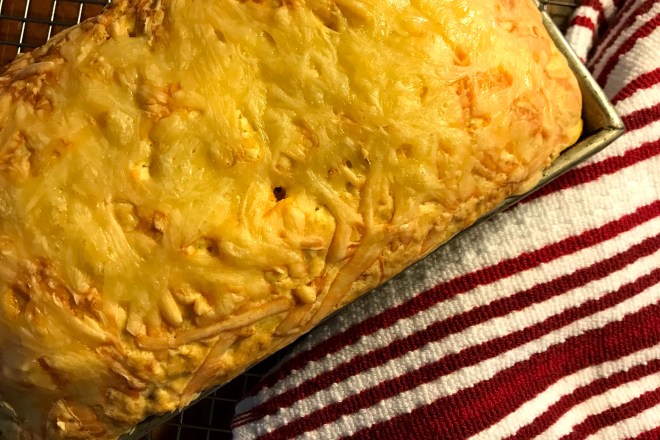
We don’t eat many sweet things in our household. We lean more to the savory spectrum. I can enjoy a quick bread like zucchini or pumpkin as well as the next person; but this….this savory quick bread has multiple options galore. Remember that piece of ham you froze during the holiday’s? Perfect. That hunk on cheese in your refrigerator? Yes! Don’t like Gruyere ? Ok…use cheddar. Those herbs in your crisper that need to be used or composted soon? Yup. Vegetarian? Leave out the ham and toss in some olives, or sun-dried tomatoes. You can make two loaves and freeze one. I love it toasted the next day with butter and a fresh slice of tomato and sprouts. You are only limited by your imagination. Enjoy.
SAVORY QUICK BREAD
INGREDIENTS:
1/2 stick unsalted butter (4 tablespoons), melted and cooled
2 1/2 cups all-purpose flour
1 1/2 teaspoons baking powder
1 teaspoon sea salt
1/2 teaspoon baking soda
1 cup ham, chopped in small cubes
1/4 cup scallions, using both green and white parts, sliced thinly
2 cups (8 ounces) Gruyere, Swiss or cheddar cheese, shredded
2 large eggs
1 cup buttermilk *
Note: If you find yourself without buttermilk on hand, use 1 cup whole milk and add 1 tablespoon lemon juice or white vinegar.
INSTRUCTIONS:
Heat oven to 350 degrees F. Butter and flour a metal 9 x 5 inch loaf pan and set it aside.
In a large bowl, whisk together the flour, baking power, salt and baking soda. Stir in chopped ham (or olives and sun-dried tomatoes), scallions, herb of choice, and all but 1/4 cup of your selected cheese (you will use the rest for topping).
In a separate bowl, whisk together the melted butter, eggs and buttermilk. Add the wet mixture to the flour mixture and stir to combine. The batter will be thick.
Transfer the batter to your prepared loaf pan. Spread batter out evenly with a spatula. Top with remaining 1/4 cup cheese. Bake until the top springs back when lightly pressed, about 45-55 minutes.
Cool on a wire rack for 10 minutes, then remove from loaf pan and let completely cool on wire rack.












 Twisted Basics