Romancing The Garlic

Hard-neck garlic drying

Hard-neck garlic drying

July is garlic time here at our farm,. We’re busy harvesting, cleaning, hanging and selling heady, beautiful hard-neck garlic. It’s an intense time for a small farm such as ours.  Each step of the process is by hand so although time consuming, it’s definitely a labor of love.  There’s nothing quite like fresh garlic and many of our customers buy large quantities. When stored properly garlic can last well into the following year, while adding that welcome punch to so many recipes.  One way to preserve garlic is to make a “confit”.  The French verb confit means “to preserve.” The term confit in our country has come to mean to poach something in fat at a low temperature for a long time.

Peeled garlic ready to poach

Peeled garlic ready to poach

During the growing season I am always looking for ways to preserve and extend each crop.  Many times while harvesting garlic we have ‘dingers’; heads that we accidentally sink a shovel into or rip the roots off by pulling a little too hard.  We collect these and rather than resign them to the compost pile, we turn them into a delicious garlic confit. These make wonderful hostess or Christmas gifts and can be used in a variety of ways. Try them as a dipping oil for crusty artisan bread, add them to bean soups, to pasta, mashed potatoes or even roasted red peppers for a great bruchetta.  The possibilities are endless, limited only by your imagination.  Who wouldn’t love a jar of this liquid gold?

Garlic Confit:

  • 4 cups whole garlic cloves, separated and peeled
  • Small handful of fresh woody herbs (approximately 8-10) such as thyme or rosemary
  • 1 bay leaf, 8 peppercorns, or 1/2 teaspoon red pepper flakes (try different combinations, as these are entirely optional)
  • 3 cups extra virgin olive oil

Place garlic, herbs, oil and any additional ingredients you have chosen in a medium heavy saucepan.  Cover a cook over very low heat for about 30 minutes.  Don’t allow the oil to rise above 200 degrees F.  You may see small bubbles rise to the top.  To check for doneness, take a paring knife and test a clove.  It should be very soft; if not, poach for an additional 10 more minutes.

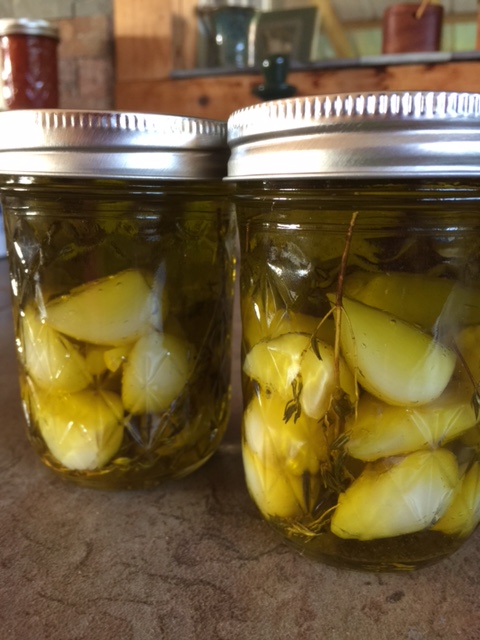
Remove pan from heat, keep covered and allow to cool to room temperature.  Using a clean spoon, divide garlic, herbs and oil among resealable jars. (I use 1/2 pint jelly jars)  Can be kept in the refrigerator for up to 4 months.

Garlic ready to slowly poach

Garlic ready to slowly poach

Liquid Gold

Liquid Gold

“The combination of olive oil, garlic and lemon juice can lift the spirits in winter.”

—Yotam Ottolenghi

Bad To The Bone(less)

Yesterday was hot and humid at market; today our windows are closed after 2.5 inches of rain, with a high of 58 degrees.  Welcome to Michigan!  We have been very busy this week on the farm with planting lettuce, spinach, squash and potatoes.  Today is indeed a day of rest.  I think I have been overdosing on asparagus, so when planning dinner I decided on something fairly easy, yet piquant.  The result:  Chicken Piccata.

Because cutlets are lean and cook in just a few minutes, they produce very little drippings to use in a sauce.  A light coating of flour will act as an emulsifier and thickener, while a simple addition of fresh lemon slices, dry vermouth and capers create the classic piccata flavors.  Because I am gluten-free, I used a 1 to 1 All-Purpose flour from Bob’s Red Mill. Quick, easy, delicious.  Add a simple salad with a homemade vinaigrette and you have a meal that’s healthy and flavorful.

Chicken Piccata:

  • 2 boneless, skinless chicken breasts, cut in half and pounded into cutlets about 1/4 of an inch thick
  • Salt and freshly ground black pepper
  • 1/2 cup all-purpose flour
  • 2 Tbsp. olive oil
  • 1/4 cup dry vermouth
  • 3 garlic cloves, minced
  • 2 Tbsp. fresh lemon juice
  • 1 Tbsp. drained capers
  • 2 Tbsp. unsalted butter
  • 6 fresh lemon slices
  • 3 Tbsp. fresh parsley, minced

Season both sides of cutlets with salt and pepper, then dredge in flour.  Heat a skillet over medium-high, add olive oil until very warm.  Saute cutlets until golden on one side, about 3-4 minutes.  Turn over cutlets and saute the other side, covered for 1-2 minutes.  Transfer to platter.

Deglaze pan with vermouth and add minced garlic.  Cook until liquid is nearly evaporated, about 2 minutes.

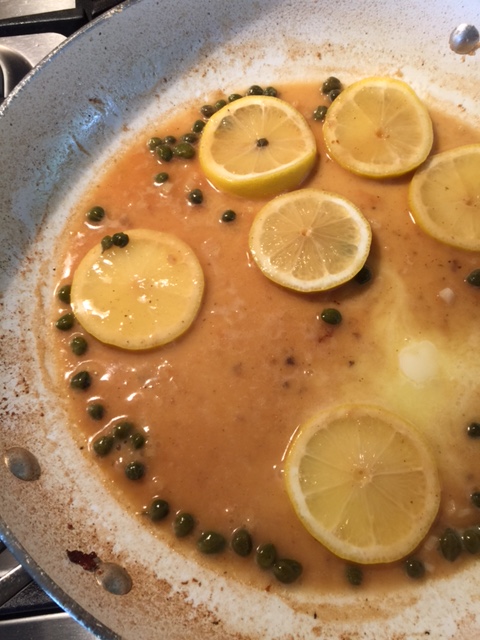
Add broth, lemon juice and capers to pan.  Return cutlets to pan and cook on each side for about 1 minute. Transfer cutlets to warm plates.  Finish sauce with butter and lemon slices.  Once butter melts, pour sauce over cutlets.  Garnish with fresh parsley.

Melting butter with lemon slices

Melting butter with lemon slices

Bad to the Bone(less)!

Bad to the Bone(less)!

“It’s funny that day by day nothing changes.  Yet when you look back everything is different.”

Many Shades of Green

After working in the heat and humidity today, we decided it was high time to remove the storm windows in our screened-in porch.  It’s really our “family room” during the summer.  Our dining room table is temporarily retired and we open the french doors.  It is here that we have our morning coffee, our evening cocktail, eat our meals and play endless games of domino’s. Overlooking the lake, surrounded by trees and our flower gardens, it is our sanctuary at the end of a hectic farm day.

After a shower and Bloody Mary, I wanted to make something in contrast to the heavy humidity of the past several days.  Remembering I had purchased beautiful English cucumbers from Real Food at the farmer’s market on Saturday; it was time to turn them into a refreshing chilled soup.  This is super easy and just right for those night’s when your tired but want something quick and healthy.  The olive oil gives this soup a creamy texture.

Tangy Cucumber Soup:

  • 3 Persian or English cucumbers, ends trimmed and coarsely chopped
  • 1/2 cup Greek yogurt
  • 1/4 cup buttermilk
  • 3 cloves garlic, pressed
  • 3 Tbsp. fresh lemon juice
  • 2 Tbsp. fresh chives, chopped
  • 3 Tbsp. fresh dill or cilantro, chopped
  • 1/2 cup extra-virgin olive oil (omit if you choose to drink this as a smoothie)
  • Kosher salt and freshly ground black pepper to taste

Place all ingredients except the olive oil in a blender.  Puree until smooth.  With the blender still running, gradually add the olive oil until incorporated.  Transfer to a bowl and chill for at least an hour.  Ladle into bowls and garnish with additional dill or cilantro.

Serves 4

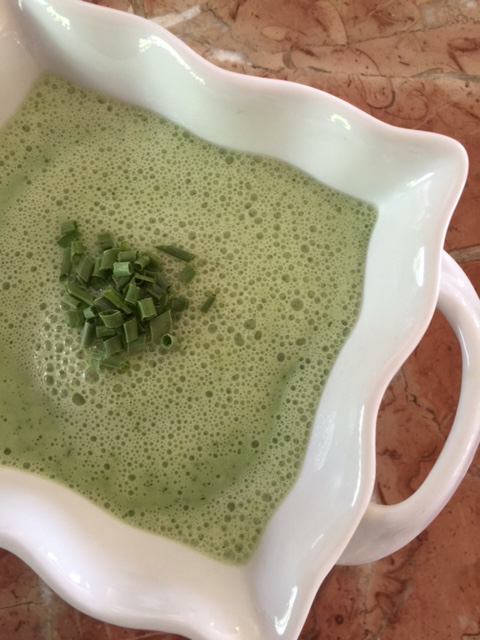
Chilled soup or smoothie, you be the judge

Chilled soup or smoothie, you be the judge


“Live within your harvest.”  —Persian Proverb

Cream Of The Crop

Spring seems to be dragging its feet around here.  One day it’s warm, the next day it’s cool, while the night’s plunge into the low 40’s and occasionally the 30’s.  It looks like our tomato planting is put off another week. Those 2600 little darlings will just have to wait it out in the hoop house until the night temperatures warm up.

The good news is that the rain and warm daytime temperatures are wonderful for glorious spring asparagus!  Do I see a pattern here?  Wasn’t I just making a pronouncement last week that it’s one of the few vegetables I will only use fresh?  Well, that was last week.  We bought 10 pounds to put up, taking full advantage of fresh Michigan asparagus while it’s plentiful now; and boy is it ever!  Nearly every stall at the farmer’s market is overflowing with the stuff.  I know that we will be reminded of our favorite veggie in this wonderful cream soup long after the season is over.

There are many approaches to asparagus soup, but typically the essentials involve asparagus, onions or leeks and chicken stock.  With spring leeks available, that choice was a no-brainer.  However the addition of garlic, fresh spring tarragon and vermouth kick it up a notch.  And of course there’s the cream.  Honestly, it’s decadence is worth the calories!

Cream of Asparagus Soup:

  • 2 lbs. fresh asparagus
  • 4 Tbsp. unsalted butter
  • 4 small leeks, using white and light green parts only, thinly sliced
  • 3 garlic cloves, minced
  • 1/4 cup dry vermouth
  • 4 cups chicken stock
  • 1 Tbsp. fresh tarragon, minced
  • 1 Tbsp. fresh lemon juice
  • 3/4 cup heavy cream

Directions:

Snap off the tough stem ends from the asparagus spears.  Cut the tips off a dozen or so and set aside for garnish. Chop the remaining asparagus into 1 inch pieces.

In a small saucepan, blanch the asparagus tips for 2 minutes, then plunge into ice water.  Let drain on paper towels.  Reserve for later.

In a heavy soup pot over medium heat, melt the butter.  Add the leeks and garlic and saute until tender and translucent, about 3-4 minutes.

Fragrant leeks and garlic

Fragrant leeks and garlic

Getting better all the time

Getting better all the time

Add the asparagus and 4 cups of chicken stock.  Season with salt and freshly ground black pepper.  Bring to a simmer, then reduce the heat to medium-low.  Add the chopped tarragon.  Cover and cook for about 20 minutes.

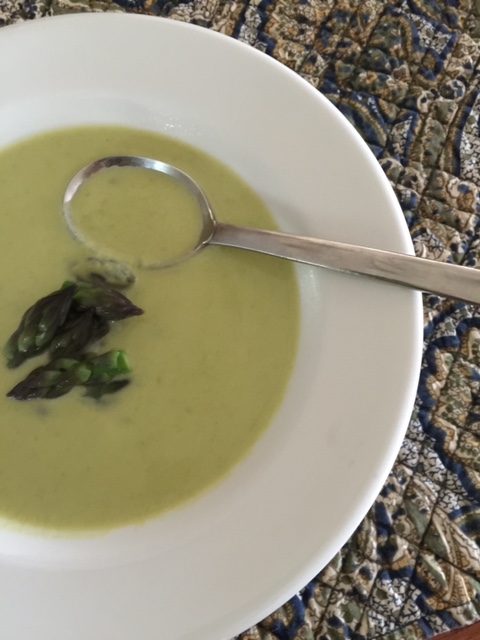
Using an immersion blender, puree the soup until smooth, about 2 minutes. Alternately, you can puree the soup in batches in a blender, then return to the pot.  Add lemon juice and heavy cream.  Reheat the soup to serving temperature.  Ladle in shallow bowls and garnish with reserved asparagus tips.

Tip:  This soup is also great cold, so pack it for your next lunch if you’re luck enough to have leftovers.

Serves: 4

Spring never tasted so decadent.

Spring never tasted so decadent.

“Worries go down better with soup.”

Crazy Love

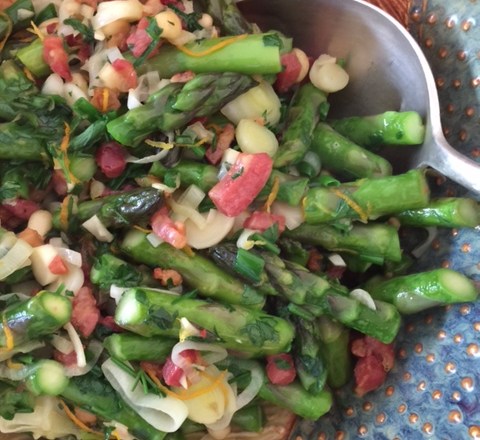
Certain foods simply go together; peas and mint, tomatoes and basil, apples and pork, mac and cheese, fries and ketchup.  Ooops, I digress.  For me the first spring asparagus inspire endless combinations for salads, soups, omelettes and tarts.  Asparagus have always been my favorite veggie; one of the few that I will only use fresh.  In asparagus, texture is everything!  I have found the combination of asparagus, leeks and pancetta to be down right decadent; I mean who needs chocolate?  Ok…maybe for dessert!

I was taught at a young age, that you “eat with your eyes”, meaning all the visual elements in a recipe matter.  The tender-crisp asparagus, smokey pancetta, the buttery leeks;  the dish is greater than the sum of its parts.  The citrus adds a counter-balance to the richness.  Bingo…seasonal, local and delicious.

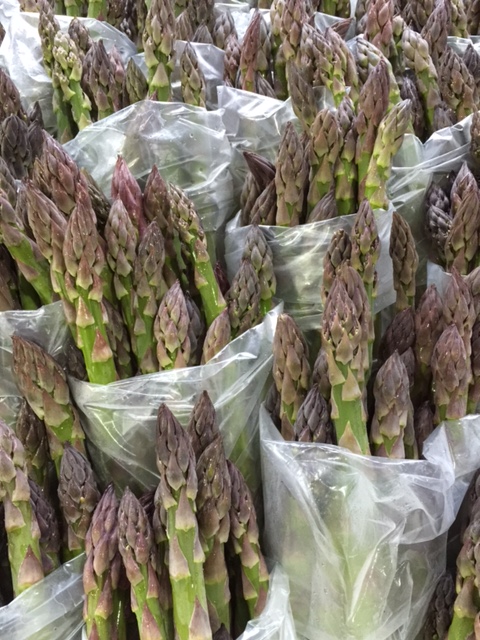
Perfect asparagus from our neighbors at Fulton Street Farmer's Market

Perfect asparagus from our neighbors at Fulton Street Farmer’s Market

Crazy Love Asparagus:

  • 4 oz pancetta, cut in 1/4 inch dice
  • 1 Tablespoon unsalted butter
  • 1 pound asparagus, woody ends trimmed and sliced into 2 inch pieces on the bias
  • 1 1/4 cup leeks, thinly sliced crosswise (white and pale green parts only)
  • 4 cloves garlic, minced
  • Zest of one lemon
  • 2 teaspoons orange zest
  • 3 Tablespoons toasted pine nuts
  • 2 Tablespoons fresh Italian parsley, chopped
  • Salt and freshly ground black pepper to taste
  1. In a large non-stick skillet, saute pancetta, stirring frequently, over medium heat, until crisp and lightly golden.  Drain on paper towels.
  2. Add 1 tablespoon of butter to pan.  Add asparagus and leeks to pan and saute until asparagus is crisp tender, about 4 minutes.
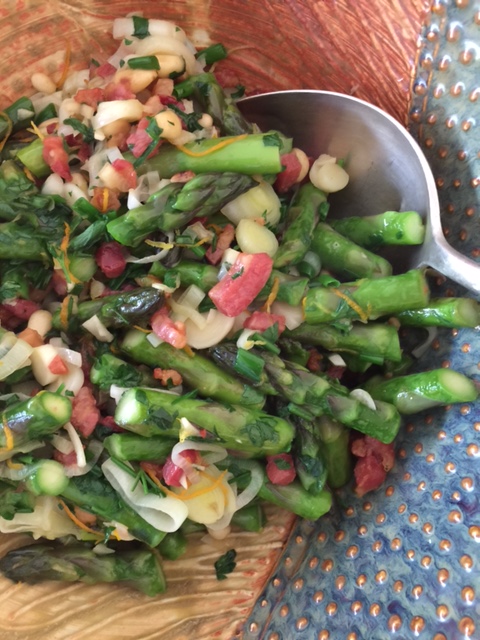
  3. Add in the drained pancetta, garlic, lemon and orange zest, toasted pine nuts and parsley and saute for about 1 minute, until fragrant.  Season to taste with freshly ground black pepper and salt.  Serve immediately.  Swoon.
I just can't stop making this!

I just can’t stop making this!

“It is spring again.  The earth is like a child that knows poems by heart.”

—-Rainer Maria Rilke

Spicy Chicken Little

Spring in Michigan is often a practice in patience.  Just when you think she’s here for good, you wake up to a hard frost or an inch of snow.  Our tomato starts in the greenhouse struggled against stiff north winds and low temperatures.  Yet hope for spring returns when you step inside that greenhouse and are greeted by a bright green hum.  You plant seeds with the hope that each one produces the miracle called a plant.  It’s an exercise in faith.  I could never live in an area of the country where the seasons never change.  Seasons remind me to pay attention to the earth’s rhythms. As farmers, we are hyper-sensitive the many signs that nature provides; our livelihood depends on it.

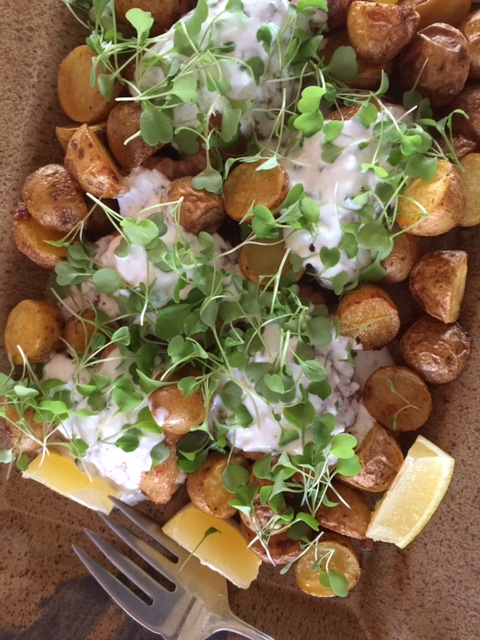
Today, after helping our neighbor Lynne start rehabbing her pontoon, I wanted something simple and fast for dinner.  I love recipes that use ethnic flavors with common ingredients. Inspired by a recipe from the NY Times, I made some slight alterations and came up with a dish that balances warm spices with cool yogurt.  The arugula sprouts and baby potatoes, reminded me of the newness of spring.  You can adjust it to feed a few or a crowd.

Roasted Chicken With Baby Potatoes and Spicy  Yogurt:

  • 2 lbs. bone-in chicken thighs
  • 1-2 lbs. baby Yukon Gold potatoes, halved
  • 2 tsp. kosher salt
  • 1/2  tsp. freshly ground black pepper
  • 3 Tbsp. sriracha or thick hot sauce of your choice
  • 1 tsp. ground cumin
  • 5 Tbsp. extra-virgin olive oil, divided
  • 1/2 tsp. lemon zest, plus 6 lemon wedges
  • 1 cup plain yogurt (not Greek)
  • 2 Tbsp. fresh chives, chopped
  • 3 garlic cloves, pressed
  • 1-2 cups arugula sprouts
Spring fresh, arugula sprouts

Spring fresh, arugula sprouts

  1. Combine chicken and potatoes in a large bowl.  Season with 1 tsp. of the salt and all of the pepper.  In a small bowl, whisk together the sriracha, cumin and 3 Tbsp. of olive oil.  Pour over chicken and potatoes and toss to combine.  Let stand at room temperature for 30 minutes, or up to 8 hours in the refrigerator.
  2. Heat oven to 425 degrees F.  Arrange chicken thighs and potatoes on sheet pan in a single layer.  Roast for approximately 40-50 minutes, or until everything is golden and slightly crisped.
  3. While the chicken cooks, whisk together the yogurt, chives, garlic and lemon zest.  Salt and pepper to taste.
  4. To serve, spoon yogurt sauce over chicken and potatoes.  Scatter arugula sprouts over mixture.  Drizzle remaining 2 Tbsp. olive oil and squeeze a few lemon wedges over the whole thing.  Pass extra yogurt sauce.

Serves: 4

Contrasts in flavor

Contrasts in flavor

“Each experience leaves an imprint, its transformation into something useful is a choice.”

Low and Slow

It’s official, all the ice is off our lake.  The yellow finches are turning color; the sand-hill cranes and Canadian geese have returned to nest along the reeds.  Spring is raising her head in triumph!  Although it might seem early, we have already planted 4000 hard neck garlic, and 6000 onions (only 20,000 to go)! Granted, there are many different varieties in that total, but call us crazy!

Once our growing season starts, our slow-cooker is a godsend.  You can take a shoulder roast, or some other muscular cut and turn it into something so tender, you can cut it with a fork.  We come in with aching muscles and are greeted with the smell of something luscious.  Hot shower, before dinner cocktail and dinner is ready…

Slow-Cooked Brisket and Onions:

Caramelizing onions in Val's grandma's cast iron skillet

Caramelizing onions in Val’s grandma’s cast iron skillet

  • 2 Tbsp olive oil
  • 2 large yellow or red onions, sliced into half moons
  • 3-4 lb grass-fed beef brisket
  • Kosher salt and fresh ground black pepper
  • 6 cloves garlic, minced
  • 2 cups homemade beef stock (you can use organic in a carton also)
  • 2 Tbsp Worcestershire sauce
  • 1 Tbsp tamari
  • 1/4 cup fresh parsley, chopped
  1. Heat a saute pan or cast iron skillet over medium heat with the olive oil.  Add the onions and cook on medium-low, stirring frequently, for about 20-30 minutes or until the onions are starting to turn golden and caramelize.
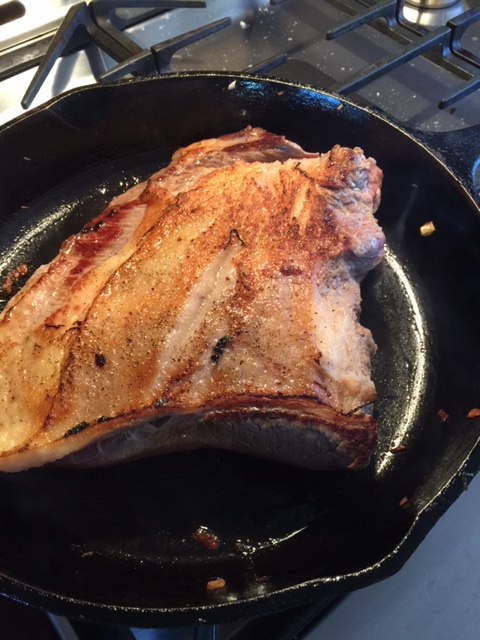
  2. While the onions are cooking, pat the brisket dry with paper-towels and season generously with salt and pepper.  When the onions are done, place them in a bowl and set aside.  Turn the heat up to medium-high (along with your vent or fan).  Sear the each side of the brisket until a golden crust has formed, about 7-10 minutes.  Remove from skillet and place in the slow-cooker.
  3. Sprinkle the garlic over the meat.  Mix together the stock, Worcestershire sauce and tamari and pour into the slow-cooker insert.  Top with the reserved onions, cover and cook on low for 6-8 hours.
Beautiful golden crust

Beautiful golden crust

Garlic and brisket, ready for onions

Garlic and brisket, ready for onions

4.  When the brisket is very tender, turn your slow-cooker to the warm setting for 30 minutes.  If you do not have a warm  setting, remove the brisket from the cooker, place in a baking dish and cover with foil for the same amount of time.

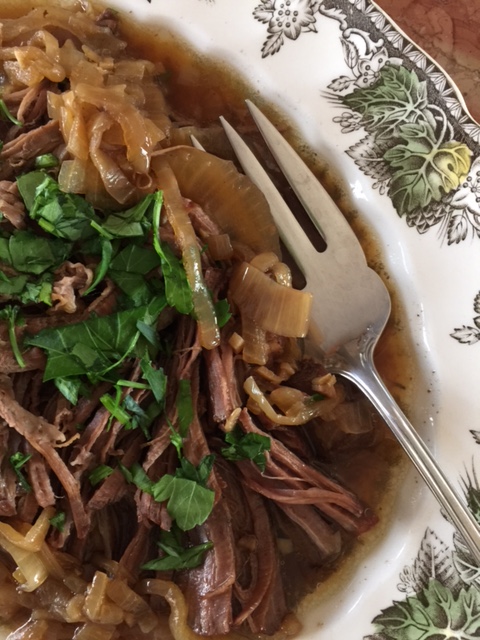
5.  After you have let the brisket rest for 30 minutes, it should be tender enough to take a piece of it, and place in on a platter.  Take two forks and pull or shred the brisket, pulling in opposite directions.  Continue with the rest of the brisket until it is all shredded.  Top with onions and several ladles of au jus from the insert. Garnish with fresh parsley.  Serve of mashed potatoes or rice, with extra au jus on the side.

Succulent, tender, perfection!

Succulent, tender, perfection!

Serves 6-8

Note:  Don’t have a slow cooker?  Cook in a Dutch oven with a tight fitting lid on 325 degrees F for 3-4 hours or until very tender.

“In the spring, at the end of the day, you should smell like dirt,”  —Margaret Atwood

Getting My Spring Back

I sometimes find it difficult to rest when there is so much work to do.  Spring is fast approaching with its intense and frantic schedule. We are poised to start greenhouse planting in two weeks; yet I have not regained the energy level I need to be a full and active partner on our farm.  Anemia is a process that can’t be rushed.  I sleep 10-12 hours each night, eat whole foods and…..wait.  My partner Val moves forward in her typical upbeat way without complaint, doing more than her share and then some.  I am held gently in the home that Val built, as I learn over and over the definition of patience.

There is a rhythm to the heart beat of life.  The ice on the lake doesn’t melt  at the first rise in temperature.  The buds on trees are set in the fall, waiting for the days to lengthen before they swell enough to expose their leaf or flower.  During injury or illness we must nurture ourselves with deep rest, so we can walk before we run.  This requires a certain level of trust in silence, in things unseen, in opening to the rebirth in spring.

Val and I put up a great deal of food during the growing season.  We roast and can dozens of quarts of tomatoes in their many forms, make jams for holiday gift giving, freeze assorted vegetables and fruit.  We do this partly to extend the season; a memory evoked each time we stir a sauce, eat a pickle or spread a jam.  It invites the warmth of the growing season into our home, while the land waits under feet of snow.

Although we are now getting low on our quarts of tomatoes, they were used in many dishes that were shared with friends and family.  In lieu of home-canned tomatoes, use Muir Glenn’s Diced Fire-Roasted which are a wonderful option. The following Lamb Ragu is savory and goes well over pasta (for those who can tolerate wheat) spaghetti squash, zucchini noodles or as we did yesterday sauteed diced zucchini.  Your choice.

Lamb Ragu:

  • 2 lbs grass-fed ground lamb
  • 2 Tbsp olive oil
  • 1 large onion, chopped
  • 1 head garlic, peeled and thinly sliced
  • 4 carrots, peeled and diced
  • 2 tsp dried Greek oregano
  • 2 tsp dried thyme
  • 1 tsp ground cinnamon
  • 1 tsp sea salt
  • 1/2 tsp red pepper flakes
  • 1 tsp freshly ground black pepper
  • 1 32 oz can diced tomatoes
  • 1 15 oz can of tomato sauce
  • 6 small zucchini, sliced lengthwise, then diced
  • pecorino, feta or fresh chopped parsley for garnish
  1. Heat olive oil in large pot or Dutch oven over medium-high.  Add carrots, onions and garlic; saute for 4 minutes or until onion is soft.  Add ground lamb, breaking up meat and incorporating into vegetables; cook for 8-10 minutes or until cooked through and no longer pink.
  2. Add oregano, thyme, cinnamon, salt, pepper and red pepper flakes.  Cook 3-4 more minutes.
  3. Add diced tomatoes and tomato sauce; turn heat to medium-low and simmer for 20 minutes.
  4. While the sauce is simmering, heat 1 Tbsp olive oil in 12 inch skillet on medium-high.  Add diced zucchini and saute, stirring frequently until lightly browned.
Sauteing diced zucchini

Sauteing diced zucchini

IMG_1051

Hot and savory lamb ragu

5.  Place sauteed zucchini in individual bowls, top with sauce and sprinkle on garnish of your choice.

Warm and inviting

Warm and inviting

Serves 6-8

“Take rest; a field that has rested gives a bountiful crop.” —Ovid

Slow Dance Perfection

The snow is melting.  The deck was warm enough for morning coffee.  Bleu chased his Frisbee with abandon.  The slow dance of spring has started.  I’m a turtle personality by nature.  I’ve always preferred slow to fast (except in cars!) and like the length and depth of things in general.  This applies to the transition of the seasons, as well as the time it takes to produce a meat that is tender and succulent.  Although I prefer slow-roasting in the oven during winter; you cannot beat the convenience of a slow-cooker. We even use it during the summer since it doesn’t heat up the kitchen.

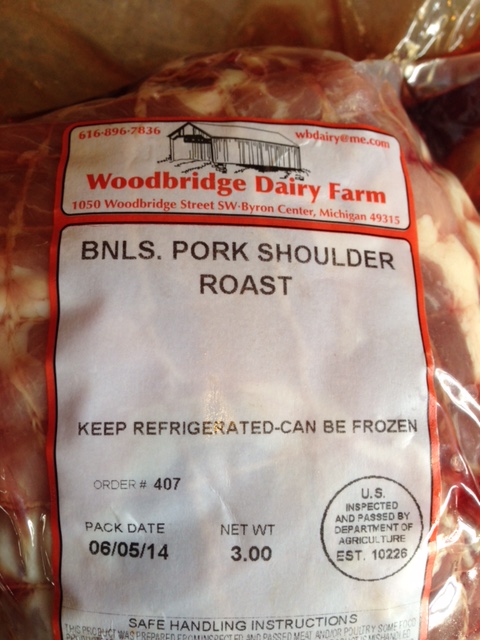
There is something about pork shoulder that makes me salivate.  First of all, it’s versatile; change up the spices and you can pair it up with several cuisines.  My favorites are Cuban and Mexican.  The cut is affordable and you can locate quality milk-fed pork locally.  Karin Uebbing from Woodbridge Dairy Farm has pork shoulders that are a perfect size, running approximately 3 pounds each.  This assures me that the pigs aren’t ancient, and overly fatty. They fit perfectly into a average size slow-cooker and turn into something luscious after 8-10 hours on low.  Bring on the Margaritas!

Brickyard Farms Pork Carnitas With Avocado Lime Dressing:

Healthy milk-fed local pork

Healthy milk-fed local pork

  • 3-4 lbs milk-fed pork shoulder
  • 2 Tbsp bacon grease
  • 1 large onion, chopped
  • 1 head garlic, peeled and sliced
  • 1 cup fresh squeezed orange juice
  • 1 Tbsp sea salt
  • 2 Tbsp ground cumin
  • 1 Tbsp ancho chile powder
  • 2 tsp Mexican oregano
  • 1 tsp green Tabasco sauce
  • 3 Tbsp fresh cilantro, chopped
  1. Smear the bacon grease on the bottom of the slow-cooker.  Pour orange juice over pork. Combine sea salt, cumin, ancho chile powder and oregano and sprinkle on top of pork shoulder.  Sprinkle onion, garlic and green Tabasco over the pork.
  2. Turn on the slow cooker on:  Low for 8-10 hours or High for 4-6 hours.  Once the pork is fork-tender, use two forks to shred the meat into the juices.  Pull out pork with a slotted spoon and place on platter.  Top with chopped fresh cilantro.
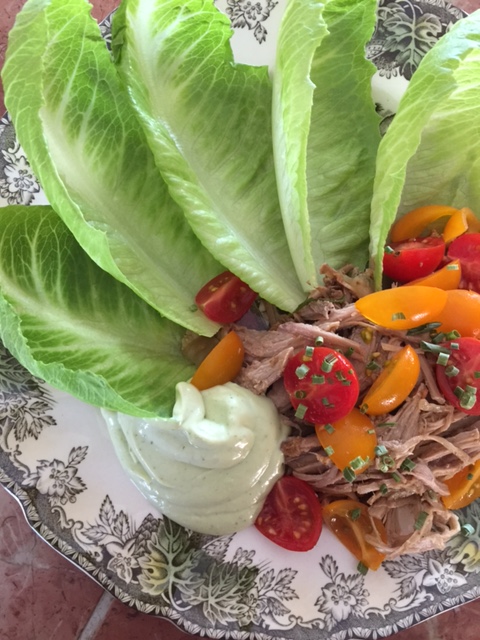
  3. Serve over rice, turn into a salad with chopped avocado, tomatoes and black olives; or make it Paleo friendly and place it on romaine leaves with the toppings of your choice.
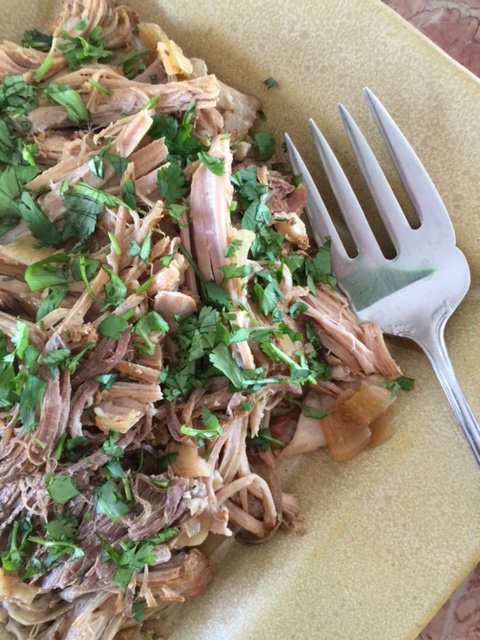
Beautiful, tender carnitas

Beautiful, tender carnitas

Avocado Lime Dressing:

  • 2 ripe fresh avocado, put removed
  • 1/2 cup buttermilk
  • 1/2 cup Greek yogurt
  • 1/2 cup soy-free or homemade mayo
  • 1/2 cup cold water
  • 3 Tbsp fresh lime juice
  • 1 tsp sea salt
  • 2 garlic cloves, pressed
  • 3 Tbsp fresh cilantro, chopped
  • 1/2 tsp ground cumin
  • 1 tsp green Tabasco

Blend in a blender on low until thoroughly blended.

Flavorful carnita salad with avocado lime dressing

Flavorful carnita salad with avocado lime dressing

Carnita shell-less tacos

Carnita shell-less tacos

Perfect Margarita:

  • 1 1/2 oz blanco tequila of your choice
  • 3/4 oz Cointreu or triple sec
  • 3/4 oz fresh lime juice

Rim chilled cocktail glass with lime and salt.  Shake remaining ingredients with ice and strain into glass.

“Life without Mexican food is like no life at all!”  —unknown

Cabbage Rolls Revisited

I love cabbage rolls.  My mother-in-law Elsa made them for me the first time in the early 80’s.  she mixed beef and pork together with onions and rice, placed them in cabbage leaves and tied them with thread.  She called this peasant-food.  Her son John and I called it heaven.  The first time I tried making cabbage rolls I was surprise just how bad I was at getting the leaves separated from the head in one piece.  I kept saying, “It can’t be that hard!”  I decided to get out of the box and approach it differently.  Why not turn it into a casserole I thought?  It would be less time-consuming and we could enjoy it more often.  While I was getting out of the box, I decided to use ground lamb, different spices and feta for a different take on it completely.

3049

Assembling the ingredients

Doing the cabbage ‘rolls’ as a casserole allowed me to follow my own whimsy.  I could shake it up a bit with non-traditional spices and be able to enjoy more cabbage in the process.

Lots more cabbage!

Lots more cabbage!

Cabbage and Lamb Casserole:

  • 1 medium head green cabbage (about 2 lbs), core removed, halved and sliced into 1/2 inch sections
  • 1 lb grass-fed ground lamb
  • 1 large yellow onion, finely chopped
  • 1 large farm-fresh egg
  • 8 oz (1 cup) crumbled local feta
  • 1/2 cup short-grain rice, such as Arborio
  • 1 Tbsp fresh oregano, finely chopped (11/2 tsp dried)
  • 1/2 cup fresh Italian parsley, chopped
  • 1 Tbsp fresh lemon juice
  • 1 tsp ground cumin
  • 1 tsp fennel seeds, crushed
  • Salt and freshly ground black pepper to taste
  • 1 15 oz can diced tomatoes (I use our own canned tomatoes)
  • 1 cup chicken stock (I also used homemade)
  1. Preheat oven to 400 degrees F.  Grease a 13×9 inch casserole dish with ghee.
  2. Cut cabbage in half, core, then slice in 1/2 inch wedges.  Place the wedges in casserole dish so they overlap each other in two rows.
  3. In a large bowl, use your hand to combine the lamb, onion, egg, rice, parsley, oregano, lemon juice, feta, cumin, fennel, salt and pepper.  Place mixture on top of cabbage, leaving a 1 inch space round the sides of the casserole so that the cabbage shows through.
  4. Combine the tomatoes and chicken broth in a medium bowl, then pour the mixture over the meat.  Cover with foil (shiny side down).
  5. Bake covered for 45 minutes.  Uncover and bake an additional 30 minutes.  Let stand 15 minutes.

Serves 6

Ready for the oven

Ready for the oven

New Traditions!

New Traditions!

“A smiling face is half the meal.”  —Latvian quote