Root vegetables

Scandinavian Dauphinoise

Every morning during coffee, Val asks me the same question, “What’s for dinner today?” We go over the fresh vegetables we still have in our larder. When we created our larder for self-sheltering this winter, we chose vegetables with a long shelf-life such as potatoes, sweet potatoes, beets, onions, carrots, cabbage, winter squash and celeriac or celery root. I try to combine fresh with anything that was ‘put up’ during our farm year. Some items are frozen, some canned, others dried, so you can find all sorts of creative ways to make dishes that are unique and delicious. Simple ingredients combined together can yield unexpected results.

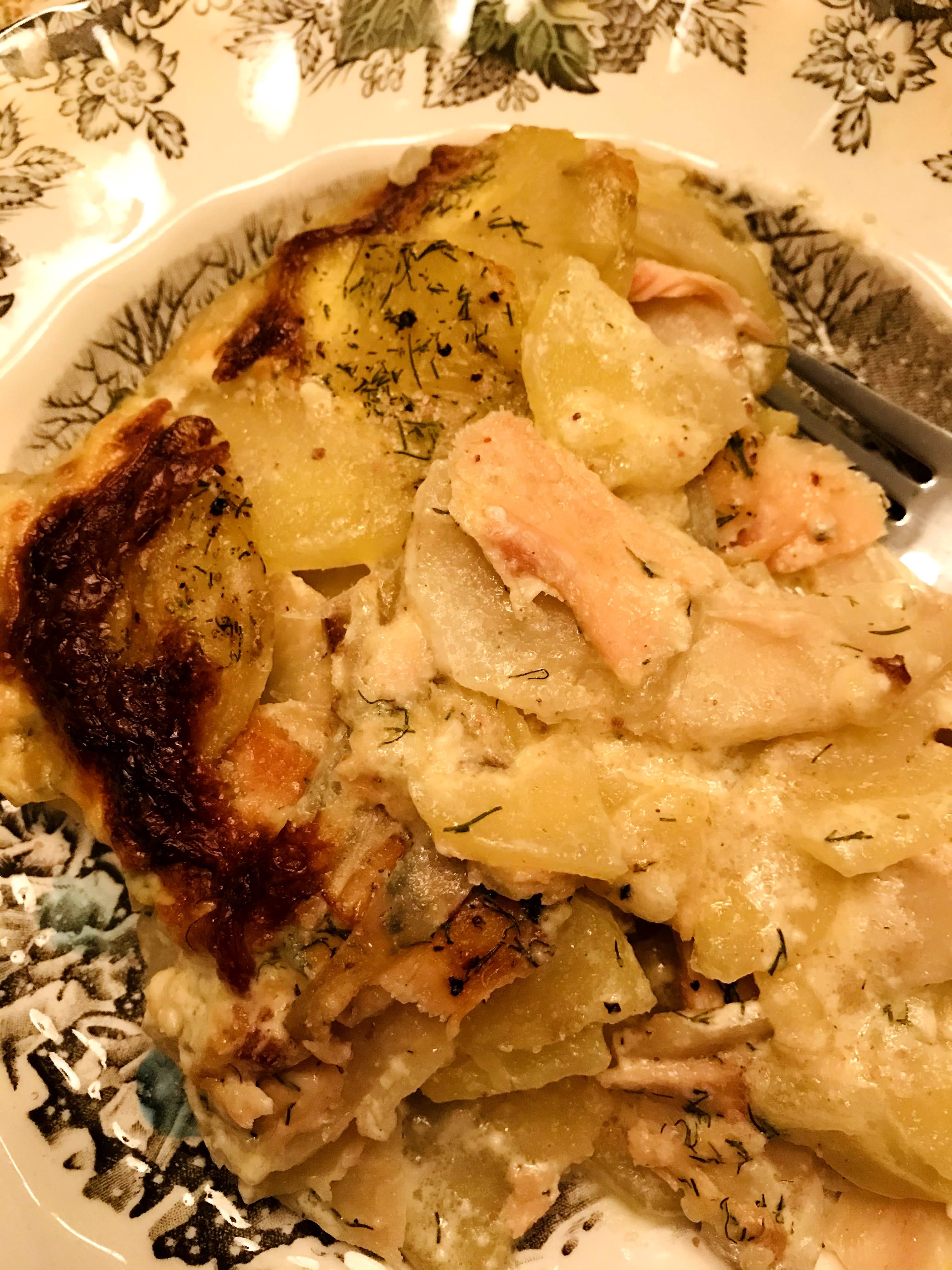
Whenever I am looking for inspiration, I will flip through cookbooks, take a look at what we have on hand, and try to create something that often crosses different cultures. The term dauphinoise (do-fin-WAHZ) is French for scalloped potatoes. Smoked salmon is found throughout Scandinavia. I find that certain combinations repeat themselves regardless of where they originated. In this case, cream with potatoes, onion, and dill with smoked salmon. This gratin, rather than being a side dish for a protein, is totally appropriate as a complete meal. Although you can make this with either cold or hot cured smoked salmon, I like using the cold cured so I can layer it between the potatoes and celeriac. If you choose hot cured, you will have to crumble it. But no worries they both taste delicious. If you have never tried celeriac before, you are in for a treat. It blends beautifully with the other ingredients, with its mild taste of celery, along with providing a nice texture difference. The finished product was surprisingly rich, and flavorful.

SCANDINAVIAN DAUPHINOISE

INGREDIENTS:

  • 1 lemon, juiced, mixed with 1/4 cup water
  • 1 medium celeriac, peeled and quartered vertically
  • 3 medium baking potatoes, peeled (I use Yukon Golds or Russets)
  • 2 x 125g packs of cold cured smoked salmon
  • 1/2 cup fresh dill, chopped
  • 1 onion, halved and finely sliced vertically
  • 2 cups heavy cream (1 pint)

INSTRUCTIONS:

  1. Preheat oven to 400 degrees F. Place the lemon juice and water in a large bowl. On a mandolin, slice each quarter of celeriac 1/4 inch thick. Place in bowl and toss with lemon water. This will prevent it from browning.
  2. Do the same with the potatoes; slicing them 1/4 inch thick horizontally, placing them in the lemon water as well. Toss. In a 9×9 square ceramic baking dish, place slices of potatoes overlapping across the bottom; then layer with slices of celeriac on top of potatoes. Place slices of smoked salmon over celeriac; then slices of onion, followed by dill. Spoon 1/2 cup of heavy cream over the layers, and sprinkle with salt and freshly ground black pepper. Repeat. You should be able to have 3 layers, ending with a layer of potatoes, cream and dill.
  3. Cover the dish with foil and place on a tray. Bake for 45 minutes, then remove the foil and bake for another 30-40 minutes, until bubbling and the top is crispy and golden. Let rest for 10 minutes before serving. Don’t forget a glass of crisp white wine.

Serves 4-6

“Food, like a loving touch, or a glimpse of divine power, has the ability to comfort.” –Norman Kolpas

Deep Roots

As we prepare to self-quarantine for the winter, I am wondering how many people really enjoy being home? What is the meaning of home for each of us? Is it easier to be home as we age? By the time I turned 30, I had already moved 36 times in my life. I remember never really feeling at ease or content when I was at home. The following 36 years I have moved 3 times. I have lived in a rural climate now for 14 years and I find that my sense of place has changed dramatically since I lived in the urban world.

My writing desk overlooks both marsh and lake. I face a large window that beckons I not only write, but rest in this environment. I stare at our bird feeders and the weather for long periods of time. I learn subtleties, and patterns of nature and the seasons. I find this calming; and who wouldn’t want to feel calmer during these days of upheaval?

It seems to me, when I lived in the city I was much more interested and connected to both entertainment and personal possessions. Being pleasing and accepted by people was of prime importance. It wasn’t until I began searching out periods of solitude and quiet that I began requiring those things to stay balanced. As I stay in one place, my roots grow deeper in the soil, providing a vessel for my own thoughts and perspectives. I feel held. My relationship with my wife is nurtured by this sense of place. We have our rhythms and interests that continue the story of this land. We both love the quiet, growing and cooking food along with sharing that food with others. For some, the meaning of roots is about tradition, for us the meaning of roots is about the land, food and relationships. Our relationships are based on mutual respect and love. They are reciprocal in the most fundamental of ways. We have each others backs. We can ask for help, and often it is given without request. There is laughter, discussion and heart. As Joni Mitchell once said, “All we ever wanted was to come in from the cold.”

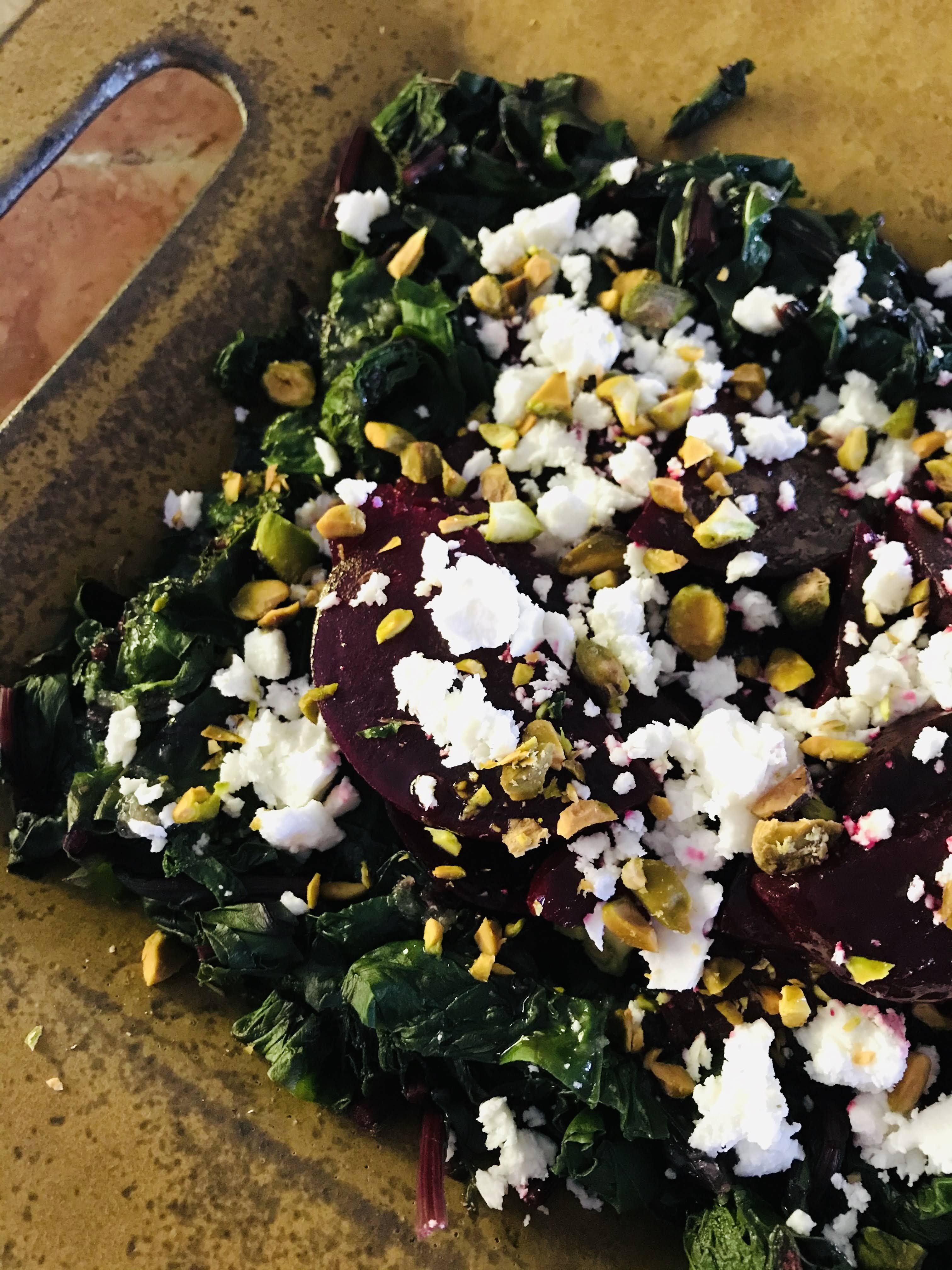
The following recipe has some flexibility to it. I love purchasing (or growing) beets with greens. The greens are beautiful, healthy and add color and interest to this meal salad. If beet greens are not available, arugula or spinach are a good option, but use them raw rather than sautéed. I also enjoy alternative dressing ideas. The basic dressing uses extra-virgin olive oil, red wine vinegar and garlic. Try using extra-virgin olive oil, white wine vinegar and peach or apricot jam. Beets love being pared with stone fruits; or you can use orange juice. Free you imagination to add interest and surprise. If you find yourself out of capers, chop up some olives; and chevre or goat cheese can easily substitute for feta. No pistachios? Try toasted walnuts.

Savory, hearty and delicious

ROASTED BEET SALAD WITH FETA & PISTASCHIOS

INGREDIENTS:

  • 6 tablespoons extra-virgin olive oil
  • 2 1/2 tablespoon red wine vinegar
  • 1 tablespoon minced garlic
  • 7 medium-large beets with greens
  • 1 cup water
  • 2 tablespoons chopped drained capers
  • 3/4 cup crumbled feta cheese (about 3 ounces)
  • 3 tablespoons chopped roasted pistachios
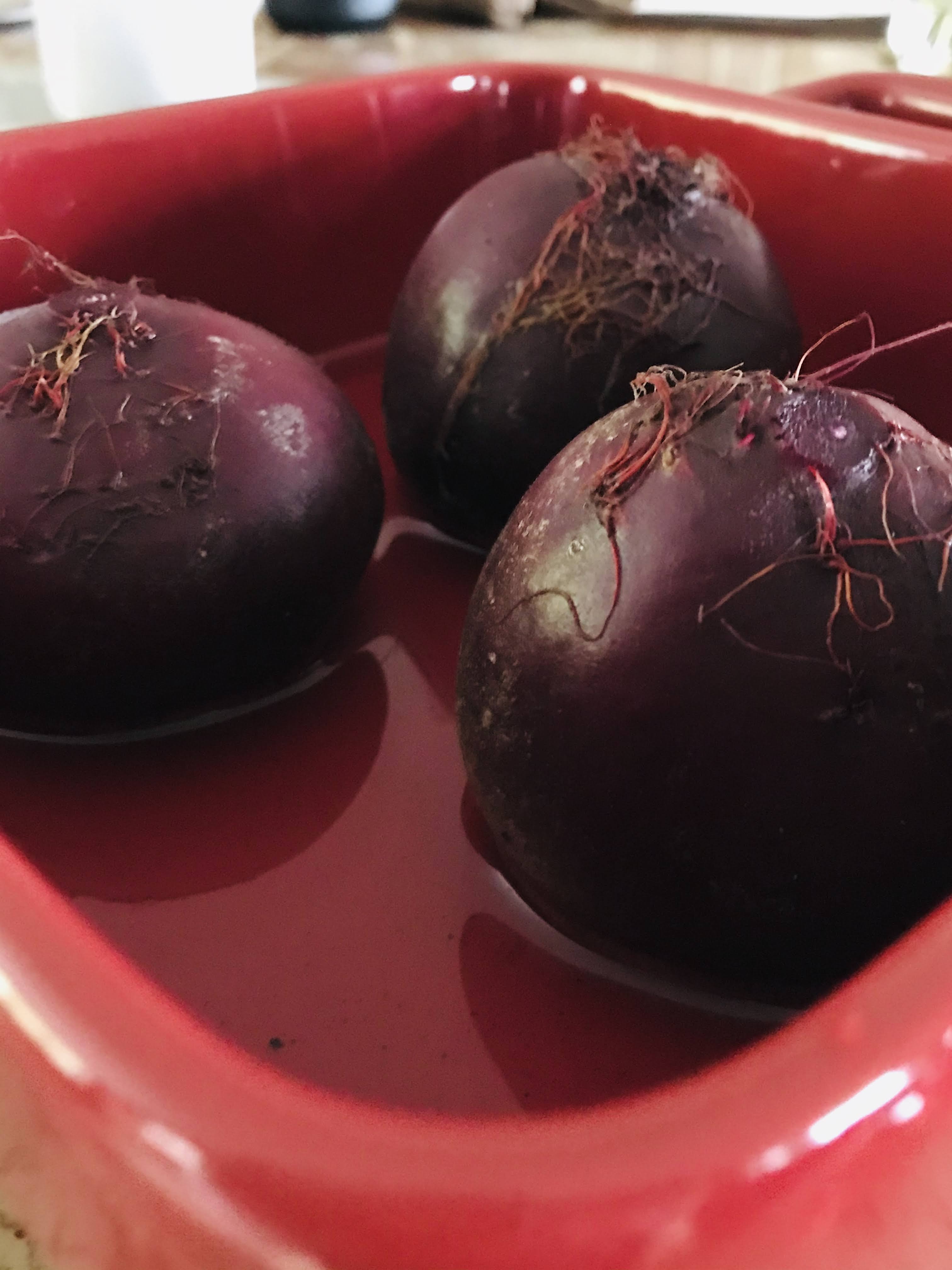
Beets ready to go into oven
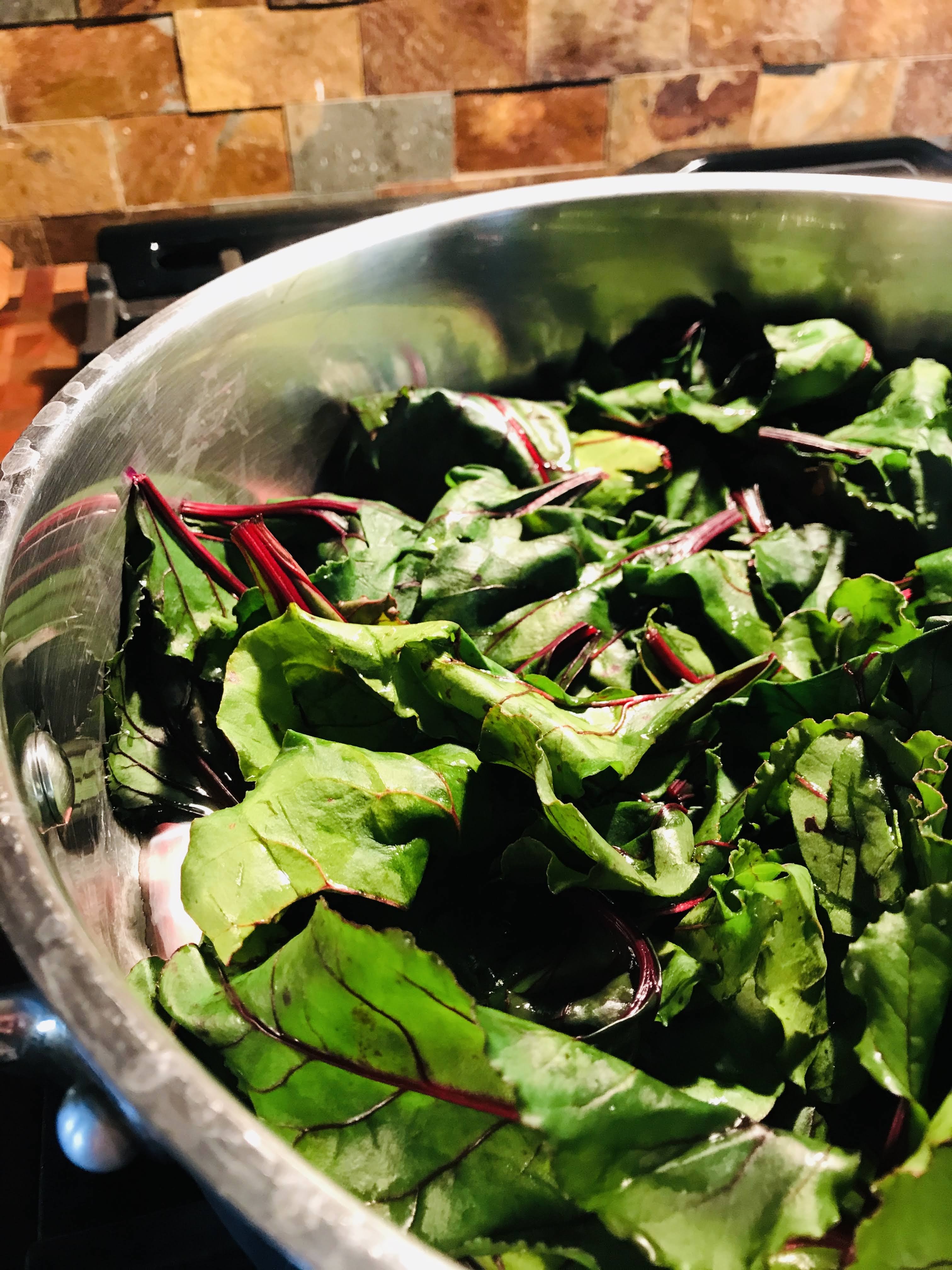
Vibrant beet greens

INSTRUCTIONS:

  1. Preheat oven to 375 degrees F. Whisk oil, vinegar and garlic in small bowl to blend. Season dressing generously with salt and fresh ground black pepper.
  2. Cut tops off beets; reserve greens. Arrange beets in single layer in a baking dish; add 1 cup water. Cover with aluminum foil and bake until beets are tender when pierced with a knife; about 1 hour 15 minutes. Let cool until you can handle them and peel off the skins. I pick them up with paper towels and slip them off.
  3. Cut beets in half and slice thinly. Transfer to large bowl and mix with capers and 1/4 cup dressing. Season with salt and freshly ground black pepper.
  4. Cut stems off beet greens and discard. Wash greens, then with some water still clinging to the leaves, transfer to large pot or skillet. Stir over high heat until just wilted but still bright green, about 4 minutes. Drain greens; squeeze out excess moisture. Cool; chop coarsely. Transfer to medium bowl and toss with enough dressing to coat. Season with salt and pepper.
  5. Arrange beets in center of platter. Surround with greens; sprinkle with feta and pistachios. Drizzle with any remaining dressing.

Serves 4-6

Yum.

“A tree with strong roots laughs at storms. –Malay proverb

Your My Thrill

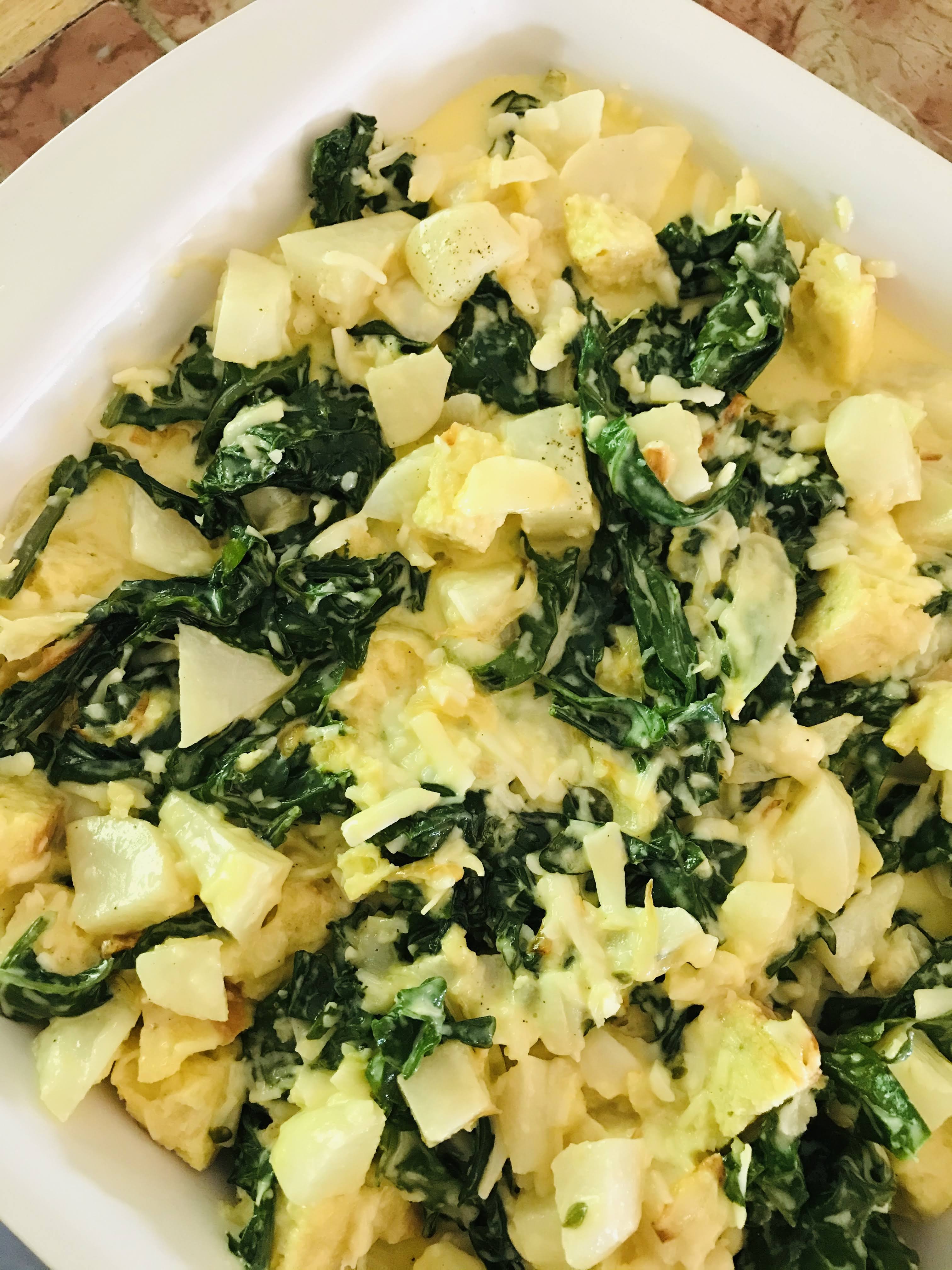
You do something to me! It was so unexpected when it happened. Caught totally off guard, I find I just can’t get enough of my new love! There are so many ways to use these little gems, and this recipe is perfect for a breakfast or brunch. Full of cheese, eggs, kale, cream and bread cubes it is a meal by itself, or if you prefer, with something simple from the grill. Turnips have the added benefit of not being a carbohydrate. They have less than half the calories of potatoes or sweet potatoes; and can easily be swapped out in recipes. So you can literally eat them with abandon!

TURNIP AND KALE GRATIN

INGREDIENTS:

  • 5 cloves garlic, thinly sliced
  • 2 cups heavy cream
  • 1 teaspoon fresh thyme leaves (lemon thyme is wonderful)
  • 2 tablespoons unsalted butter, divided
  • 3 medium onions, thinly sliced
  • Kosher salt and freshly ground black pepper to taste
  • 3 bunches kale, ribs and stems removed, leaves torn (you can use any type of kale, I find Tuscan and Red Russian particularly good)
  • 6-8 medium turnips, trimmed, and cut into 1/2 inch cubes (I don’t peel mine, however if you do feel free)
  • 3 large farm-raised eggs, beaten
  • 1 cup Fontina cheese, grated (about 4 ounces)
  • 1 cup pecorino cheese, grated (about 1 ounce)
  • 2 cups day-old bread such as ciabatta, cut into 1/2 inch pieces

img_6645

INSTRUCTIONS:

  1. In a medium pan, bring garlic, cream and thyme to a simmer over medium heat. Reduce heat to low and continue to simmer for 30 minutes. Let cool.
  2. Meanwhile, heat 1 tablespoon butter in a large skillet over medium-low. Add onions, season with salt and cook, stirring occasionally until they turn a nice light amber color, about 20-30 minutes. Add a splash or two of water if they start to stick to the bottom of your pan. Transfer to a large bowl and let cool. Wipe out skillet.
  3. Heat remaining 1 tablespoon of butter in same skillet. Working in batches, add your kale, tossing and letting it wilt slightly before adding more; season with salt. Cook until kale is wilted and tender, about 5 minutes. Add to bowl with onions.
  4. While kale is cooking, cook turnips in a large pot on well-salted water until crisp tender, about 2 minutes; drain. Transfer to a bowl of ice water and let cool. Drain and pat dry. Transfer to the bowl with onions and kale.
  5. Preheat oven to 375 degrees F. Whisk eggs, Fontina cheese, pecorino cheese, and cooled cream mixture in a large bowl to combine. Add onion and kale mixture, along with bread; season with salt and pepper. Transfer to a 8 x 8 casserole dish and bake uncovered until well browned, 40-50 minutes. Let rest 10 minutes before serving. Gratin can be assembled 12 hours ahead. Cover and chill.

Serves 6

img_6647

“The best things happen unexpectedly.”

Not On My Radar

Today I am grateful. Grateful for living in the country on our vegetable farm. It provides a much needed counterbalance to the daily stress and anxiety of watching our world unravel by the seams. So many things are out of our control; so I focus on the things I can do to live a meaningful life. These include keeping in touch with those I love, planning for an uncertain future, reading, playing games with Val, and above all cooking with as much creativity that I can muster.

If I am an obsessive cook, Val is an obsessive farmer. She loves growing vegetables that are unfamiliar to us. These include some vegetables that don’t necessarily excite me, like turnips. Turnips have never been on my radar. When there are so many vegetables that I love, why grow turnips? When I expressed this to Val she simply said, “Then learn to like them.” She was obviously not detoured. So grow them she did, while I did my part and explored recipes for ideas on how to use them.

I found myself gravitating to recipes that featured them roasted. I figured most vegetables that are roasted are usually sweeter. Really, I didn’t know what to expect, so I tried a simple side dish that roasted them, then tossed them with a vinaigrette while warm; I imagined similar to a French potato salad. It was certainly worth a try. I made a vinaigrette using scallions, tarragon vinegar, whole-grain mustard, extra-virgin olive oil and fresh parsley. I reasoned if I liked everything else in the recipe, I would have a good chance of enjoying them. I butterflied a whole chicken for the grill and we were in business.

I roasted and tossed the turnips with the vinaigrette and the sharpness of the mustard with the vinegar and olive oil smelled wonderful. I went out to finish up the chicken, when Val appeared shortly after with a piece of turnip between her fingers. “It’s time.” she said and popped it in my mouth. Frankly, I was stunned! This was a turnip? This was what I had been avoiding? It was absolutely delicious! Wow. Val stood there with a smirk on her face. “I assume we should grow these again?”

It’s safe to say, I am now a convert. I was so impressed with them I decided that I could use a similar strategy to roast them with chicken. This time I pan-seared chicken thighs, then pan-roasted turnips with fresh tarragon, course mustard, garlic, lemon zest, white wine and chicken stock. I then finished the whole thing covered in the oven for 25 minutes. I have found that turnips love roasting, tarragon and mustard for sure.

ROASTED TURNIPS IN MUSTARD-VINAIGRETTE

INGREDIENTS:

  • 1 tablespoon tarragon or white wine vinegar
  • 2 teaspoons whole-grain mustard
  • 1 scallions, sliced thin
  • 1/2 cup extra-virgin olive oil
  • 2 tablespoons chopped flat-leaf parsley
  • Kosher salt and freshly ground black pepper to taste
  • 24 small or 10 larger turnips, cut in half or wedges depending on size

INSTRUCTIONS:

  1. In a bowl, whisk the vinegar with the mustard, scallion, parsley and 1/4 cup of the olive oil. Season with salt and pepper.
  2. Preheat oven to 425 degrees F. Line a rimmed baking sheet with foil. Cut the turnips in half through the stems if small, quarter or cut in sixths if larger. In a large bowl toss the turnips with the remaining 1/4 cup olive oil and season with salt and pepper. Spread the turnips on the baking sheet and roast for about 18 minutes.
  3. After 5 minutes or so, transfer to a decorative bowl and toss with vinaigrette. Serve.

Serves 4-6

ROASTED CHICKEN WITH TURNIPS, TARRAGON AND LEMON

INGREDIENTS:

  • 3-4 pounds skin-on, bone-in chicken thighs
  • 1 tablespoon extra-virgin olive oil
  • Kosher salt and freshly ground black pepper to taste
  • 6 medium to large turnips
  • 6-8 sprigs of fresh tarragon
  • 1 tablespoon finely grated lemon zest
  • 1 tablespoon whole-grain mustard
  • 4 garlic cloves, thinly sliced
  • 1 tablespoon tarragon or white wine vinegar
  • 1/2 cup dry white wine
  • 1/2 cup chicken stock
  • 1/4 cup heavy cream
  • 1/4 cup parsley, chopped

INSTRUCTIONS:

  1. Preheat the oven to 350 degrees F. Heat a heavy oven-proof Dutch oven on a stove top over high heat. Pat the chicken thighs with paper towels, then rub with the olive oil. Sprinkle generously with salt and pepper. Add to pot and sear 6-8 minutes per side, or until well browned. Remove from pot and set aside.
  2. Turn heat down to medium. Pan roast the turnips, adding a bit more olive oil if needed, until lightly golden. Add the tarragon, mustard, garlic, vinegar, wine and stock. Bring to a simmer. Return chicken thighs to pot.
  3. Transfer to oven and roast for 20-25 minutes or until the chicken is just cooked through. Remove from oven and take out chicken thighs; cover them with tented foil.
  4. Place pot back on stove over medium-high heat. Reduce liquid by a little less than half. Stir in heavy cream. Cook an additional 5 minutes or until sauce starts to thicken.
  5. With a slotted spoon, remove turnips and place on each plate. Top with a chicken thigh; then spoon sauce over both. Garnish with parsley and serve.

Serves 4

img_6639

“This is about trying new things, and getting out of your rut.” — Teri Gault

Earthly Delights

It feels like fall today.  Our weather and climate is unpredictable.  This has been our most unusual farm year.  Vegetables that normally grow without issue have struggled or been unable to grow at all.  This has not been a singular issue.  Many of our customers that have small gardens are wondering why they can’t grow certain vegetable this year.  Although there is no definite answer, as Dylan said, “The times they are a changing.”

Although change is definite, it instructs us to be fully present each day to the small miracles that surround us.  Comfort comes in many forms and simple pleasures can sometimes bring the most well-being.  Today it came in the form of warmth.   Our Katadin potatoes are the old Irish famine potato; earthy, creamy, with thin skins, they are exceptional in taste and texture.  When I first came to the farm I thought that a potato was a potato; until I tasted these remarkable spuds.  If you don’t have access to this particular variety, you can use russets.  It’s important to use a variety that breaks down slightly when cooked.  The advantage is a creamy soup without the use of heavy cream.  Make sure you use fresh dill.  It elevates this soup to something distinctive. Although the ingredients are simple, the soup is heavenly.

POTATO LEEK SOUP

INGREDIENTS:

  • 3 pounds of Katadin (or russet) potatoes, scrubbed and cut into chunks
  • 3 medium leeks, using white and pale green parts, scrubbed and sliced thinly
  • 3 tablespoons unsalted butter (I use Kerrygold)
  • 2 teaspoons sea salt, (I use Maldon)
  • 1/4 cup fresh dill, chopped

DIRECTIONS:

  1. In a large pot, over medium-high heat, melt the butter then add the leeks and saute until soft, about 4-6 minutes.  Add the potatoes and salt; then water to cover the potatoes by about an inch.  Bring to a boil, then turn down to medium and cook until the potatoes are soft. (When using fresh potatoes, be aware that these cook much faster than other potatoes that have been cured, or harvested many months earlier).  Taste for salt, add more if needed.
  2. With an immersion blender, blend the soup to thicken, leaving a far amount of chunks.  Add half of the fresh dill.
  3. Ladle into bowls and top with additional dill.

Serves 4-6

4a35ceb7-e014-4f06-8720-0ce8273eadc3

“There is nothing like soup. It is by nature eccentric: no two are ever alike, unless of course you get your soup in a can.” — Laurie Colwin

The Hummus Among Us

It the world of junk food, it’s comforting to know we can make something substantial, healthy and satisfying: hummus.  Typically this Lebanese dip or spread is made with chickpeas, garlic, tahini, lemon juice, and salt.  But creative people have shaken up tradition but making it with additions of roasted root vegetables such as beets, carrots and red bell pepper.  It’s flexible.  It’s a great source of plant-based protein, decreases inflammation and is good for heart and bone health.  I however love it because it tastes so dam good!

img_4090

SPICY ROASTED CARROT HUMMUS

INGREDIENTS:

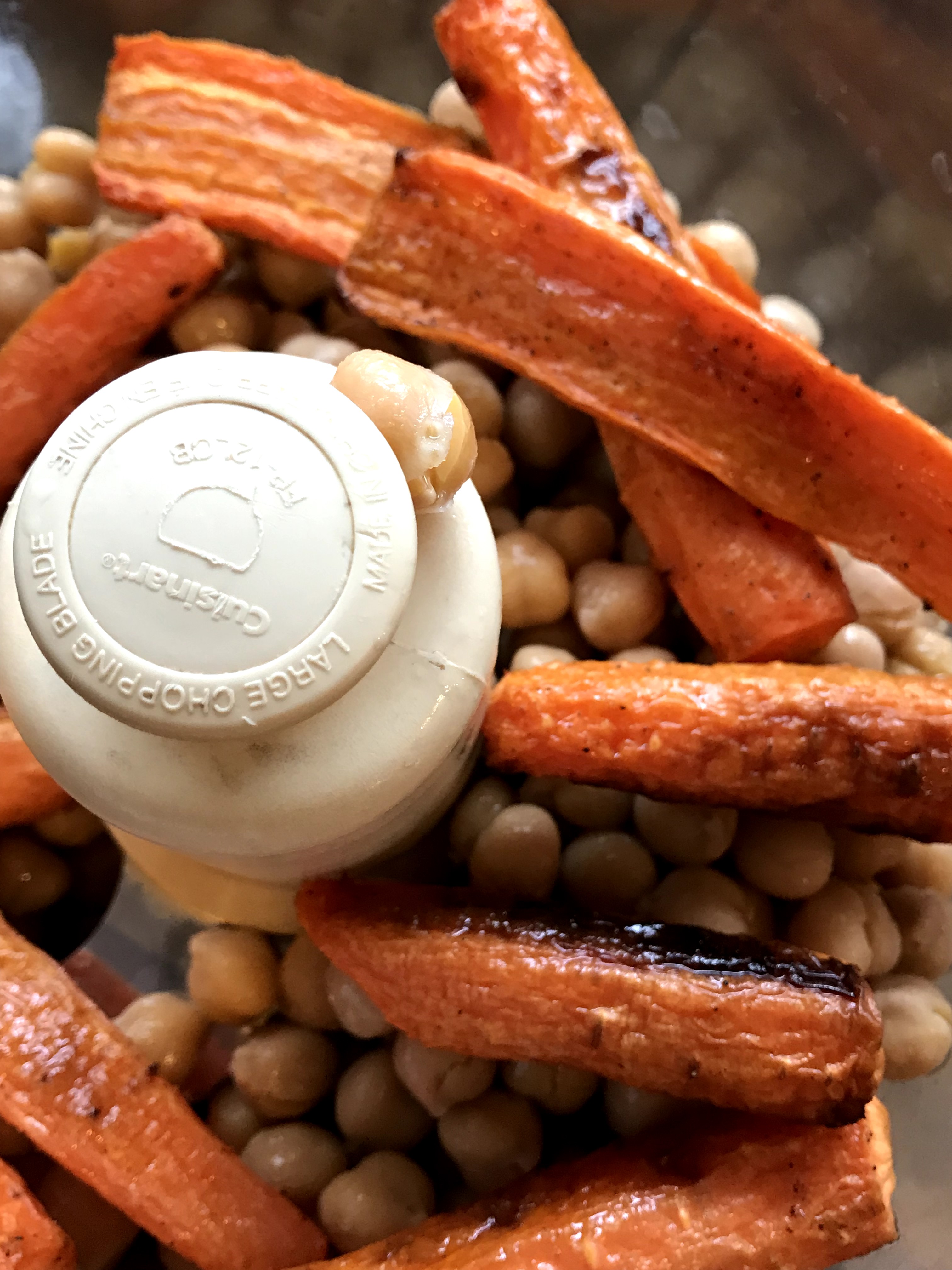
  • 3 large carrots (about 6 ounces), peeled, ends trimmed
  • 1 tablespoon extra-virgin olive oil
  • 1 15.5 ounce can chickpeas, rinsed and drained*
  • 1/3 cup tahini, well mixed
  • 1/4 cup fresh lemon juice
  • 2 garlic cloves, finely grated
  • 1 tablespoon (or more) harissa, Sriracha or gochujang
  • 1 teaspoon (or more) kosher salt
  • 1/2 teaspoon ground cumin
  • 2 tablespoons extra-virgin olive oil, plus more for drizzling
  • Roasted pistachios or toasted sunflower seeds, plus chopped parsley for serving


img_4091


img_4093

DIRECTIONS:

  1. Preheat oven to 400 degrees F.  Place carrots on a large baking sheet line with parchment paper and drizzle with 1 tablespoon extra-virgin olive oil; sprinkle with salt and pepper.  Roast until carrots are very tender, about 40-45 minutes.  Let cool.
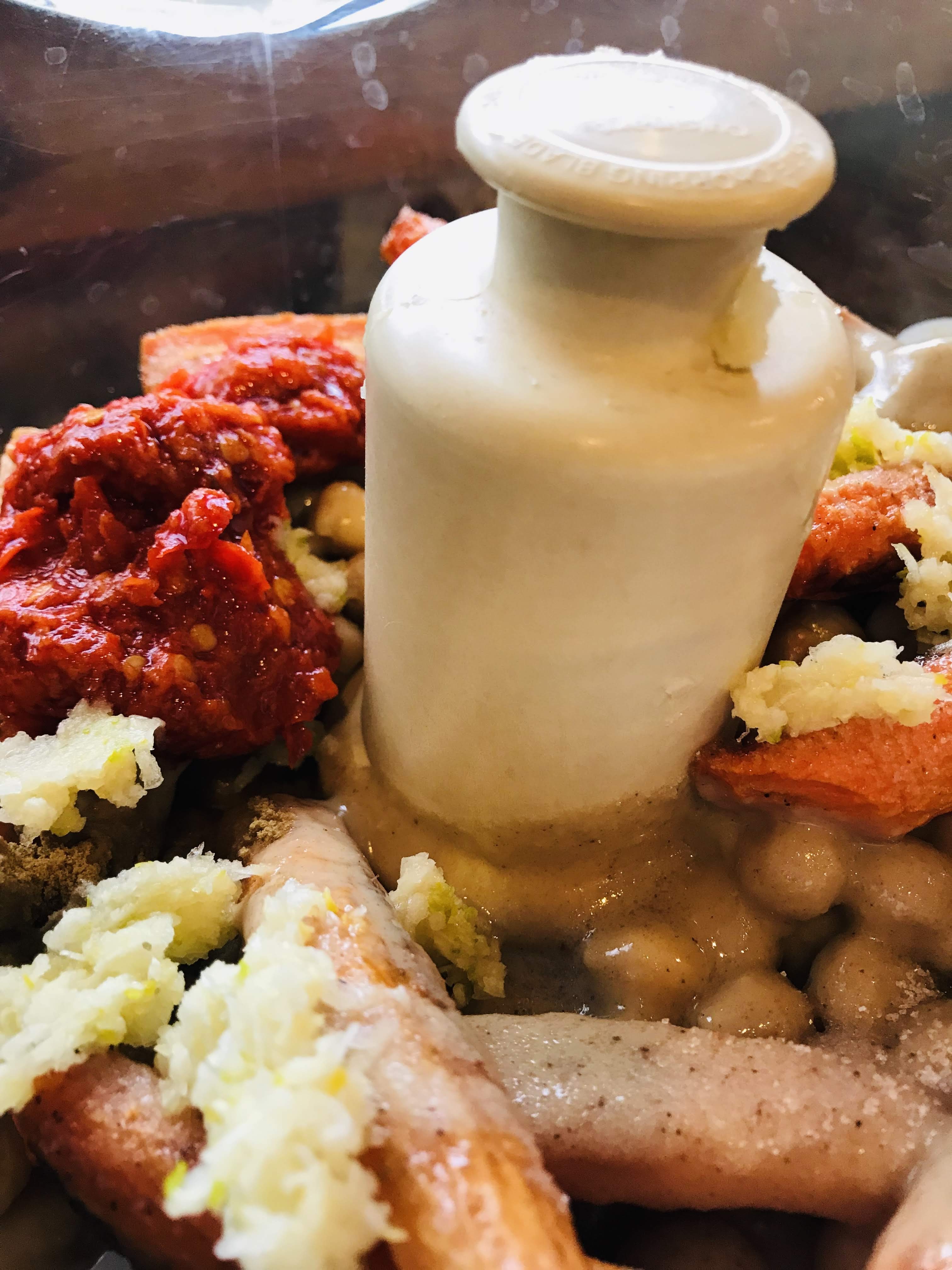
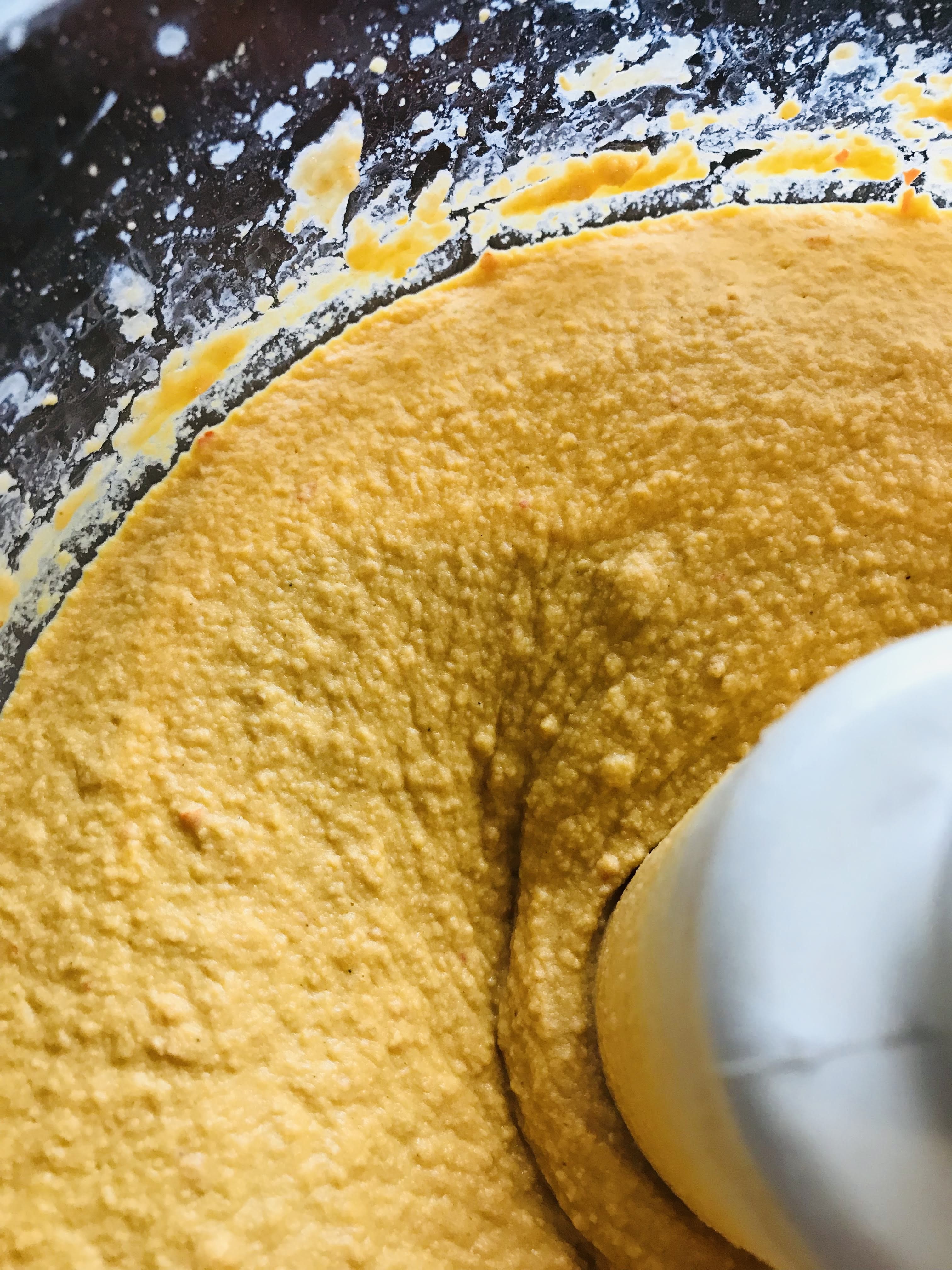
  2. Process roasted carrots, chickpeas, tahini, lemon juice, garlic, harissa, salt, and cumin in food processor until mixture is smooth, about 1 minute.
  3. With the motor running, stream in 2 tablespoons of olive oil, then continue to process until hummus is very light and creamy, 1-2 minutes more.  Taste and season with more salt if needed.  Add more harissa to make hummus spicier if desired, then process to incorporate, a few more seconds.
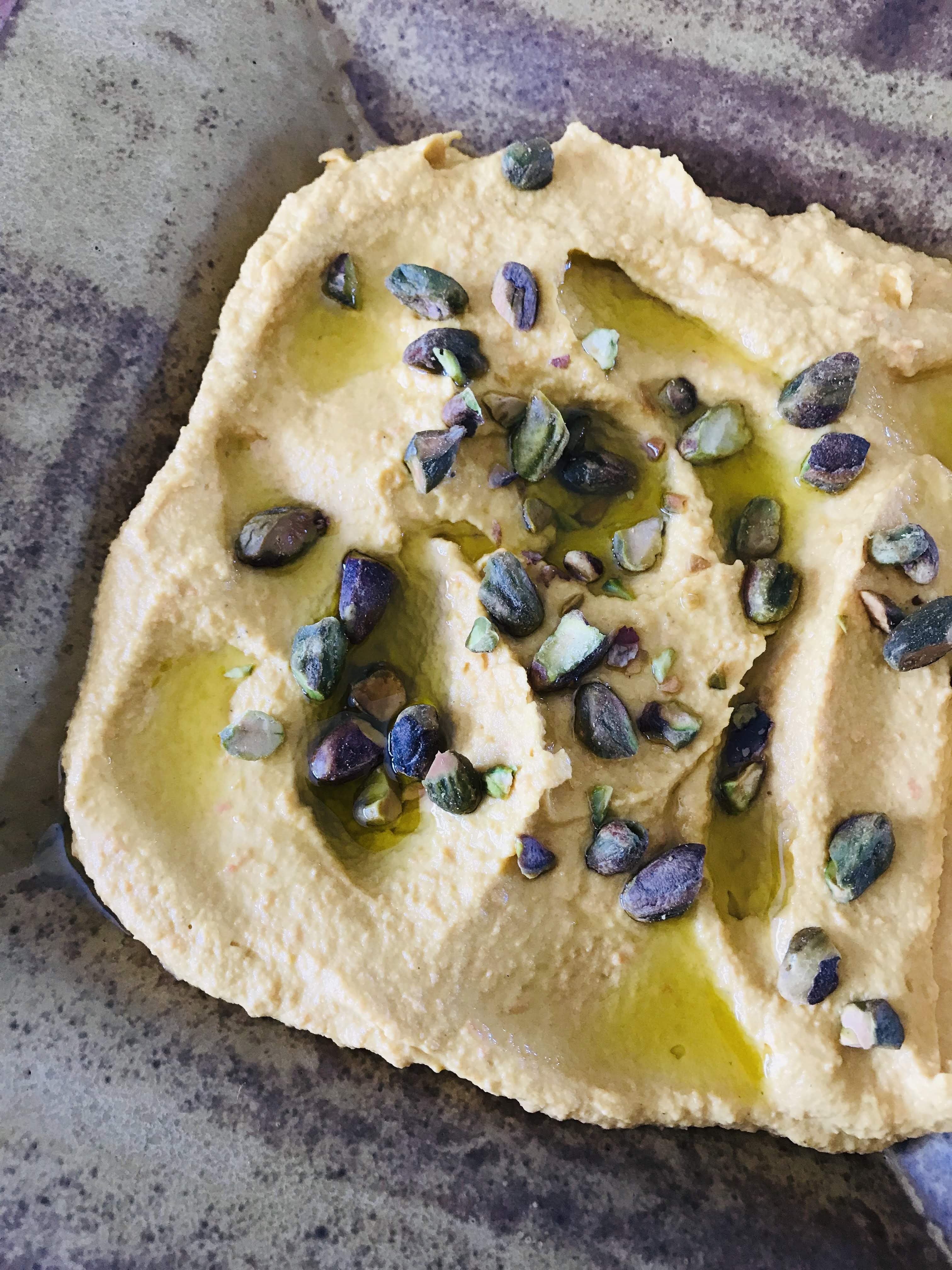
  4. Transfer hummus to a small platter or plate.  Top with nuts and parsley; drizzle with additional olive oil.  Can be refrigerated for about 5 days.

Yield: 2 cups

Note:  If you would like an even creamier hummus, take the time to slide the skins off the chickpeas.  The skins will make the hummus slightly grainy.  If this is not an issue for you, consider it optional.

img_4094

img_4098

img_4131-1

“I can’t turn water into wine, but I can turn hummus into breakfast, lunch and dinner.”  –Rebecca Barum

Beeting the System

While doing some research I came across a staggering statistic: 70% of Americans don’t cook.  That’s right.  Most Americans eat out at least 4 times a week.  We heat up, microwave or assemble food; but cooking from scratch is becoming something of a novelty.  I asked myself, “Are we really that busy?”  I can’t imagine myself not cooking regularly.  For me, it’s my most sincere expression of love.  I wonder if people understand what they are missing?  The kitchen has always been the heart of the home; a place where intimacy takes place, both in the preparation of food and the sharing of it around our tables.  As I contemplate this, I feel as though we’ve been sold a collective bill of goods.  As we scramble to meet our financial needs, we are forgetting some of the fundamental, simple pleasures of life; cooking fresh food with love, for our friends and family.  Isn’t it time we break bread together?

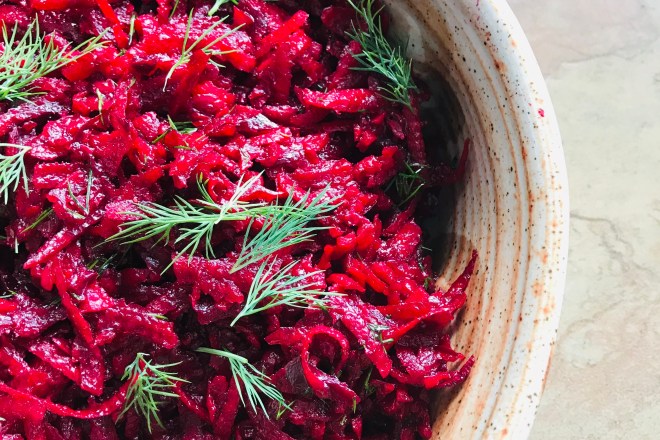
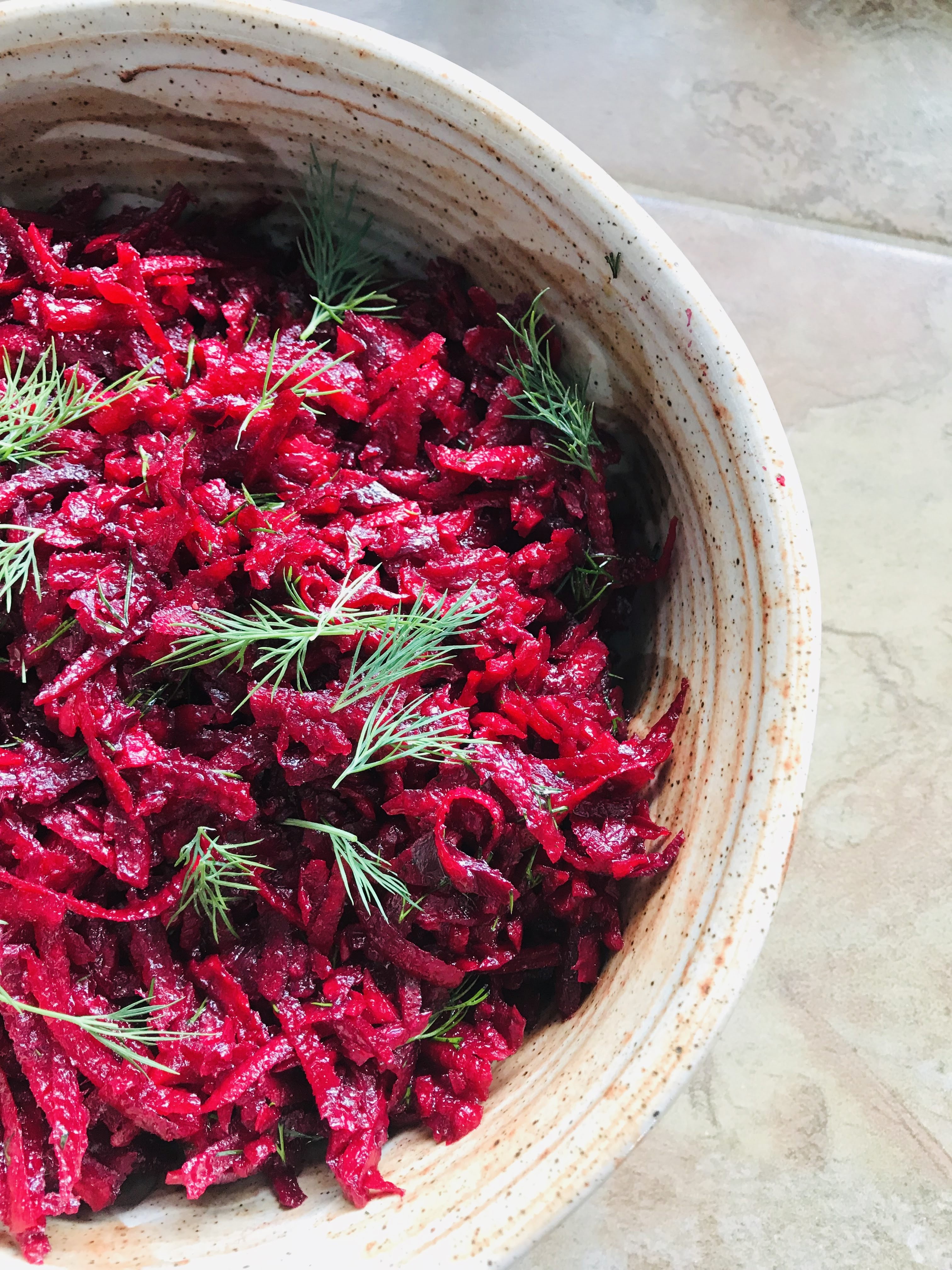
Those of you who have followed this blog or my previous one Basics with a Twist, know I have not been a beet lover until recently.  Alas I have come to my senses.  The first time I  had this salad was as a guest in the home of Kat and Tom Vanhammen.  When she told me what we were having for dinner I remember thinking, “Oh-oh, I’ve never had raw beets and can’t say I was excited about the prospect.  But as a child I was instructed to be a gracious guest and took a serving.  Wow.  Now I can’t leave this salad alone.  I could eat it for breakfast, lunch and dinner.  I make it several times a month.  It’s as though my body literally craves it..

And no wonder!  You simply can’t beat beets!  Your body does love them.  They are chock-full of nutrients like B vitamins, iron, manganese, copper, magnesium, and potassium.  They can lower your blood pressure, lower your risk of heart disease, improve your stamina, help you brain work better, and detox your liver.  Whew.  Now that’s real nutrition!

img_4115

Raw Beet Salad

INGREDIENTS:

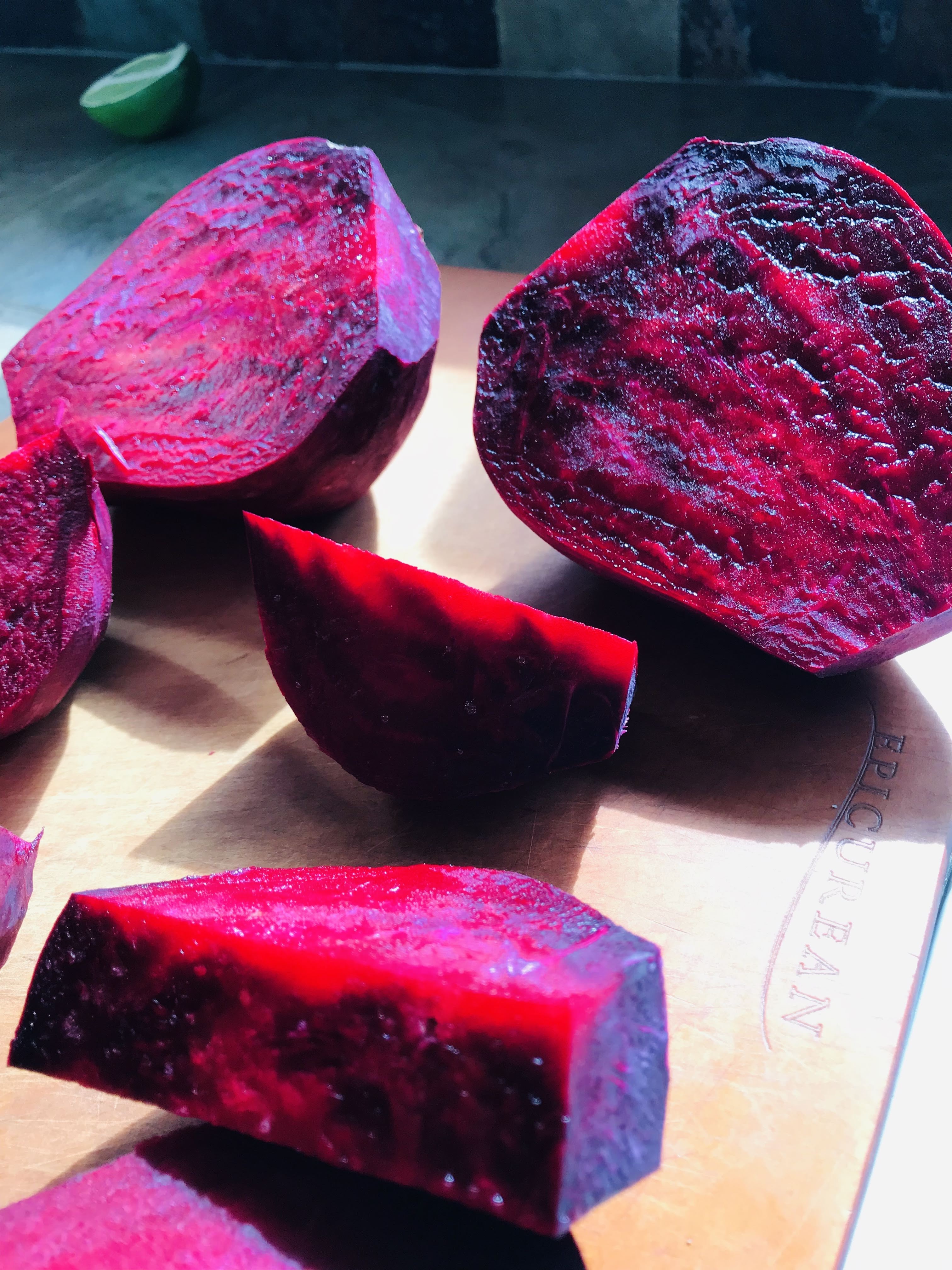
  • 2 pounds of beets, scrubbed and peeled
  • Kosher salt and freshly ground black pepper to taste (don’t be shy)
  • 1/4 cup extra-virgin olive oil
  • 1/3 cup apple cider vinegar (I use Braggs; this might seem like a lot of vinegar, but look at it as a raw pickled beet)
  • 1/4 cup fresh dill, chopped

img_4116

DIRECTIONS:

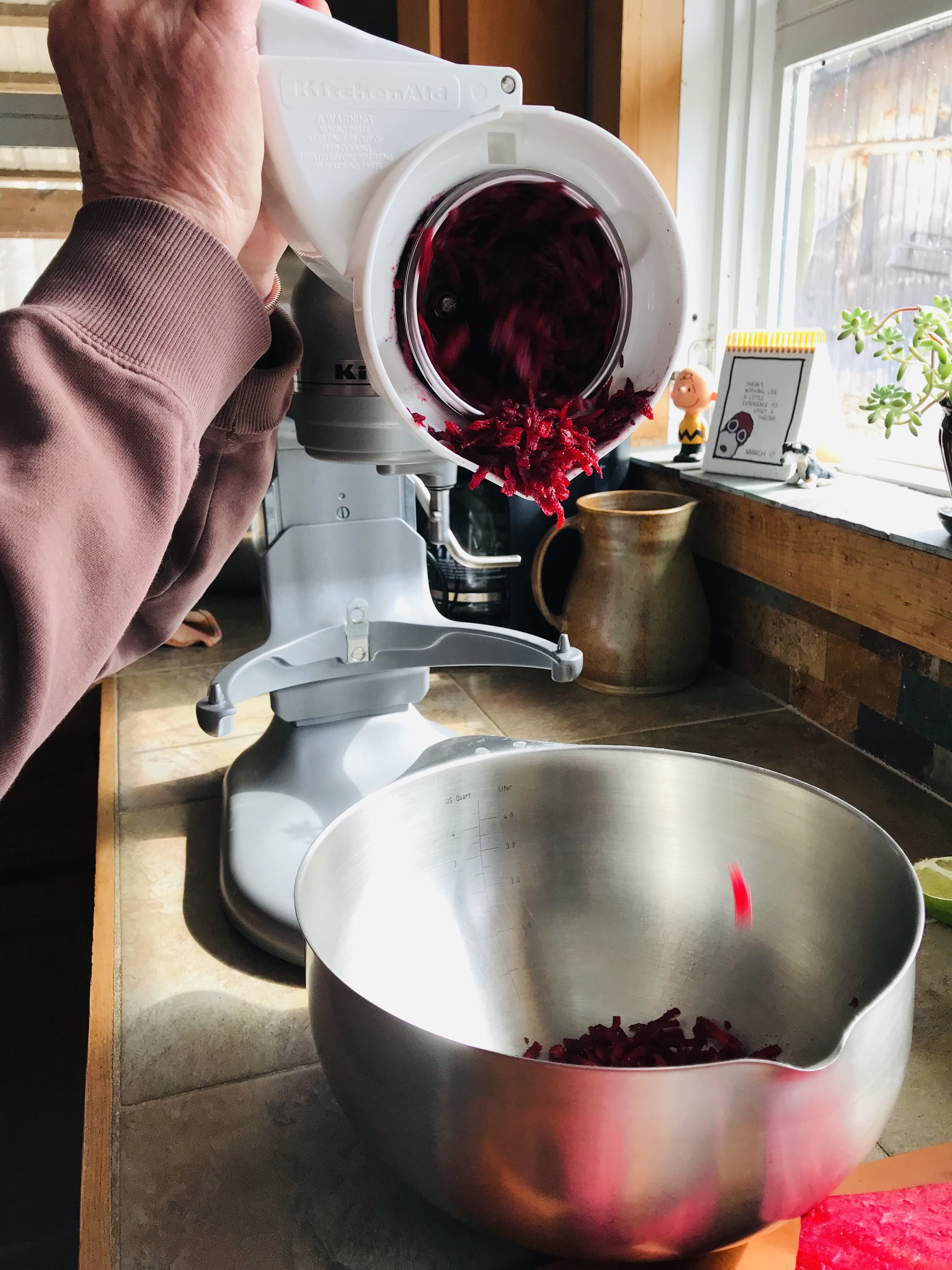
  1. Grate the beets by hand on a box-grater, or food processor fitted with a metal blade or a Kitchen Aid fitted with a shredder cone.  Place in a large bowl.
  2. Toss beets with the salt, pepper, oil and vinegar.  Add chopped dill.  Let the salad macerate on your kitchen counter for about 1 hour.  Taste and adjust with more vinegar, salt or both.  I like mine with a little zing.

Serves 4

img_3992

“The food you eat can either be the safest & most powerful form of medicine or the slowest form of poison.”   —unknown

Confit D’ Oignon, C’est Bon

What’s Confit D’ Oignon?  Why it’s French Onion Marmalade.  Most marmalade’s  or jams are sweet and made from various fruits.  This marmalade has a savory, sweet and tart quality making it an excellent condiment for many things.  I love putting up assorted foods ahead of time.  There’s something special about pulling something from your pantry that you have canned yourself.  Onion marmalade is very easy to make and believe me adds something unique to you repertoire.  This makes an incredible holiday or hostess gift; not to mention surprising your friends and family with the unexpected.

I enjoy making onion marmalade with red onions, but you can also make it with yellow or white; just make sure to change out the red wine and red wine vinegar for white vermouth and white wine vinegar.  This can be canned or frozen depending on your preference.  I prefer to can it so I can give it as a gift that I don’t have to worry about thawing.

I strongly recommend that if you tackle this recipe, consider double or tripling it.  The time is mostly spent reducing and cooking it down to syrupy deliciousness.  It’s wonderful on beef or duck as a condiment.  My favorite way is a slice of toasted or grilled baguette, topped with fresh chevre and then onion marmalade.  Or try sauteed greens, feta, poached egg and top with a bit of the onion marmalade.  Then there’s topping a circle of brie with onion marmalade, wrapping it in puff pastry, then bake.  C’est bon!

IMG_3980(Edited)

INGREDIENTS:

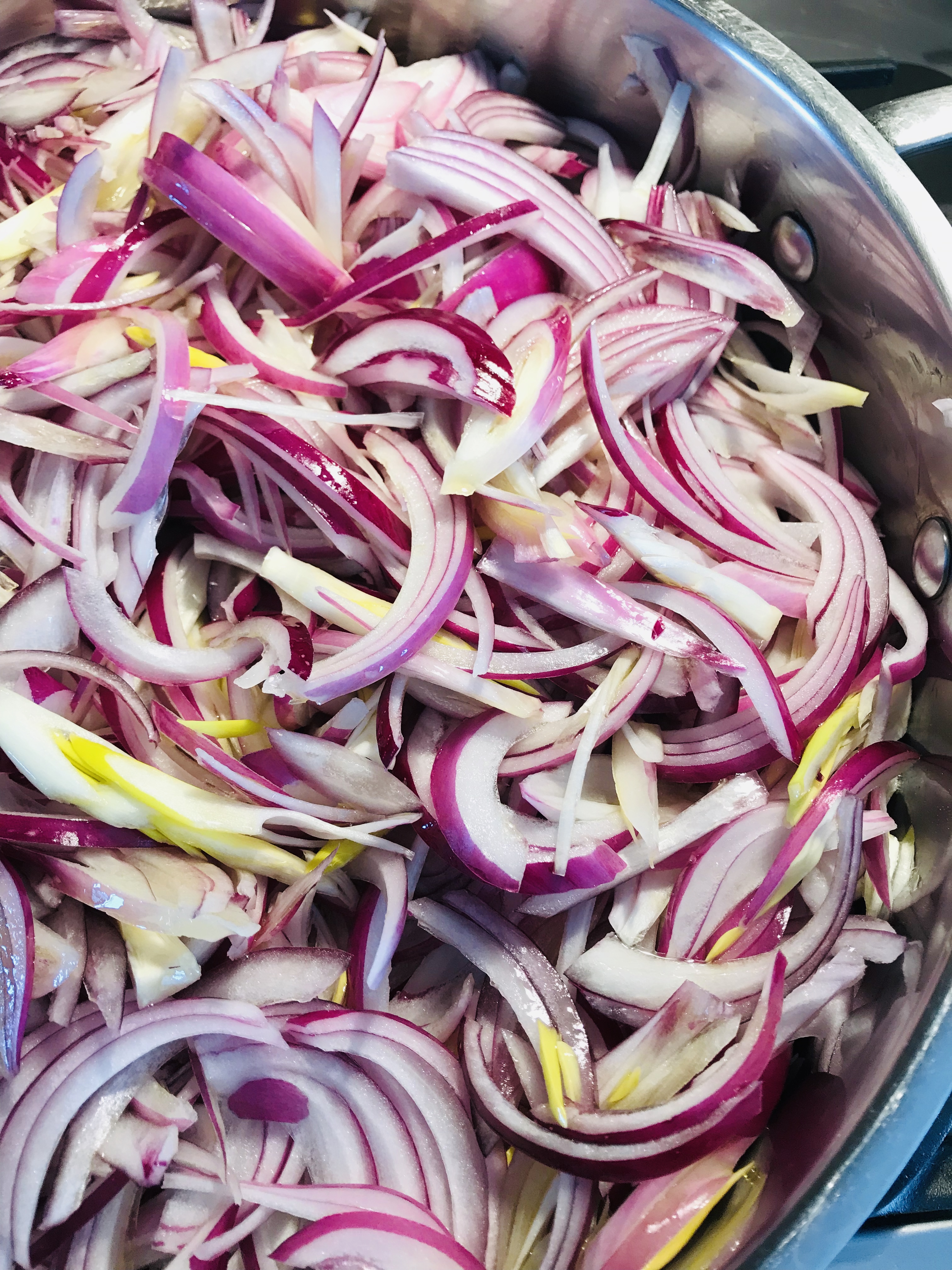
  • 3 large red onions (or 6 medium), peeled, cut in half lengthwise, and thinly sliced
  • 1/3 cup extra-virgin olive oil
  • 1 teaspoon kosher or sea salt
  • 1/2 teaspoon freshly ground black pepper
  • 2 bay leaves
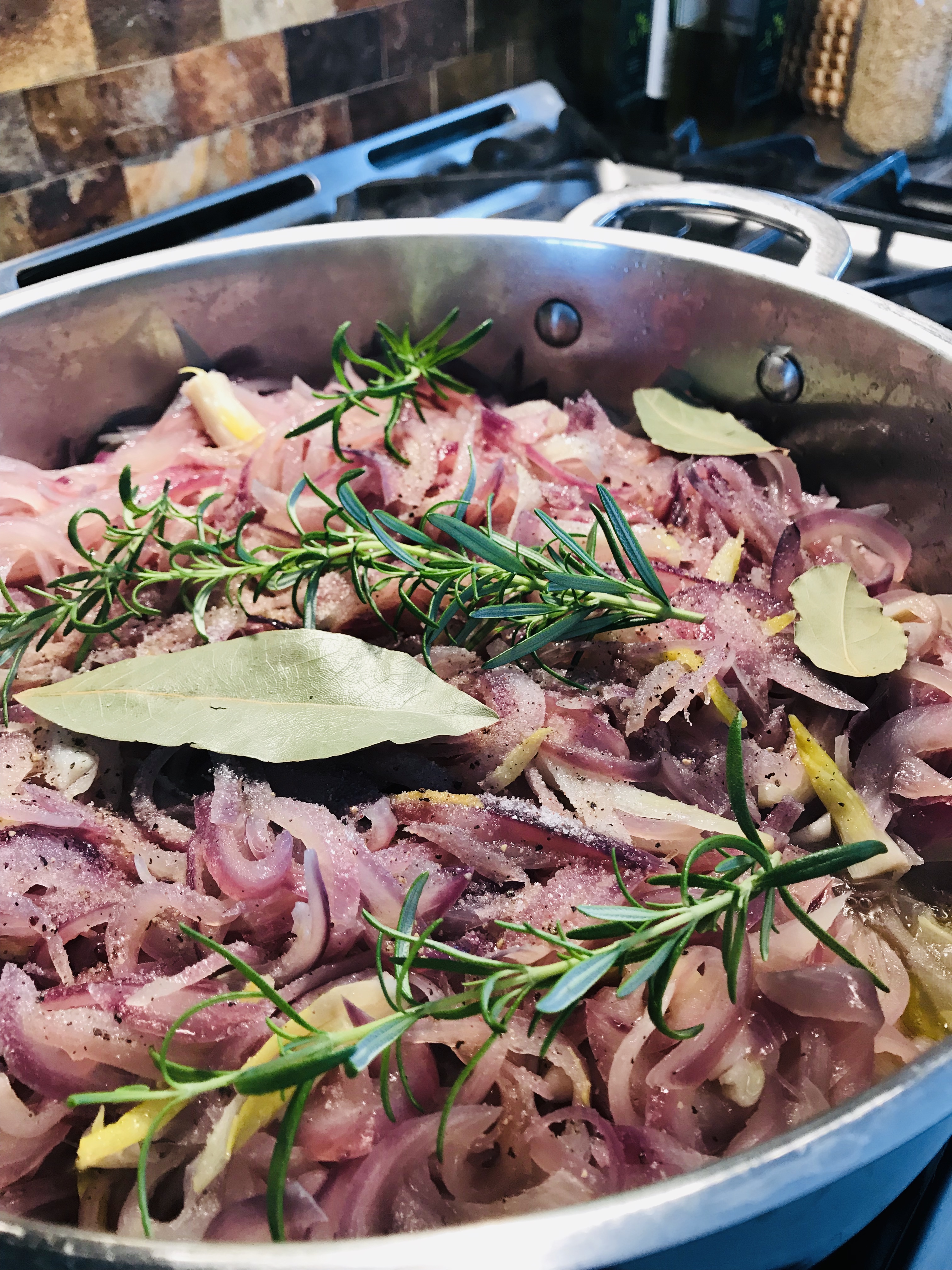
  • 2 fresh rosemary sprigs
  • 2 tablespoons brown sugar
  • 1/3 cup dry red wine (I use Cabernet)
  • 1/3 cup red wine vinegar
  • 2 tablespoons balsamic vinegar

IMG_3981(Edited)

DIRECTIONS:

  1. In a large heavy skillet over medium-high heat, add your olive oil and sliced onions.  Toss them around to make sure they all have a coating of the oil.  Reduce heat to medium and cook, covered until they start to color; about 10-15 minutes.
  2. Add the salt, pepper, bay leaves and rosemary.  Cook, stirring occasionally, for 20-30 minutes, or until the herbs have become soft and wilted.
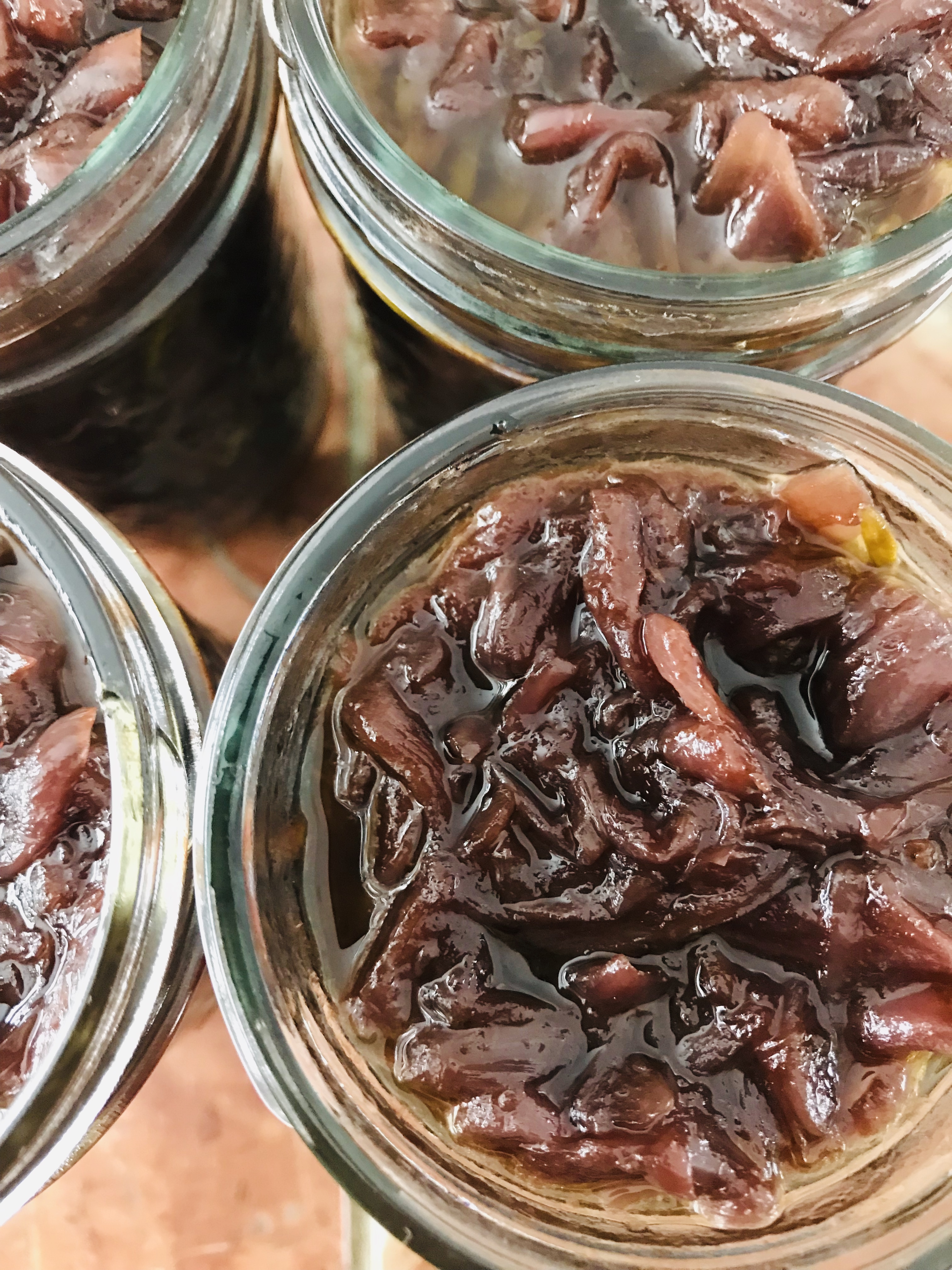
  3. Add the brown sugar, wine and wine vinegar.  Bring to a boil, stirring constantly; then lower the heat to low and let simmer for 30-40 minutes (if you are doubling or tripling the recipe, this will take longer. In fact the more you make, the longer it will take to cook down; as long as a couple hours.)  Remember patience is a virtue.  Continue simmering on low until the liquid is dissolved and the onions are soft and sticky.  Note:  Stir frequently during this process so that the onions do not stick to the bottom of the pan from the sugar and become burnt.
  4. Remove the rosemary sprigs and bay leaves; discard.
  5. Let marmalade cool before serving or it you are refrigerating it for use within a week.  Otherwise, keep it hot for your water bath canning.  Can in sterilized 4 ounce or 1/2 pint mason jars, leaving 1/8 inch clearance.  Can for 15 minutes.

Yield: 4-5 4 ounce jars

IMG_3983(Edited)

“Age and glasses of wine should never be counted.”  —unknown

The Beet Goes On

Until I moved to our vegetable farm I absolutely hated beets and avoided them at all costs.  Yet here I am staring out at the drifted snow and frozen lake with a bowl of borscht in my hand.  The smell alone is enough to make you swoon.  I feel a sense of gratitude for learning to love the darn things.  Our farm is committed to growing vegetables without chemicals (which can significantly alter their flavor) so when I tried them again I was surprised by their inherent sweetness.  What was I thinking?  They are one the best things you can eat; full of essential vitamins and minerals.  They are low in calories and sodium along with assisting in the reduction of inflammation in the body.  They also support heart, digestion and brain function.  So what’s not to like?  There’s nothing like a bowl of warm goodness to set you straight.

INGREDIENTS:

  • 2 tablespoon extra-virgin olive oil
  • 1 medium leek, cleaned and sliced thinly (make sure you use the light green part as well)
  • 2 garlic cloves, finely minced
  • 1 medium red onion, peeled and chopped
  • 4-6 carrots, peeled and grated on the large holes of a box grater
  • 1 large sweet potato, peeled and cut into bite size chunks
  • 6 small or 3 large beets, peeled and cut into bite size chunks
  • 3 cups of thinly sliced red cabbage
  • 1/4 cup minced fresh dill
  • 8 cups organic vegetable stock (or homemade of course)
  • 1/4 cup red wine vinegar
  • Greek yogurt to serve (optional)

IMG_2048

INSTRUCTIONS:

  1.  Heat the olive oil in a soup kettle or Dutch oven on medium high heat.
  2. Add leek, garlic and red onion.  Saute until soft and translucent.
  3. Add sweet potato, beets and grated carrot.  Cook for 5 minutes stirring frequently.
  4. Add red cabbage, dill and vegetable stock.  Bring to a boil and reduce heat to medium.  Simmer for 30 minutes or until beets are soft when a paring knife is inserted.
  5. Add red wine vinegar off heat.  Serve in bowls topped with a dollop of yogurt if using and sprinkle additional fresh chopped dill on top.

Serves 6-8

IMG_2049

“Soup fills us, nurtures and comforts us.  Soup is the song of the heart and the home.”

Can’t Beet It!

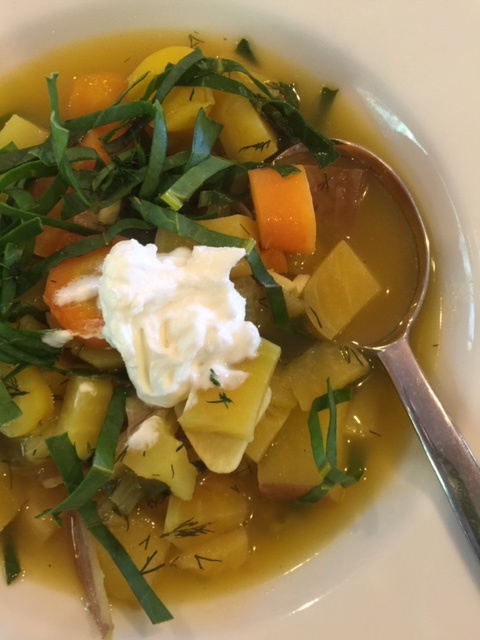
When I first came to the farm and was getting my sea-legs, I did not like beets.  In fact I’ve never liked beets. When I saw dozens of 100 foot rows planted, I remember asking Val, “Is there really a call for this many beets?”  I soon learned that beets are one of our most popular crops.  I also learned that when you grow food without chemicals, it directly affects the flavor of those vegetables.  You have an opportunity to find how they genuinely taste, which is often incredibly sweet.  Over time, with Val’s encouragement, I learned to not only like beets, but love them!  Now I pickle them, roast them and put them in soups.  When the weather cools off, soups come front and center.  After making borscht for several years with red beets, I began to wonder if it would work with our beautiful golden beets.  Slightly milder in flavor, I knew they would match up equally well with our carrots, onions, potatoes and dill.  It’s a wonderfully satisfying soup.

IMG_1638

IMG_1640


Golden Beet Borscht:

  • 4 cups golden beets with greens, peeled and diced, greens reserved and cut into thin ribbons
  • 2 cups red-skinned potatoes, scrubbed and diced
  • 1 1/2 cups yellow onions, chopped
  • 1 1/2 cups carrots, scrubbed and sliced in disks about 1/2 inch
  • 1 cup celery, chopped
  • 2 cloves garlic, sliced thinly
  • 1 bay leaf
  • 1 cup fresh dill, chopped
  • 1/2 tsp. fennel seeds
  • 4 cups organic or homemade chicken or vegetable stock
  • 1 Tbsp. apple cider vinegar
  • 1 tsp. salt
  • 1/2 tsp. freshly ground black pepper
  • 2 Tbsp. olive oil

IMG_1647


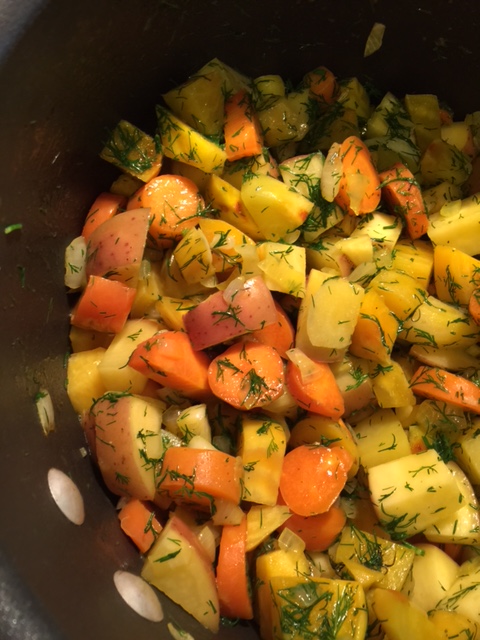
  1.  In a large Dutch oven or soup pot, saute the garlic and onions with the olive oil on medium-high until softened.  Add the remaining vegetables and continue to cook for 5 minutes.
  2. Add the fennel seed, dill, bay leaf, and stock.  Bring to a boil, then simmer until vegetables are soft.  About 15 minutes.
  3. Ribbon the beet greens and add half to soup.
  4. Add the salt, pepper and apple cider vinegar.  Taste and adjust seasoning to your preference.
  5. Ladle into bowls, top with additional beet greens and a dollop of Greek yogurt.

Serves 4

Warm and inviting golden beet borscht


I live on good soup, not on fine words.”   …Moliere